

A high filling won't fix itself. Filling material wears far too slowly to level out a high spot in days or weeks, so if your bite still feels off 2 to 3 days after the numbness wears off, the filling needs a quick adjustment. Waiting longer keeps the tooth overloaded, which can leave it sore and bruised and strain your jaw.
The fix is one of the quickest procedures a dentist does, often a few minutes in the chair with no anesthesia. Below are the signs to watch for, how to tell a high bite from normal healing, and what to do while you wait for your appointment.
Key Takeaways
- A noticeably high filling will not fix itself. Composite on chewing surfaces wears only about 15 to 29 microns a year, far too slowly to flatten a high spot.
- Signs such as sharp pain when biting, an uneven bite, and jaw soreness usually appear within 24 to 72 hours.
- If your bite still feels high 2 to 3 days after the numbness wears off, or biting on the tooth is sharply painful, contact your dentist instead of waiting it out.
- Pain that worsens day by day, rather than easing, is the clearest sign the filling needs adjustment, not more time.
- Never file, sand, or grind a high filling at home; DIY attempts crack natural teeth long before they smooth the filling.
- A high filling isn't a dental emergency, but adjusting it within a few days prevents TMJ strain and a bruised, tender tooth. The adjustment usually takes under 10 minutes with no anesthesia.
What is a High Filling?
A high filling is a dental filling that sits slightly above the level your bite needs, so the filled tooth hits before the others when you close. Patients usually describe it as an uneven bite after filling. That imbalance concentrates chewing force on one tooth, which can cause discomfort, difficulty chewing, and strain on your jaw muscles.
With composite fillings, the dentist shapes the material and checks your bite with thin marking paper. That final check happens while you're still numb, though, which is how a small high spot can slip through.
So why doesn't it just wear away? A study on composite wear indexed by the U.S. National Library of Medicine reports an average clinical wear rate of about 29 microns a year on molar contact areas and about 15 microns on premolars. A high spot you can clearly feel would take many months of chewing to flatten, and the tooth and jaw absorb the extra load the whole time.
How to Know If a Filling Is Too High
When a dental filling is placed even slightly above your natural tooth surface, your bite quickly tells you something is wrong. The good news is that the signs are usually clear within the first 24to 72 hours after your procedure. Knowing what to look for helps you decide whether to wait it out or call your dentist for a quick adjustment.
7 Signs and Symptoms of a High Filling
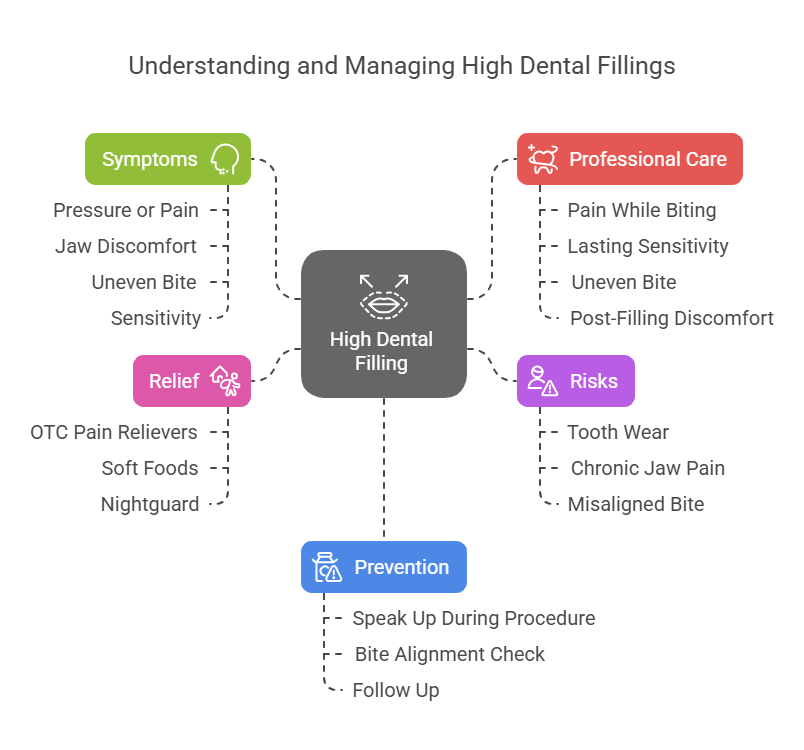
A high filling rarely causes one dramatic symptom. It shows up as small changes in how your bite, tooth, and jaw feel.
- Uneven Bite (Most Common Sign): One tooth touches before the others when you close. This is the clearest indicator of occlusal interference.
- Sharp Pain When Biting Down: A sudden, shooting pain that stops the moment you stop chewing on that side, unlike the lingering ache of an irritated nerve. A cracked tooth can feel similar, so have it checked.
- Increased Sensitivity to Hot, Cold, or Sweet Foods: Constant pressure from a high filling stresses the tooth's nerve, and tooth sensitivity after a filling that worsens instead of improving over 3 to 5 days is a red flag.
- Difficulty Chewing on the Affected Side: You start chewing on the opposite side of your mouth without thinking about it.
- Jaw Pain, Soreness, or Clicking: Aching in front of the ear, morning soreness, or clicking when you open are early signs of TMJ strain from muscles compensating for the uneven bite.
- Tension Headaches (Especially in Temples): Overworked jaw muscles refer pain to the temples, behind the eyes, or the base of the skull.
- Loose or Pressured Feeling in the Tooth: Constant heavy contact can inflame the ligament that holds the tooth in its socket, so the tooth feels "tall," bruised, or slightly loose. This usually calms down once the bite is corrected.
When to Call Your Dentist: If you notice the first or second sign, or any of these signs still there 2 to 3 days after the numbness has worn off, contact your dentist for a bite adjustment. The fix usually takes less than 10 minutes and requires no anesthesia.
High Filling vs Normal Post-Filling Discomfort
Some odd sensations after a filling are normal while the anesthesia wears off and your brain adapts to the new shape. The table shows where normal recovery ends and a high filling begins.
| Symptom | Normal (Will Pass) | High Filling (Needs Adjustment) |
|---|---|---|
| When you bite down | Slight tenderness that fades in 3 to 5 days | Sharp pain, or one tooth clearly hits first |
| Sensitivity to cold | Mild, fading over about 2 weeks (up to 4 weeks after a deep filling) | Strong, persistent, and getting worse |
| Jaw soreness | None, or barely noticeable | Aching jaw, especially when you wake up |
| Headaches | None | Tension headaches after a day of chewing |
| Chewing on that side | Maybe briefly avoided | You keep avoiding that side |
| Pain pattern over time | Improves a little each day and is gone within a few weeks | Stays the same or gets worse; won't resolve on its own |
The simplest rule: if things get better day by day, you're in normal recovery. If symptoms stay the same or get worse after 2 to 3 days, your bite needs adjusting.
Why Does My Filling Feel Too High?
A filling that feels too high rarely means your dentist made a mistake. It usually comes down to a few normal factors:
- You were numb during the bite check: Anesthesia makes it hard to bite naturally, so a tiny high spot can slip through the in-chair check and only become obvious once the numbness wears off.
- You were lying back in the dental chair: Your jaw sits in a different position when you're reclined, so a filling that felt right in the chair can feel too tall once you sit up.
- The cavity was large or in a tricky spot: Bigger fillings and molars, with their complex bumps and grooves, leave more room for a microscopic high spot.
- The tooth is tender, not the filling: Composite resin hardens right away under a curing light, and amalgam reaches full strength within about a day, but neither material sinks or shrinks to fit your bite. If the tooth feels different the next day, the usual cause is tenderness in the tooth or the ligament around it.
- Your cheek or tongue was swollen: Mild swelling can change how your teeth meet, so your bite may feel different again once it goes down in a day or two.
- Your brain is still adjusting: Your nervous system notices even a tiny change in a tooth's shape. Sometimes the filling isn't high at all, and the feeling fades within a few days.
If the filling genuinely is too high, the fix takes a few minutes with articulating paper and a polishing tool.
Need help getting started? Our California-based offices in Culver City and Inglewood are ready to assist. Reach out by filling out the consultation form or calling 310-643-6221.
What Should You Do If Your Tooth Filling Feels Too High?
Wait until the numbness is completely gone, check your bite, and call your dentist if one tooth still hits first. Here's the order to do it in:
- Give it a few hours. Anesthesia and a tired jaw make the first evening a poor time to judge your bite.
- Test your bite the next day. Sit upright, close gently, and tap your back teeth together a few times. If the filled tooth touches first or feels like it's standing on a step, note it. Then chew something soft on that side.
- Call within 2 to 3 days if it still feels high, or the same day if biting on the tooth is sharply painful.
- Know what the visit involves. You bite on thin colored articulating paper, which leaves a mark on the high spot. The dentist polishes that spot down a little at a time and rechecks until your bite feels even. Since only filling material is smoothed, numbing usually isn't needed.
How Long Does It Take for a High Filling to Settle?
A filling that is truly high doesn't settle. What does settle is normal tenderness and your brain getting used to the new shape, which usually takes a few days:
- Day of the filling: Some high feeling is normal while numbness wears off. Don't judge your bite yet.
- Days 1 to 3: Tenderness should ease a little each day. If one tooth still clearly hits first, call now.
- After day 3: Continuing to wait risks an inflamed, tender tooth, jaw strain, TMJ symptoms, and in some cases a cracked tooth.
Is a High Filling an Emergency?
A high filling usually isn't a true dental emergency like a knocked-out tooth or a severe infection, but plan to have it adjusted within a few days, sooner if you have jaw pain or sharp pain when biting. A cracked tooth or TMJ strain is easy to prevent with a quick visit and much harder to fix later.
When in doubt: if your filling is causing pain that's worsening day by day, treat it as urgent and contact an emergency dentistry provider before the pressure leads to more serious complications.
How to Fix a High Filling at Home
A high filling can't be fixed at home; only a dentist can reshape filling material safely. These steps make the wait for your appointment more comfortable.
Safe Ways to Stay Comfortable Until Your Appointment
- Over-the-counter pain relief: Ibuprofen eases both pain and inflammation; acetaminophen is an alternative if you can't take ibuprofen.
- A cold compress on the jaw: About 15 minutes against your cheek eases a sore jaw.
- Salt water rinses: A gentle rinse twice a day soothes the gums around the new filling.
- A nightguard if you grind: Grinding multiplies the pressure on a high filling while you sleep.
What You Should Never Try at Home
Avoid all of these, even if a TikTok video makes them look easy:
- Don't file or sand the filling. Nail files and sandpaper scratch enamel and can crack the tooth.
- Don't use a Dremel or any rotary tool. Without the water cooling dental burs use, it can damage the nerve in seconds.
- Don't bite hard objects to wear it down. Pencils, coins, and ice don't work, and fractured teeth are a common result.
- Don't pick at the filling. Metal tools can chip it or push bacteria into the gum line.
- Don't apply vinegar or baking soda paste. They don't soften filling material, and repeated use can irritate your gums.
How to Avoid High Fillings
- Ask to sit up for the final bite check: Your jaw closes differently when you're reclined, so an upright check catches more high spots.
- Make sure the bite check is thorough: Your dentist should mark your bite with articulating paper and recheck after each adjustment.
- Speak up before you leave: If your bite feels even slightly off in the chair, say so. It takes seconds to fix then.
Final Thoughts on High Fillings
Watch the direction your symptoms are heading, not just how they feel today. A bite that improves each day is healing normally; one that stays the same or gets worse after a few days won't fix itself, and that's the moment to call.
A high filling caught early takes minutes to fix. Left alone for months, the same filling can lead to a cracked tooth, jaw problems, or a worn-down opposing tooth, none of which are easy to repair. There's no reward for toughing it out.
Common Questions About High Filling
Will a high tooth filling wear down on its own?
Not in any useful time frame. Filling material wears by only a few hundredths of a millimeter a year, so a high spot you can feel stays for months while it strains the tooth and jaw. A dentist can polish it down in a few minutes.
Can a high filling cause long-term issues if left untreated?
Yes. It keeps overloading one tooth, which can lead to ongoing sensitivity, tooth wear, fractures, and temporomandibular joint (TMJ) problems. An early adjustment prevents this.
How long does it take to get used to a high filling?
A filling that simply feels different usually feels normal within a few days. A filling that is actually too high keeps overloading the tooth, so if it still hits first after 2 to 3 days, have it adjusted.
Why does it hurt to chew after a filling?
A filling that's too high is a common cause, because it puts uneven pressure on the tooth every time you bite. Other causes include normal nerve irritation after a deep filling, which fades over a few weeks, and less often a crack in the tooth. If the pain continues, see your dentist.
Why does my new filling feel rough?
A new filling can feel rough if it hasn't been fully polished or shaped to match your natural tooth surface. This is common, and your dentist can smooth it during a quick follow-up visit.
Can a high filling cause tooth pain or sensitivity to cold?
Yes. The uneven bite puts extra pressure on the filled tooth, which can cause pain when biting and make it react more to cold drinks. Both usually fade once the bite is corrected.
Can a high filling cause a headache?
Yes. Your jaw muscles constantly compensate for the uneven bite, and that strain can cause tension headaches around the temples, behind the eyes, or along the sides of the head, especially after a day of chewing.



0 Comments