

For most people, getting a cavity filled does not hurt. Local anesthesia numbs the tooth before any drilling starts, so what you notice is pressure, vibration and cool air rather than pain. The injection is a short sting that passes in seconds. Mild soreness afterward is normal and usually fades within a few days. Below is what each step feels like, which cavities are more likely to be uncomfortable, and how long tenderness lasts.
Key Takeaways
- Local anesthesia blocks pain signals from the tooth, so a routine filling feels like pressure and vibration, not pain.
- The injection lasts 10 to 30 seconds and is the only part most patients call uncomfortable.
- A small filling takes about 20 to 40 minutes from numbing to bite check.
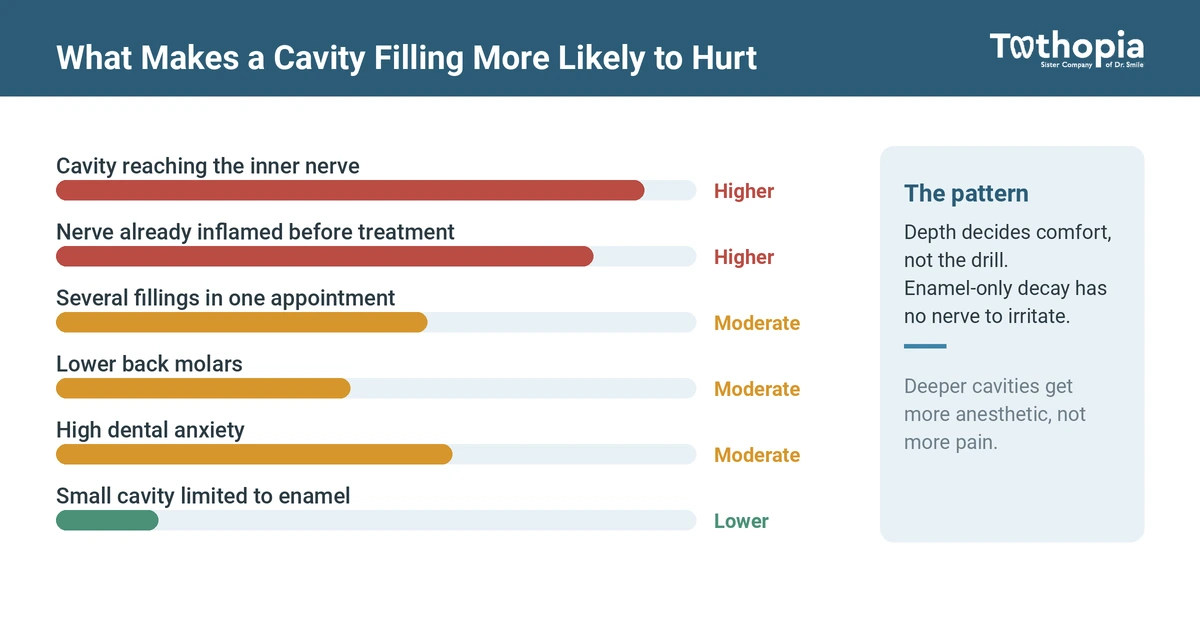
- Cavity depth predicts comfort. Enamel-only decay has no nerve to irritate.
- Tooth pain after filling placement peaks in the first 24 to 48 hours and usually clears within a week.
- Pain that worsens, throbs at night or spikes on biting needs an appointment, not more painkillers.
Does a Cavity Filling Hurt During the Procedure?
No. A cavity filling should not hurt while it is being done, because the tooth is numb before a drill touches it. Anesthetic blocks the nerve endings inside the tooth, so the signals that would register as pain never reach your brain.
“blocking the nerves that sense or transmit pain”
The American Dental Association lists injectable anesthetics as standard for filling cavities. If anything feels sharp, say so. A top-up takes a minute.
What Does a Cavity Filling Feel Like?
The cavity filling procedure runs in five short stages, and only one involves a needle.

- Numbing gel sits on the gum for one to two minutes. You taste something faintly bitter, nothing else.
- The anesthetic goes in over 10 to 30 seconds. A sting, then a spreading heaviness in the lip or cheek.
- Decay is removed over 5 to 15 minutes. Pressure, vibration and water spray, no pain.
- The material is placed and hardened in 5 to 10 minutes. Cool air, a bright curing light, some shaping.
- Your bite is checked with a marking strip. You tap your teeth together and any high spot is smoothed. Some offices isolate the tooth with a thin rubber sheet first, which keeps debris out of your throat.
Ask for the bite check twice, once while numb and once as the anesthetic fades. A filling that felt level under anesthesia can feel tall an hour later, and catching it in the chair saves a second visit.
Five stages, half an hour, one brief sting. That sting deserves its own section.
Is the Numbing Injection the Worst Part of a Filling?
Usually yes, and it is over in under a minute. Dental needles are thinner than the ones used for blood draws, and topical gel dulls the surface first. Most of what people call the pinch is anesthetic spreading through tissue, not the needle.
You might be thinking you would rather skip the shot and push through the drilling. That backfires. Enamel carries no nerve supply, but the dentin beneath it sends pressure and temperature straight to the pulp, and a bur reaching that layer unnumbed turns sharp fast.
Yes, shallow cavities are sometimes treated without an injection, and there are situations where a filling is placed without anesthetic. That call belongs to the exam. It also helps to know how long dental numbness lasts, since lip and cheek numbness fades in two to four hours.
The real variable is not the needle. It is how deep the cavity went.
When Is Getting a Cavity Filled More Likely to Be Painful?
Is getting a cavity filled painful for everyone? No, but depth changes the odds. A cavity confined to enamel sits far from any nerve. One that has reached dentin or pulp is working beside tissue that is already irritated.
| Cavity depth | What the dentist finds | During treatment | Numbing approach |
|---|---|---|---|
| Enamel only | White or brown spot | Often no discomfort | Injection sometimes optional |
| Into dentin | Soft decay, cold twinge | Pressure and vibration | Standard local anesthetic |
| Near the pulp | Lingering cold pain | May need a second dose | Anesthetic plus a liner |
| Into the pulp | Night pain or swelling | Harder to numb fully | Root canal, not a filling |
Position matters too. Lower back molars need a nerve block rather than a local injection, which takes longer to set in. Three fillings in one visit leave the jaw sore, though no single tooth hurts more.
Anxiety shifts the math too, which is why nitrous oxide exists. Decay hiding between two molars often turns out deeper than expected, since those surfaces only show on X-rays. An exposed nerve is the one case where waiting genuinely makes treatment worse. The classes of tooth decay map onto the table above.
What most people miss is that catching decay early is a comfort decision, not only a health one. The filling you postpone is a deeper filling later.
How Long Does a Filling Hurt Afterward?
Most tooth pain after a filling fades within three to seven days, and cold sensitivity after a deep filling can take two to four weeks to clear. The pattern matters more than the intensity.
| Time after the filling | Normal | Not normal |
|---|---|---|
| 0 to 4 hours | Numb lip and cheek | Numbness spreading to the eye |
| 24 to 48 hours | Tender to chew on | Throbbing that wakes you at night |
| 3 to 7 days | Cold sensitivity fading daily | Pain stronger than day one |
| 2 to 4 weeks | Occasional twinge, deep filling | Sharp pain every time you bite |
| Beyond 4 weeks | Tooth feels normal | Any lasting pain or swelling |
Think of the tooth like an ankle after a mild sprain. It was handled, not injured, and inflamed tissue calms down on its own schedule. Lingering sensitivity in the weeks after a filling usually reflects how deep the decay was.
How to Make a Cavity Filling More Comfortable
A few choices before the appointment matter more than willpower does.
- Book a morning slot. Waiting all day gives anxiety hours to build.
- Eat first. You cannot chew comfortably for a few hours afterward.
- Say the word anxious out loud. Offices adjust pacing or offer nitrous oxide if they know.
- Agree on a stop signal. Raising your left hand puts you in control of the pace.
- Ask for the full two minutes of topical gel. Thirty seconds will not dull the injection.
- Take ibuprofen before the numbness wears off, if it suits you medically. Getting ahead of inflammation beats chasing it.
Skip caffeine that morning. It raises heart rate and jitteriness, the same physical state as anxiety, and it makes the epinephrine in most dental anesthetics feel stronger than it is.
That covers ordinary discomfort. A different set of signs points to something that needs fixing.
When Tooth Pain After a Filling Means Something Is Wrong
Pain after cavity filling treatment that intensifies instead of fading, or that spikes on biting, points to a specific and usually fixable cause.
- The filling sits high. Your teeth meet on that spot first. An uneven bite after a cavity filling is fixed in a two-minute adjustment, and a high filling will not wear itself down.
- The pulp is inflamed. Deep decay near the nerve leaves the tooth reactive to heat or throbbing at night, the pattern that leads to root canal treatment.
- Decay returned underneath. Bacteria work in at the margin of an older filling, and decay recurring beneath fillings and crowns causes pain before it shows visually.
- The tooth has a crack. Pain on release, the moment after you bite rather than during it, is the classic sign.
None of these are emergencies on day one, but all get worse if you sit on them. Swelling, fever or facial pain warrants a same-day call.
Need help getting started? Our California-based offices in Culver City and Inglewood are ready to assist. Reach out by filling out the consultation form or calling 310-643-6221.
Final Thought on Cavity Filling Pain
The fear attached to fillings belongs to an earlier era of dentistry. With the tooth numb, the honest answer to does getting a filling hurt is that the anticipation beats the appointment.
Timing is the part you control. Decay does not reverse once it breaks through enamel, and every month of delay moves it closer to the nerve.
If a tooth already reacts to cold or sweets, treat that as your prompt. Book the exam and get the filling done while it is small. Habits that keep decay from starting are the cheapest dental appointment you will ever have.
Common Questions About Cavity Fillings
Can I eat right after getting a cavity filled?
Tooth-colored fillings are hardened by the curing light before you leave, so the material needs no waiting period. The limit is the anesthetic. Wait until feeling returns, then start with something soft on the opposite side.
Do I need a shot for a very small cavity?
Not always. Decay limited to enamel can sometimes be filled without an injection, because that layer holds no nerve endings. Your dentist decides after the X-ray and exam, and you can ask for anesthetic if you would rather have it.
Does a deep filling hurt more than a root canal?
Both are done under the same local anesthesia, so neither should be painful during treatment. A root canal takes longer, but it treats a nerve that is already hurting, which is why most patients feel better afterward.


0 Comments