
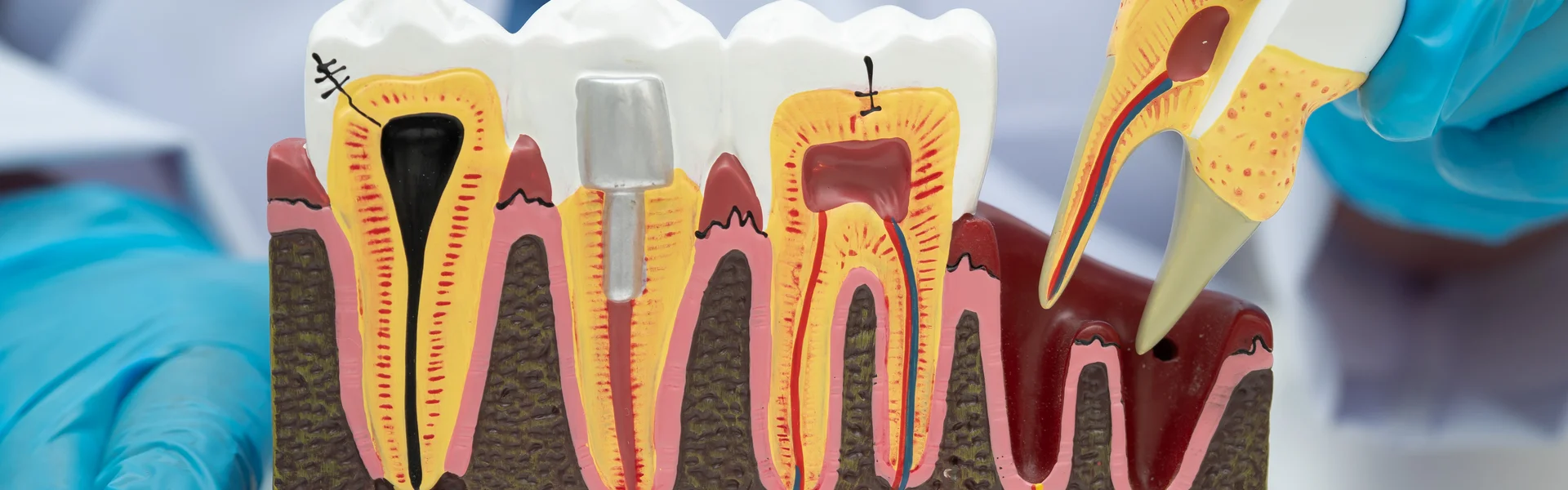
A healing normal socket after tooth extraction looks like a dark red blood clot in the first 24 hours, a whitish-gray film across the opening by days four to seven, and pink tissue closing inward by days seven to ten. That white film is what sends most patients searching at midnight, and it is almost always granulation tissue rather than infection. What follows is the day-by-day appearance of a healthy site, the full tooth extraction healing timeline, the difference between normal recovery and dry socket, and the specific symptoms worth a phone call. One signal separates a socket that is healing from one that is not, and most people watch the wrong thing entirely.
Key Takeaways
- A blood clot forms within the first 24 hours and is the only structure covering exposed bone and nerve endings until gum tissue grows over the site.
- Whitish-gray tissue around days four to seven is granulation tissue, the new tissue that replaces the clot. It is not pus.
- Soft tissue closes in roughly seven to ten days, while bone fills the socket underneath over three to six months.
- Pain direction matters more than pain level. Pain that falls a little each day is normal. Pain that climbs after day three is not.
- Dry socket affects roughly 0.5% to 5% of routine extractions, rising toward 30% after surgical removal of lower wisdom teeth.
- Smokers develop dry socket at about 13.2% compared with 3.8% in non-smokers, more than a three-fold increase in odds.
- Call your dentist for bleeding that will not stop, visible bone, fever, spreading swelling, or numbness lasting past the first day.
What Does a Normal Extraction Socket Look Like?
A normal extraction socket looks like a dark red clot sitting roughly level with the gum line during the first day, a creamy whitish-gray film across the opening by days four to seven, and pink tissue narrowing that opening from the edges inward by days seven to ten. The site should look progressively less raw each time you check it.
A healing socket after tooth extraction changes color on a schedule, and the color sequence is the part that catches people off guard. Dark red is what you expect. Gray-white on day five is what you do not expect, and it arrives on schedule in most healthy sockets. The socket also stays visibly open as a shallow crater for a few weeks, because surface tissue closes long before the bone underneath fills in.
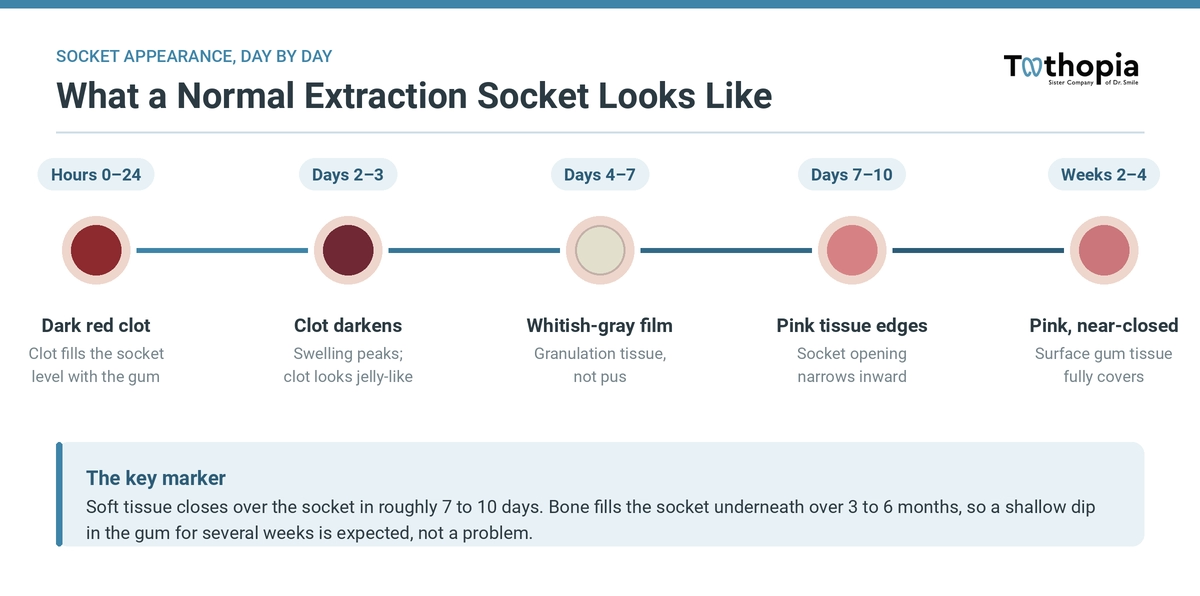
Held against a mirror, a healthy extraction site at each stage shows a specific set of features:
- Day 1: a dark red, jelly-like clot filling the socket, with pink-red gum edges around it.
- Days 2 to 3: the clot darkens and firms. Facial swelling peaks in this window, then starts to recede.
- Days 4 to 7: a whitish or grayish-yellow layer covers the clot. The socket opening looks slightly smaller.
- Days 7 to 10: pink tissue is visible at the socket margins, growing inward across the opening.
- Weeks 2 to 4: the surface is pink and largely closed, often with a shallow dimple where the tooth sat.
That visible clot is doing more work than its appearance suggests, and losing it is the one event that changes recovery completely.
Why the Blood Clot After Tooth Extraction Matters Most
The blood clot after tooth extraction is the only thing covering exposed bone and nerve endings inside the socket, and it doubles as the scaffold that new tissue grows into. Protecting it for the first 72 hours does more for recovery than anything else you can do.
The clot seals bone, shields nerve endings, and scaffolds the tissue that replaces it.
The American Dental Association frames post-extraction care around a single principle rather than a long list of rules.
In practice, that means avoiding suction and pressure at the site. The ADA specifically advises against smoking, vigorous rinsing, and drinking through a straw for the first 24 hours. If you have already rinsed your mouth too soon after an extraction, the practical response is to stop rinsing, avoid the site, and watch pain direction over the next two days rather than assume the worst.
White Tissue in the Extraction Socket: Granulation or Infection?
White tissue in the extraction socket around days four to seven is granulation tissue, the new connective tissue that replaces the blood clot. It is creamy white to grayish-yellow, sits flush inside the socket, and comes with pain that is going down rather than up.
You might be thinking: that looks exactly like pus. Patients describing white tissue in extraction socket recovery are almost always looking at this exact stage. The resemblance is real, and it is the single most common reason patients call a dental office during a recovery that is going fine. The difference is behavior, not color. Granulation tissue stays put and is attached. Discharge from an infection accumulates, can be wiped or rinsed away, and comes back.
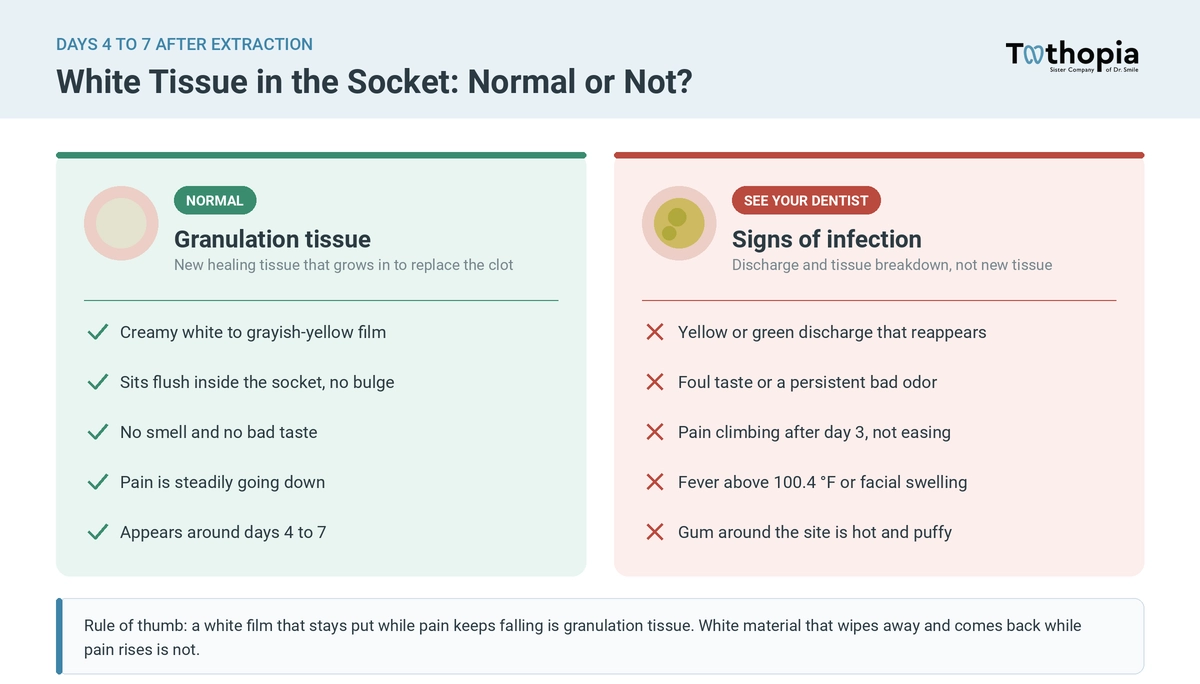
Two accompanying signals settle it in most cases. The first is smell. Granulation tissue is odorless; infection and dry socket both tend to produce a foul taste or persistent bad odor that brushing does not clear. The second is temperature. A fever above 100.4 °F alongside white material at the site moves the situation out of normal healing and toward an infection that has formed at the extraction site.
Once the white layer is explained, the rest of the timeline becomes much easier to read, because each stage has a documented schedule.
Tooth Extraction Healing Stages, From Clot to Bone
Socket healing runs through five overlapping stages: clot formation in the first 24 hours, granulation tissue replacing that clot by about day seven, young connective tissue by day 20, bone trabeculae filling roughly two-thirds of the socket floor by day 38, and complete surface closure over weeks four to six.
These are not estimates drawn from general experience. They come from a classic human histologic study published in the Journal of the American Dental Association in 1960, in which Amler, Johnson, and Salman biopsied undisturbed extraction sites at two to three-day intervals across 50 days. The sequence they documented is still the reference used in oral surgery literature today.
Translated into what you can actually observe:
- Clot formation, hours 0 to 24. Bleeding slows, and a fibrin-rich clot fills the socket. Swelling begins.
- Granulation tissue, days 2 to 7. The clot is infiltrated and replaced. This is the white layer you can see.
- Connective tissue, days 14 to 20. Firmer tissue takes over, and osteoid, the unmineralized precursor to bone, appears at the socket base.
- Bone trabeculae, around day 38. New bone fills roughly two-thirds of the socket floor. Nothing about this is visible from the outside.
- Surface closure, weeks 4 to 6. Epithelium covers the socket completely, leaving a smooth pink surface.
Notice that the visible part of recovery finishes long before the structural part does, which explains why so many people think their healing has stalled at week three.
How Long Does a Tooth Extraction Socket Take to Heal?
A tooth extraction socket takes about seven to ten days for the gum surface to close and three to six months for bone to fill the socket underneath. Tooth extraction socket healing runs on two clocks at once, and confusing them is the reason a normal recovery can feel unfinished.
The bone side of the timeline also involves reshaping, not just filling. In a 12-month prospective study, Schropp and colleagues found the alveolar ridge lost about 50% of its width after a single-tooth extraction, with two-thirds of that change happening in the first three months. A later systematic review by Tan and colleagues put ridge height reduction at 11% to 22% by six months. This matters if you are planning to replace the tooth, because the window for straightforward treatment is earlier than most people assume.
How long your own site takes depends heavily on the type of extraction:
| Extraction type | Gum closes | Back to normal activity | Bone fill |
|---|---|---|---|
| Simple extraction of a visible tooth | 7 to 10 days | 1 to 3 days | 3 to 4 months |
| Surgical extraction with an incision | 10 to 14 days | 3 to 7 days | 4 to 6 months |
| Impacted lower wisdom tooth | 2 to 3 weeks | 5 to 10 days | 4 to 6 months |
| Molar with multiple roots | 10 to 14 days | 2 to 5 days | 4 to 6 months |
Timelines describe the average case. Reading your own case requires a different set of signals.
Signs of Normal Healing After Tooth Extraction
Normal healing after tooth extraction shows four consistent signs: bleeding that stops within the first day, pain that decreases a little each day after day one, swelling that peaks at day two or three and then recedes, and a socket that looks less raw each time you check it. Any one of these reversing direction is the signal worth acting on.
A few changes are worth contacting your dentist about:
- Bleeding: Oozing should settle with pressure. Steady bleeding that continues after 30–45 minutes of firm pressure needs attention.
- Pain: Pain should gradually improve. Pain that starts getting worse after day three is more concerning.
- Swelling: Swelling usually peaks around days two or three and then decreases. New or spreading swelling should be checked.
- Socket: The site may change from dark red to a whitish film and then pink tissue. An empty-looking socket with visible bone is not typical.
- Taste or odor: A persistent foul taste or smell may signal a problem.
- Fever: A temperature above 100.4°F (38°C) warrants a call to your dentist.
Dry Socket vs Normal Healing: The One Signal That Separates Them
Pain from dry socket typically gets worse between days two and five, often spreading toward the ear or temple. The socket may also look empty, with the blood clot missing and bone visible.
The key difference is the direction of pain: normal extraction pain should gradually improve, while dry-socket pain becomes stronger after initially improving.
According to the National Center for Biotechnology Information, alveolar osteitis (dry socket) is a common complication after tooth extraction. It affects about 0.5%–5% of routine extractions, but the risk can approach 30% after surgical removal of impacted lower wisdom teeth.
What increases the risk?
Smoking is a major risk factor. A 2022 systematic review found dry socket in 13.2% of smokers versus 3.8% of non-smokers. Difficult extractions, fractured teeth or roots, periodontal disease, and posterior teeth can also increase risk.
Avoiding straws is still sensible, but smoking and the difficulty of the extraction are bigger risk factors.
If your pain is getting worse rather than better, contact your dentist. Dry socket is treatable, and prompt care can provide significant relief.
What Slows Extraction Site Healing and What Actually Helps
The strongest evidence-backed lever on extraction site healing is tobacco. Beyond that, healing responds to protecting the clot for 72 hours, gentle cleaning after the first day, soft food, and keeping the head elevated while swelling peaks.
What genuinely moves the outcome, in order of impact:
- Stop smoking for at least several days. The 13.2% versus 3.8% gap between smokers and non-smokers is the largest single risk difference in the literature, and the reasons smoking interferes with recovery after an extraction combine suction with impaired blood supply.
- Skip suction for 72 hours. No straws, no forceful spitting, no vigorous swishing. The ADA sets 24 hours as the floor for straws; oral surgeons commonly extend it.
- Start warm salt water rinses after the first day. The American Association of Oral and Maxillofacial Surgeons recommends half a teaspoon of salt in a glass of warm water, several times daily, rinsed gently rather than swished.
- Keep food soft and lukewarm. Yogurt, eggs, soup, and mashed potatoes carry no risk of lodging in the socket. Stocking a few soft foods before the appointment removes the temptation to chew on the healing side too early.
- Use anti-inflammatory pain relief as directed. Ibuprofen addresses both pain and inflammation, which matters during the day two to three swelling peak. Follow the dose your dentist specifies.
- Keep brushing, carefully. Brush the rest of the mouth normally from the first night. Avoiding oral hygiene altogether raises infection risk rather than lowering it.
Resist the urge to inspect the socket with your tongue or a finger. Repeated probing is one of the most common ways patients disturb an otherwise stable clot, and it delivers no information a mirror cannot.
Good aftercare handles the vast majority of cases. A short list of findings falls outside what aftercare can fix.
When to Call Your Dentist About Your Extraction Site
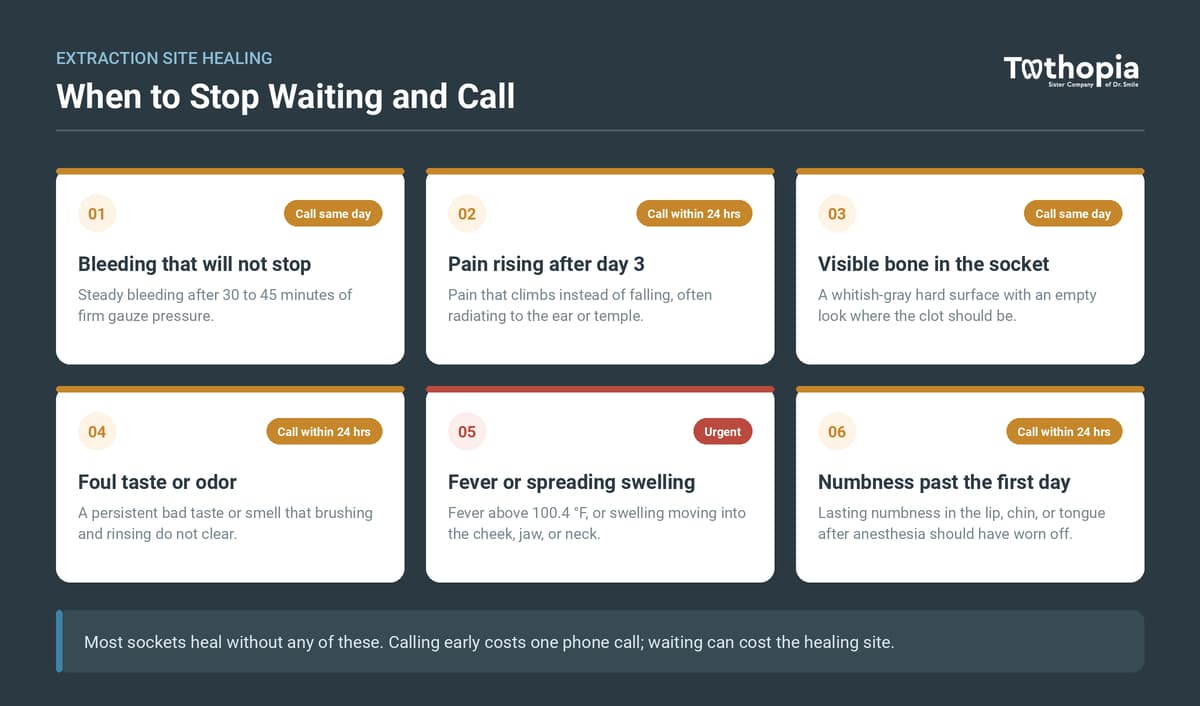
Call your dentist for bleeding that continues after 30 to 45 minutes of firm gauze pressure, pain that rises after day three, visible bone in the socket, fever above 100.4 °F, swelling that spreads into the cheek, jaw, or neck, or numbness that persists well past the day of the procedure.
Two of these deserve extra emphasis. Swelling that spreads beyond the immediate area, particularly toward the neck or under the jaw, can indicate an infection tracking into deeper tissue spaces and should be treated as urgent rather than monitored overnight. Numbness that has not resolved once anesthesia should have worn off warrants a same-week conversation, since early assessment matters for nerve-related findings.
Most patients who call about a normal-looking socket hear that everything is on track, and that reassurance has value of its own. Describing what you see, when it started, and which direction the pain is moving gives the Toothopia Dental team enough to judge whether you need to be seen.
Need help getting started? Our California-based offices in Culver City and Inglewood are ready to assist. Reach out by filling out the consultation form or calling 310-643-6221.
Reading Your Socket With Confidence
Healing after an extraction is one of the more predictable processes in dentistry. A clot forms, granulation tissue replaces it around day seven and looks alarming while doing exactly the right thing, pink tissue closes the surface within two weeks, and bone quietly fills the space over the following months. Almost every worrying appearance during those first ten days has a normal explanation.
The one habit worth keeping is tracking direction rather than severity. Pain, swelling, and bleeding should all be trending downward by day three. When any of them reverses, that is information, and it deserves a call rather than another night of searching. Protecting the clot through the first 72 hours and leaving the site alone handles nearly everything else.
Common Questions About Normal Socket After Tooth Extraction
Is white stuff in my extraction socket normal after 5 days?
Yes. White or yellowish tissue is often normal granulation tissue. It should not have a foul odor or worsening pain.
How do I know if my tooth extraction socket is healing properly?
Pain and swelling should gradually improve, while the socket becomes less raw. Worsening pain or swelling may indicate a problem.
How long does it take for a tooth extraction hole to close up?
The gum usually closes within 7–10 days after a simple extraction. Wisdom tooth sites may take 2–3 weeks.



0 Comments