

A cavity between molar teeth is decay that forms in the tight contact point where two back teeth meet, a spot your toothbrush cannot reach, and your eyes cannot see. Because it hides between the teeth, this kind of decay, also called an interproximal cavity, often stays silent until it sets off sensitivity, pain, or a tooth that keeps trapping food. The good news is that when it is caught early, the fix is simple. This guide covers the warning signs most people overlook, how dentists find and treat molar tooth decay at every stage, and the daily habits that stop it before it starts. First, here is what usually goes unnoticed.
Key Takeaways
- A cavity between molars, or an interproximal cavity, forms in the contact point between two back teeth, where a toothbrush and even your own eyes cannot reach.
- Early decay is usually painless. Sensitivity, pain when chewing, and food trapping in one spot are the first real clues.
- Dentists confirm these cavities with bitewing X-rays, because they rarely show up in a mirror.
- Under poor oral hygiene, decay can move from the enamel surface toward the nerve in as little as six months.
- Treatment scales with depth: fluoride and monitoring, a filling, an inlay or onlay, a crown, or root canal treatment.
- Daily flossing plus regular checkups catch molar tooth decay while the fix is still small and inexpensive.
What Is a Cavity Between Molars?
A cavity between molars is tooth decay that forms in the narrow contact point where two back teeth press against each other, known medically as an interproximal cavity. Unlike decay on the flat chewing surface, this kind sits hidden between the teeth, so it rarely shows up when you look in the mirror.
Molars are built for heavy chewing, with broad surfaces and tight side-by-side contacts. Those tight contacts are exactly where plaque collects and where bristles cannot follow. Bacteria feed on trapped sugars and starches, release acid, and slowly weaken the enamel. Once that outer shell is breached, the same decay can spread into the dentin and, eventually, the pulp.
Think of the gap between two molars like the space behind a radiator. Dust gathers there easily, yet a normal cloth cannot reach it. A cavity between back teeth works the same way, which is why a molar cavity can grow for months before you feel a thing.
What most people miss: You can brush perfectly and still develop one of these cavities. A brush bristle simply cannot fit into the contact point between two molars, so only floss or an interdental cleaner reaches the zone where interproximal decay begins.
This is why routine exams and consistent preventive dental care matter so much. They are built around catching quiet decay early, before it turns into something you can feel. Recognizing the signs comes next, and they are easy to dismiss.
Symptoms of a Cavity Between Molars
Cavities between molars often develop silently, which is what makes the early symptoms so easy to overlook. In the beginning, you may notice nothing at all. As the decay works deeper, the signs grow more obvious and, at times, more uncomfortable.
Common cavity between molars symptoms include:
- Tooth sensitivity: a sharp or lingering twinge with hot, cold, or sweet foods as the enamel weakens and exposes the layers beneath.
- Pain while chewing: anything from mild pressure to a real jolt when you bite down, especially on hard or crunchy foods.
- Food trapping in one spot: debris that keeps wedging between the same two molars can signal a developing cavity or lost tooth structure.
- Dark spots or shadows: faint discoloration between the teeth, though it is hard to see without proper lighting.
- Bad breath or an off taste: the result of bacteria collecting in a place you cannot clean.

Symptoms do not always appear early, though. Many of these cavities are found only during a routine visit, which is exactly why steady checkups matter for both individuals and families.
Symptoms are only half the story. The harder question is how you actually confirm a cavity you cannot see.
How to Know If You Have a Cavity Between Your Molars
You usually cannot confirm a cavity between molars on your own, because it hides in a place no mirror reaches. To know if you have a cavity between teeth for certain, a dentist relies on a bitewing X-ray plus a few tools used right at the chair.
Here is how these hidden cavities are actually found:
- Bitewing X-rays: the main way to spot decay between teeth. The image shows how far the cavity has reached, including whether it has moved from enamel into dentin or closer to the pulp.
- A dental explorer: a fine, hooked instrument that detects soft or sticky spots the eye cannot see.
- Cavity-detecting dye or special lights: stains and fluorescence that make weakened areas stand out during an exam.
- Your own clues: floss that catches in one spot, one-sided sensitivity, or a molar that keeps trapping food are worth reporting even if nothing hurts.
You might assume that no pain means no problem. Yes, but by the time a molar cavity actually aches, it has usually already broken through the enamel and reached the dentin, where it moves faster. That gap between silent decay and real pain is the whole reason regular imaging is worth it.
If it has been more than a year since your last set of bitewing X-rays, ask for them specifically. Interproximal cavities are the type these images catch first, often long before you would ever feel them.
Once you understand how these cavities are found, the next question is why they form in such a stubborn spot.
What Causes Cavities Between Molars?
Cavities between molars are almost always the result of several factors working together, not a single cause. Understanding them helps you make smarter choices about your daily routine and where molar tooth decay tends to start.
Key causes include:
- Plaque buildup: a sticky film of bacteria that forms every day and thrives in the tight spaces between molars when it is not cleaned out.
- Skipping floss: brushing alone cannot clean between teeth, so food and bacteria stay trapped at the contact point.
- Frequent sugar and acid: snacks, sodas, and acidic drinks feed the bacteria that produce enamel-damaging acid.
- Dry mouth: less saliva means less natural rinsing and protection, so decay develops more easily.
- Irregular dental visits: without routine exams and cleanings, early cavities go unnoticed and worsen over time.
You might be thinking that you barely eat sweets, so this should not apply to you. The catch is that frequency matters more than quantity. Every snack drops the acidity in your mouth for about half an hour, so constant grazing keeps your enamel under attack even without much sugar at all.
Knowing the cause is useful, but the reason these cavities are so risky is speed.
How Fast Can a Cavity Between Molars Spread?
Under poor oral hygiene, a cavity can begin forming in as little as three to six months, and once it breaks through the enamel into the softer dentin, it can advance toward the nerve within several more months. Dry mouth, frequent snacking, and decay in children can all speed that timeline up.
The progression tends to follow a predictable path. Early enamel demineralization, the white-spot stage, is slow and often partly reversible, sometimes lasting a year or more. After the enamel is breached, decay races through dentin much faster, often within roughly six to eighteen months, because dentin is softer and threaded with tiny tubules that lead straight to the nerve. From there it can reach the pulp and then form an abscess.
Here is the part most people miss with cavities in this location. Because the decay sits in the contact point, it can wear into the neighboring tooth too. One ignored interproximal cavity can quietly turn into two, which is why waiting rarely pays off.
If you notice new sensitivity or food trapping between the same two molars, book within a few weeks rather than waiting for your next routine cleaning. Catching decay while it is still in the enamel is the difference between a quick fix and a much larger one.
That range of speed is exactly why treatment is staged around how deep the decay has reached.
How Dentists Treat a Cavity Between Molars
Treatment for a cavity between molars depends entirely on how deep the decay has reached at the time it is found. The goal is always to remove the decay, stop any infection, and keep as much natural tooth as possible, moving from the gentlest option to the most involved only when the damage requires it.
Here is how the main options for molar teeth cavity treatment compare:
| Treatment | Best for | Typical visits | What it does |
|---|---|---|---|
| Fluoride and monitoring | Very early, pre-cavity decay | Ongoing | Rebuilds weakened enamel and halts progress |
| Composite filling | Small to moderate cavities | One | Seals the cleaned space with tooth-colored material |
| Inlay or onlay | Larger cavities, still restorable | Two | Custom lab-made piece that rebuilds a weakened molar |
| Dental crown | Structural damage to the tooth | Two | Full cap that protects against fracture |
| Root canal | Decay that reaches the nerve | One to two | Removes infected pulp, then seals the tooth |
Stage 1: Early Enamel Demineralization (Pre-Cavity Phase)
At this stage, the damage is limited to the outer enamel, and a true cavity has not formed yet. There are usually no symptoms, and the issue is spotted during a routine exam or on an X-ray.
Here the goal is reversal, not repair. A dentist may recommend:
- Fluoride treatments to strengthen enamel and stop early decay
- Better daily habits, especially consistent flossing
- Cutting back on sugar and acidic foods and drinks
Handled early, this stage can often be managed without any drilling, which is what makes early detection so valuable.
Stage 2: Small to Moderate Cavity (Dentin Involvement)
Once decay breaks through the enamel and reaches the dentin, a real cavity has formed, and the tooth can no longer heal on its own. Patients often notice sensitivity to cold or sweets, or mild discomfort when chewing.
The standard fix is a filling. The dentist removes the decay, cleans and disinfects the space, places a thin band between the teeth to rebuild the contact, and restores it with a tooth-colored composite filling. A single filling usually takes about thirty to sixty minutes and is minimally invasive when the cavity is caught early. When a cavity is a bit larger, but the tooth is still solid, a custom inlay or onlay, made in a lab and bonded in place over two visits, can rebuild it while saving more natural tooth than a full crown.
Stage 3: Advanced Decay (Structural Damage to Tooth)
When a cavity grows large, it can weaken the whole structure of the molar, and a simple filling may no longer provide enough support. Patients may notice more pain when biting, visible cracks or damage, or increased food trapping.
In these cases, a dental crown is often the answer. A crown covers the entire tooth, restores strength and durability, and protects it from further fracture or decay, all while preserving the natural root beneath.
Stage 4: Severe Decay (Pulp Infection)
If the decay is left to advance, bacteria can reach the pulp, the innermost part of the tooth that holds the nerves and blood vessels. That leads to infection, inflammation, and often significant pain. Common signs include a persistent or throbbing toothache, sensitivity to pressure and temperature, and swelling.
The treatment here is root canal treatment, where the infected pulp is removed, the canal is cleaned, and the tooth is sealed, usually followed by a crown for protection. Handled properly, it clears the infection while keeping your natural tooth in place.
Stage 5: Untreated Infection (Abscess or Tooth Loss Risk)
In the most advanced stage, untreated decay can lead to an abscess, a serious infection that may spread beyond the tooth. Patients may experience severe pain and swelling, pus or a bad taste, and sometimes fever or general illness.
Treatment can involve more complex procedures, and in some cases extraction becomes necessary when the tooth cannot be saved. This is the clearest argument for early diagnosis: acting sooner keeps you out of the most invasive, uncomfortable, and expensive part of the range.
The best treatment, of course, is the one you never need. That is where prevention comes in.
How to Prevent Cavities Between Molars
Preventing cavities between molars comes down to pairing good daily habits with regular professional care. The aim is simple: keep plaque from settling into the contact points and keep your mouth in a healthy balance. Preventing cavities between teeth is far easier than repairing one.
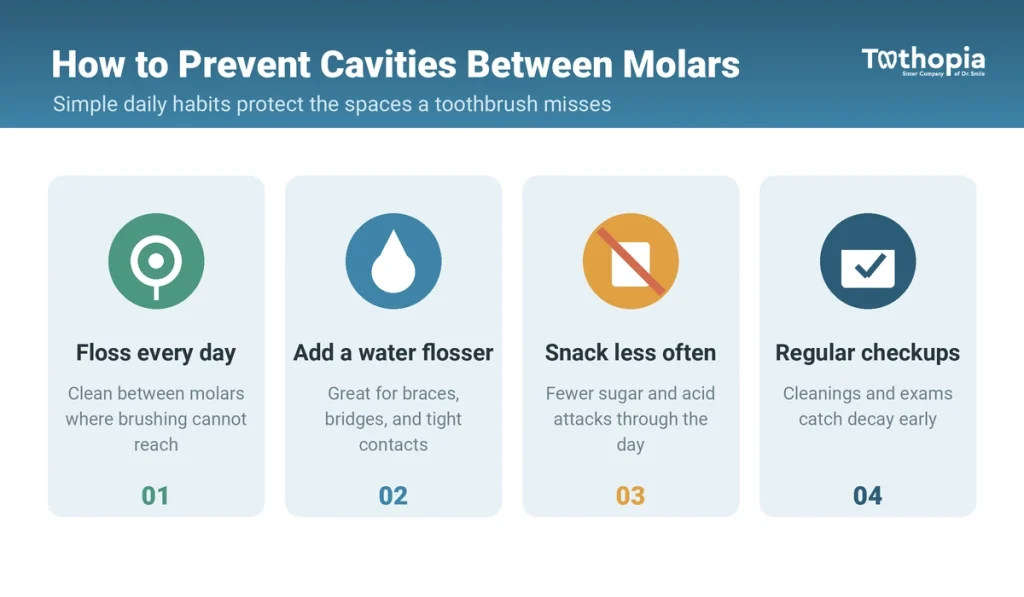
Daily habits that protect the spaces between molars:
- Floss every day: this is the one step that actually reaches the contact point between teeth, where brushing cannot.
- Brush twice a day: use fluoride toothpaste and give the back teeth extra attention.
- Try interdental tools: interdental brushes and water flossers clean tight molar spaces well, and are helpful with braces, bridges, or sensitive gums.
Smart diet and professional care:
- Snack less often: grazing keeps your mouth acidic, so spacing out food and drinks protects enamel.
- Stay hydrated: water rinses away particles and supports saliva, your mouth's natural defense.
- Ask about sealants: a thin protective coating can shield the grooves of vulnerable molars.
- Keep regular cleanings: professional teeth cleaning removes hardened tartar you cannot reach at home and lets your dentist catch early decay.
None of this has to be dramatic. Small, steady improvements in your routine add up to a real drop in your risk over time.
Need help getting started? Our California-based offices in Culver City and Inglewood are ready to assist. Reach out by filling out the consultation form or calling 310-643-6221.
The Bottom Line on Molar Cavities
A cavity between molar teeth rarely announces itself. It hides in the one spot you cannot see or brush, which is exactly why it can slip from a reversible white spot to a painful infection while you feel almost nothing. The single most important idea to carry away is that time is the deciding factor: the earlier it is found, the smaller and simpler the fix.
Pair honest daily flossing with regular exams and bitewing X-rays, and most of these cavities get caught while a quick treatment is all that is needed. Pay attention to the quiet clues- sensitivity, food trapping, floss that keeps catching- and act on them early rather than waiting for pain. Your future self, and your molars, will thank you.
Frequently Asked Questions About Molar Cavities
Can cavities between molars heal on their own?
No, cavities cannot heal on their own once the enamel is damaged. Professional treatment is required to stop the decay and restore the tooth.
How often should I get checked to prevent cavities between molars?
It is generally recommended to visit your dentist every six months, although some individuals may benefit from more frequent visits depending on their risk level.
Is it painful to treat a cavity between molars?
Modern dental treatments are designed to be as comfortable as possible. Local anesthesia ensures that most procedures are pain-free.
Can a cavity between molars affect other teeth?
Yes, untreated decay can spread to adjacent teeth and increase the risk of gum disease and other oral health issues.



0 Comments