

Accidentally rinsing your mouth after a tooth extraction is usually not dangerous. One gentle swish of water rarely pulls the blood clot out of the socket. What dislodges a clot is force: hard spitting, vigorous swishing, sucking on a straw, or doing any of these again and again in the first 24 to 72 hours.
So stop rinsing, leave the site alone, and pay attention to how your pain changes over the next few days. Below you'll see how to check whether the clot is still there, when rinsing becomes safe again, and the specific signs that mean it's time to call your dentist.
Key Takeaways
- A single gentle rinse in the first 24 hours rarely dislodges the blood clot. Force and repetition are what cause damage.
- Hard spitting, straws, smoking, and vigorous swishing put far more pressure on the socket than a mouthful of water.
- If bleeding starts again, bite on folded gauze or a moistened black tea bag for 30 to 45 minutes.
- Start gentle warm salt water rinses the day after your extraction and let the water fall out of your mouth instead of spitting.
- Dry socket pain usually starts two to four days after the extraction and gets worse instead of better.
- Call your dentist for pain that climbs after day three, visible bone, a foul taste, fever, or bleeding that pressure won't stop.
What Happens If You Accidentally Rinse Your Mouth After a Tooth Extraction?
In most cases, nothing happens. The blood clot that forms in the socket during the first few hours is sticky and holds on better than people expect, and a light swish of water usually moves around it rather than through it. The risk goes up with force, timing, and repetition.
The clot matters because it covers the exposed bone and nerve endings at the bottom of the socket and gives new tissue something to grow into. If it washes out before healing gets going, you can end up with dry socket (alveolar osteitis), the most common complication after an extraction. Dry socket hurts, but it is treatable, and a single gentle rinse is not what causes it in most patients.
Three things decide whether an accidental rinse is a problem:
- Force. Swallowing water or letting it roll off your tongue puts almost no pressure on the clot. Swishing hard or spitting does.
- Timing. The clot is most fragile in the first 24 hours and stays vulnerable for about 72 hours.
- Repetition. One slip is rarely the issue. Rinsing several times on day one is.
What If I Spat, Used a Straw, or Brushed the Extraction Site?
These are the other common accidents, and they don't carry the same risk. Suction and hard spitting create negative pressure inside the mouth, which is why dentists warn about them more than about water itself.
| What happened | Risk to the clot | What to do now |
|---|---|---|
| One gentle swish of water | Low | Stop rinsing and leave the site alone |
| Rinsed after brushing your other teeth | Low | Next time, let the water fall out of your mouth |
| Spat hard once | Low to moderate | Check for fresh bleeding and bite on gauze if needed |
| Drank through a straw | Moderate | Stop using straws for at least 72 hours |
| Brushed directly over the socket | Moderate | Brush around it, not over it, until the gum closes |
| Smoked or vaped | High | Stop for at least 72 hours; smoking is the biggest single risk factor |
| Rinsed forcefully several times on day one | High | Watch closely for dry socket signs on days two to four |
Smoking deserves its own mention because it combines suction with reduced blood flow to the gums. The reasons smoking slows healing after an extraction go well beyond the straw effect.
Whatever happened, the next step is the same: check whether the clot is still there. It takes about ten seconds with a mirror and a flashlight.
How Can You Tell If the Blood Clot Is Still in Place?
If you can see a dark red, jelly-like plug filling the socket, the clot is still there. That holds even if the surface looks a little uneven or the water you rinsed with came out pink. Light oozing during the first 24 hours is normal and doesn't mean the clot is gone.
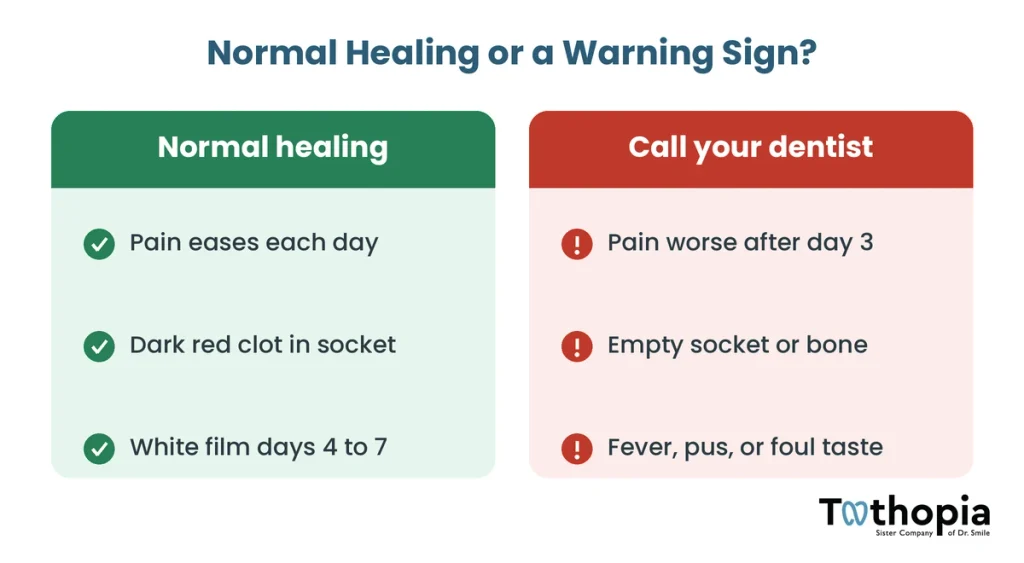
Signs the clot may have come out: the socket looks empty, you can see whitish or grayish bone at the bottom, or bleeding starts again and keeps going. Don't confuse this with the creamy white film that normally shows up around days four to seven. That film is granulation tissue, a healthy stage of healing, and what a normal extraction socket looks like walks through every stage with photos.
The most reliable signal isn't how the socket looks. It's how your pain changes. Normal extraction pain eases a little each day. Pain that settles and then sharply returns on day two, three, or four is the pattern to report.
Look once, then stop. Pulling your cheek back over and over, or poking the socket with your tongue, disturbs the clot more than the original rinse did.
What to Do Right After an Accidental Rinse
Don't try to fix it by rinsing again. Here is what to do in the first hour:
- Stop rinsing for the rest of the day. Swallow saliva normally instead of spitting it out.
- If you see fresh bleeding, fold a clean gauze pad, place it over the socket, and bite down firmly for 30 to 45 minutes without peeking. A moistened black tea bag works too; the American Association of Oral and Maxillofacial Surgeons lists it as an option for controlling bleeding.
- Keep your head raised, including an extra pillow at night, and skip exercise for the rest of the day.
- Avoid straws, smoking, vaping, and hot drinks for at least 72 hours.
- Note how your pain feels right now, so you can tell over the next few days whether it is getting better or worse.
If bleeding is still steady after two rounds of firm pressure, call the office. At that point it isn't normal oozing anymore.
The habits that put a fresh socket at risk are the same after any procedure in the mouth, and the full list of things to avoid after oral surgery covers food, exercise, and alcohol as well.
When Is It Safe to Rinse After a Tooth Extraction?
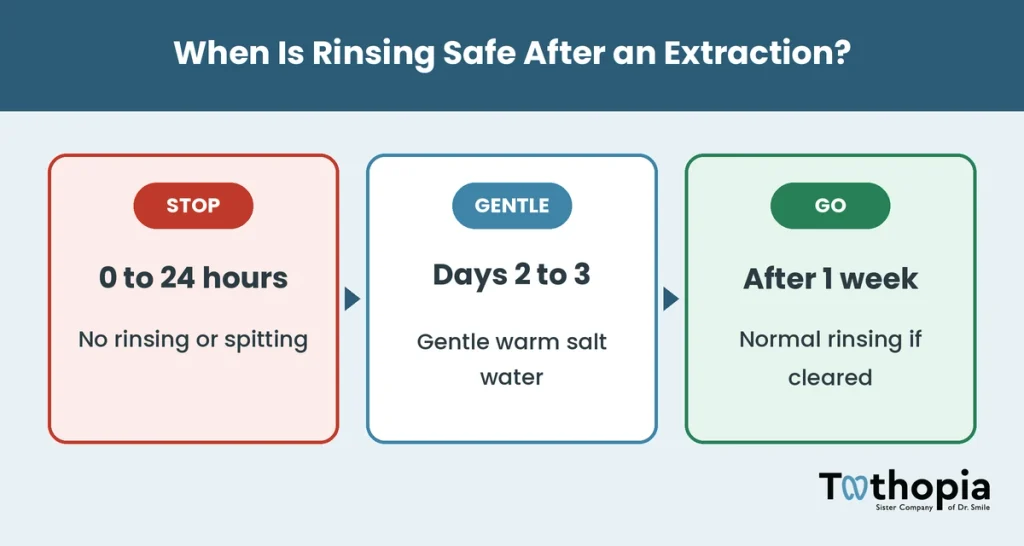
You can usually start gentle salt water rinses 24 hours after the extraction. Before that, don't rinse, spit, or use mouthwash. After that, rinsing helps keep food out of the socket, as long as it stays gentle.
Gentle means this: dissolve half a teaspoon of salt in a glass of warm water (about 8 ounces), take a small sip, tilt your head slowly from side to side, and let the water fall out of your mouth over the sink. The AAOMS recommends this rinse several times a day, and right after meals is when it does the most good.
Safe Rinsing Timeline After Tooth Extraction
| Time after extraction | Rinsing | Other habits |
|---|---|---|
| First 24 hours | No rinsing, spitting, or mouthwash | Bite on gauze as directed; brush other teeth gently and let the foam fall out |
| Days 2 to 3 | Gentle warm salt water, several times a day | No straws, smoking, or forceful spitting until at least 72 hours |
| Days 4 to 7 | Keep up salt water rinses, especially after meals | Brush closer to the site as tenderness eases |
| After 1 week | Normal rinsing if your dentist agrees | Surgical and wisdom tooth sites may need longer before vigorous rinsing |
These windows are typical for a routine extraction. A surgical extraction or a lower wisdom tooth heals more slowly, and your dentist's written instructions take priority over any general timeline.
Can You Use Mouthwash After a Tooth Extraction?
Skip regular mouthwash for the first 24 hours, and hold off on alcohol-based brands until the socket has started to close. Alcohol stings raw tissue, and most people swish mouthwash much harder than salt water. Warm salt water does the cleaning job without the sting. If your dentist prescribed a medicated rinse such as chlorhexidine, follow their instructions on when to start and how long to use it.
Signs That Rinsing Caused a Problem
Most people who rinse by accident heal normally. The signs below are what to watch for over the next week, and each one points to a specific problem.
| Sign | Likely cause | Typical timing |
|---|---|---|
| Pain that eases, then sharply worsens and spreads toward the ear or temple | Dry socket | Days 2 to 4 |
| Empty-looking socket or visible bone | Lost clot (dry socket) | Days 2 to 4 |
| Foul taste or odor that brushing doesn't clear | Dry socket or infection | Day 3 onward |
| Swelling that grows after day 3, pus, or fever above 100.4°F | Infection | Day 3 onward |
| Bleeding that won't stop after 30 to 45 minutes of firm pressure | Disturbed clot or a bleeding problem | Any time |
Dry socket is treated in the office, usually by gently cleaning the socket and placing a medicated dressing, and the pain tends to ease quickly once that's done. The symptoms are covered in more depth in how to know if you have dry socket.
Swelling that spreads toward the jaw, neck, or under the tongue, or any trouble swallowing or breathing, needs same-day care. Our emergency dental team can see you quickly, and an infection that forms at the extraction site is far easier to treat when it's caught early.
Need help getting started? Our California-based offices in Culver City and Inglewood are ready to assist. Reach out by filling out the consultation form or calling 310-643-6221.
Final Thoughts on Rinsing After Tooth Extraction
An accidental rinse sounds worse than it usually is. In most cases the clot stays put, and the right move is to stop rinsing and give the site a few days. The habits that actually lead to dry socket are suction, hard spitting, smoking, and poking at the socket, especially during the first 72 hours.
Track the direction of your pain rather than how strong it is. If it eases a little each day, healing is on track. If it climbs after day three, call your dentist, since dry socket and infection both respond quickly to treatment.
Common Questions About Rinsing After Tooth Extraction
When can I start rinsing with salt water after a tooth extraction?
Start 24 hours after the extraction. Mix half a teaspoon of salt into about 8 ounces of warm water, rinse gently several times a day, and let the water fall out of your mouth instead of spitting it.
Can one rinse cause dry socket?
It's unlikely. Large studies put dry socket at under 5% of extractions, rising to around 30% after lower wisdom teeth removal, according to StatPearls. Suction, smoking, and repeated forceful rinsing are far more common triggers than one gentle rinse.
When can I drink water after a tooth extraction?
You can sip water once the bleeding has slowed and the gauze is out, usually within the first hour or two. Drink from a cup, not a straw, and swallow instead of swishing. Wait until the numbness wears off before hot drinks so you don't burn your cheek or tongue without feeling it.
How should I brush my teeth after a tooth extraction?
Brush your other teeth gently the same day, but keep the brush away from the socket for the first 24 hours. Don't spit the toothpaste out hard; lean over the sink and let it fall out. After the first day, brush closer to the site as it feels comfortable.
Can you get dry socket if you have stitches?
Yes. Stitches help hold the gum and clot in place, but they don't protect against suction, smoking, or hard spitting, so the same precautions apply for the first 72 hours.



0 Comments