

The main difference between a partial crown and a full crown is coverage. A partial crown restores only the damaged part of a tooth, while a full crown caps the entire visible tooth down to the gumline. Both save a tooth that a simple filling can no longer fix, but they preserve very different amounts of natural structure. The choice affects how much healthy enamel you keep, how the tooth is prepared, and how long the result lasts. Below is a clear, side-by-side look at the two options and how to tell which one your tooth actually needs.
Key Takeaways
- A partial crown (an inlay, onlay, or 3/4 crown) covers only part of the tooth and keeps more natural structure. A full crown covers the whole tooth for maximum protection.
- Partial crowns suit moderate decay, cracks, or worn cusps when healthy enamel remains. Full crowns suit heavily damaged teeth, teeth after a root canal, and teeth under strong bite force.
- Full crowns need more tooth reduction, so a partial crown is the more conservative, tooth-preserving option when it is possible.
- Both restorations commonly last about 10 to 15 years with good care, and both can be made from tooth-colored porcelain or zirconia.
- A partial crown is usually the more affordable and less invasive choice, but only when enough tooth is left to support it.
- A "dental cap" is simply another name for a crown; it is not a separate treatment.
- The final call depends on an exam and X-rays, since only your dentist can measure how much healthy tooth remains.
What Is a Partial Crown?
A partial crown is a custom restoration that covers only the damaged portion of a tooth instead of the whole tooth. Dentists also call it partial coverage, and the family includes inlays, onlays, and 3/4 crowns.
The goal of a partial dental crown is to protect and rebuild a tooth while keeping as much healthy enamel as possible. It sits between a large filling and a full crown, so it is often recommended when decay or a crack is too big for a filling but not serious enough to justify capping the entire tooth. Like full crowns, our partial crowns are shaped in a dental lab for a precise, natural-looking fit.
When Is a Partial Crown Used?
A partial crown is used when a tooth has moderate damage but still has enough solid structure to avoid a full crown. It is a conservative fix that repairs the problem area without reshaping the whole tooth.
Common reasons a dentist suggests a partial crown include:
- Moderate decay that a filling can no longer support reliably
- A cracked or fractured cusp on a back tooth
- Worn or chipped chewing surfaces from grinding
- Replacing a large old filling that keeps failing
- Damage limited to one section of the tooth
Inlays, Onlays, and 3/4 Crowns Explained
The three types of partial crowns differ by how much of the tooth they cover. An inlay stays inside the grooves, an onlay covers one or more cusps, and a 3/4 crown wraps around most of the tooth.
- Inlays: fit within the grooves of the tooth and do not extend over the cusps. Used when damage sits in the center of the chewing surface.
- Onlays: cover one or more cusps, offering more protection than an inlay but less than a full crown. A good fit for more extensive decay or a fractured cusp.
- 3/4 crowns: cover about three-quarters of the tooth and are used when a large section needs support but a healthy wall of enamel can be kept.
If you want a closer look at the two most common options and how they are prepared, our guide on dental inlay vs onlay breaks down the differences in detail.
Materials Used for Partial Crowns
Partial crowns can be made from several durable materials, chosen for the tooth’s location, bite force, and how visible it is when you smile.
- Porcelain or ceramic: a natural look, ideal for teeth that show
- Zirconia: very strong and tooth-colored, balancing durability and appearance
- Gold alloy: extremely tough and gentle on opposing teeth, often used on molars
- Composite resin: a more budget-friendly option, though less durable over time
What Is a Full Crown?
A full crown is a restoration that completely encases the visible part of a tooth above the gumline. It restores the tooth’s shape, strength, and appearance when damage is too widespread for partial coverage.
A full dental crown acts like a protective cap. It is the standard choice after large fractures, deep decay, or root canal treatment, and it is also used to complete a dental implant. You can read more about how our dental crowns are designed and placed if you want the full picture on full-coverage restorations.
When Is a Full Crown Necessary?
A full crown becomes necessary when a tooth is too weak or too damaged for a filling or a partial crown to protect it safely.
Situations that usually call for a full crown include:
- Large cavities that leave little healthy tooth behind
- Cracks or fractures that reach across most of the tooth
- A tooth that has had root canal therapy and needs full support
- A crown to restore a dental implant
- Severe wear or a tooth that keeps breaking
Full Crown Materials: Porcelain, Zirconia, Metal, and Ceramic
- Porcelain: closely mimics enamel and is ideal for front teeth
- Zirconia: very strong and tooth-colored, works well on front or back teeth
- Metal (gold alloy): highly durable and wear-resistant, often chosen for molars
- Ceramic: natural-looking and biocompatible, a good option for metal sensitivities
How Long Do Full Crowns Last?
With good care, a full crown typically lasts about 10 to 15 years, and often longer. Longevity depends on oral hygiene, diet, and habits such as teeth grinding. Regular checkups let your dentist catch small issues before they shorten the life of the crown.

Partial Crown vs Full Crown: The Key Differences
The key difference between a partial crown and a full crown is how much of the tooth is covered and how much is removed. Partial crowns preserve more natural structure, while full crowns trade some healthy enamel for maximum strength.
Here is how the two restorations compare across the factors patients ask about most:
| Feature | Partial Crown | Full Crown |
|---|---|---|
| Coverage | Only the damaged part (cusps and biting surface) | The entire visible tooth down to the gumline |
| Tooth structure removed | Minimal, conserves healthy enamel | More, the whole tooth is reshaped |
| Best suited for | Moderate decay, cracks, worn or fractured cusps | Extensive damage, root canals, heavy bite force |
| Strength | Strong for moderate chewing loads | Maximum strength and full protection |
| Typical visits | Often 1 to 2 | Usually 2 (or 1 with same-day systems) |
| Typical lifespan | About 10 to 15 years with good care | About 10 to 15 years with good care |
| Natural tooth preserved | More | Less |
| Relative cost | Usually lower, more conservative | Usually higher, more preparation and lab work |
Preserving natural tooth structure is not only about looks. Every millimeter of healthy enamel you keep helps the tooth stay stronger for years, which is why many dentists pick the most conservative restoration that still fully protects the tooth.
How the Partial Crown and Full Crown Procedures Compare
Both the partial crown and full crown procedures start the same way: the area is numbed, decay is removed, and an impression or digital scan is taken. The main difference is how much of the tooth is shaped before the restoration is placed.
Getting a Partial Crown Process
- The dentist numbs the tooth and removes only the decayed or weakened area.
- The remaining healthy enamel is preserved, and the tooth is lightly prepared for an inlay, onlay, or 3/4 crown.
- A scan or impression is sent to the lab so the restoration matches your tooth precisely.
- A temporary may be placed while the final piece is made.
- At the second visit, the finished partial crown is bonded into place and your bite is checked.
Getting a Full Crown Process
- The dentist numbs the tooth and removes decay or old filling material.
- The entire visible tooth is reshaped and reduced so the crown can fit over it.
- A scan or impression captures the prepared tooth and neighboring teeth.
- A temporary crown protects the tooth while the lab builds the permanent one.
- At the next visit, the permanent crown is cemented and adjusted for a comfortable bite.
Some offices offer same-day crowns milled in a single visit instead of the two-visit lab process. If finishing in one appointment matters to you, ask whether that option is available for your specific tooth.
If you are wearing a temporary while the lab makes your final crown, chew on the opposite side and skip sticky foods. A dislodged temporary is the most common reason patients need an extra visit before the permanent crown is bonded.
Crowns After a Root Canal: Partial or Full?
After a root canal, a tooth becomes more brittle and usually needs full coverage to protect it from cracking. A full crown is the common choice, though a well-supported back tooth with strong walls can sometimes be restored with an onlay.
The right answer depends on how much solid tooth is left after root canal treatment. Front teeth, which take less chewing force, sometimes keep more structure, while molars that grind food often do better with a full crown. Your dentist decides after checking the remaining walls of the tooth on an X-ray.
Benefits and Trade-offs of Each Option
Each option earns its place in different situations. Partial crown benefits center on preserving your tooth, while full crown benefits center on strength and complete protection.
Partial crowns
- Conserve more natural tooth structure
- Less invasive preparation
- Often faster and more affordable to place
- Excellent aesthetics with tooth-colored materials
- Trade-off: not strong enough for teeth with widespread damage or very heavy bite force
Full crowns
- Maximum coverage, strength, and protection
- Ideal for severely damaged teeth and teeth after a root canal
- Restore both function and appearance fully
- Durable and long-lasting with good care
- Trade-off: requires removing more healthy tooth and usually costs more
You might be thinking that a partial crown must be the weaker choice. In practice, a well-placed onlay on a suitable tooth can be just as reliable as a full crown, because it keeps more of the tooth’s own strength. If you would rather avoid a crown altogether, it is worth asking about dental crown alternatives first.
When to Get a Partial Crown vs a Full Crown
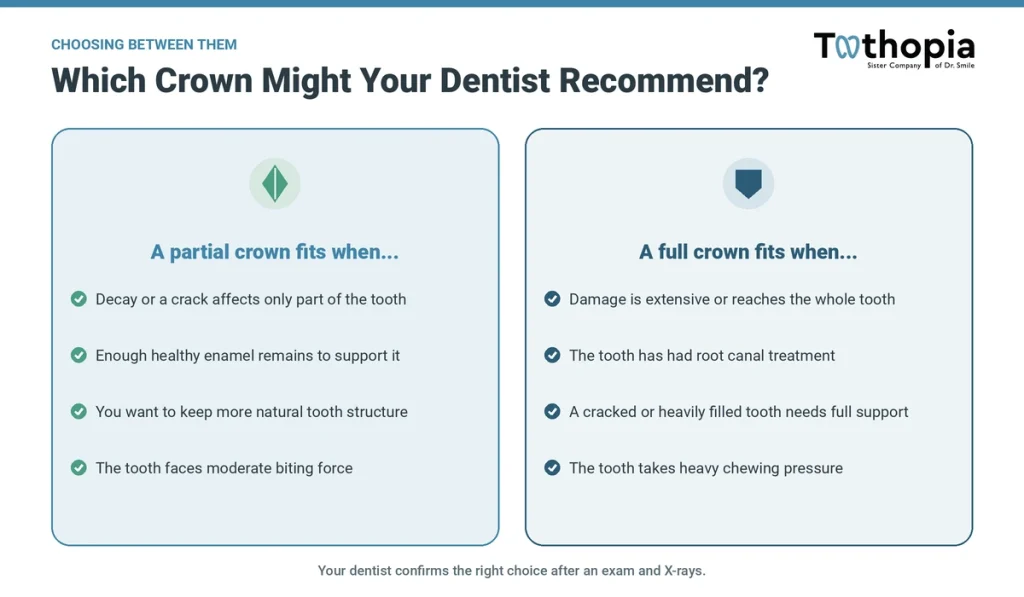
Knowing when to get a partial crown versus when to get a full crown comes down to four things: how much the tooth is damaged, cost and coverage, how the tooth looks, and your bite. Your dentist weighs all four before recommending one.
Based on the Severity of Tooth Damage
Damage severity is usually the deciding factor. Minor to moderate damage, such as a small fracture or limited decay, often does well with a partial crown that preserves natural tooth. Extensive damage, or a tooth after root canal therapy, typically needs the full coverage and strength of a full crown.
Cost and Insurance Considerations
Cost is another practical factor in the partial crown vs full crown cost question. Partial crowns generally cost less because they use less material and require less preparation, while full crowns involve more lab work. Both usually cost more than a standard dental filling, which is one reason a partial crown is often the middle-ground choice. Coverage varies by plan, so check your specific dental benefits and ask the office to review the estimate with you before treatment.
Cosmetic Preferences
If appearance is a priority, both options can be made from tooth-colored porcelain or zirconia. Full crowns give a uniform look because they cover the whole tooth, which can help on very visible front teeth. Partial crowns blend in well while leaving some natural tooth visible, which many patients prefer for a conservative result.
Your Bite and Overall Oral Health
Your bite pattern, grinding habits, and gum health all shape the decision. A tooth under heavy chewing pressure or in a mouth prone to grinding often benefits from a full crown, while a healthy tooth with a lighter load may be well served by a partial crown. A thorough exam ties all of these together.
Need help getting started? Our California-based offices in Culver City and Inglewood are ready to assist. Reach out by filling out the consultation form or calling 310-643-6221.
The Bottom Line on Choosing Between a Partial and Full Crown
The right restoration is the one that protects your tooth while removing the least amount of healthy structure. A partial crown wins when enough solid tooth remains, since it keeps more of your natural strength. A full crown wins when the damage is widespread, when the tooth has had a root canal, or when it faces heavy bite force and needs complete coverage.
As of 2026, both partial and full crowns are predictable, long-lasting solutions when they are matched to the right tooth. The one detail no article can settle for you is how much healthy tooth is actually left, and that is exactly what an exam and X-rays reveal. Bring your questions to that visit, and you will leave with a clear, tooth-specific answer.
Common Questions About Partial and Full Crowns
Does a crown cover the whole tooth?
A full crown covers the whole visible tooth down to the gumline, but a partial crown does not. Partial crowns, such as onlays and 3/4 crowns, cover only the damaged part and leave healthy tooth exposed.
Is a partial crown just a bigger filling?
Not quite. A partial crown is stronger and more durable than a filling and is custom-made in a lab, while a filling is placed directly in the mouth. A partial crown is best when a filling would be too large to hold up over time.
Can you put a partial crown on a front tooth?
Yes, in the right situation. A partial crown or onlay can restore a front tooth when the damage is limited and enough enamel remains, and tooth-colored materials keep the result natural. Your dentist confirms whether the tooth has enough support for partial coverage.
Is a dental cap the same as a crown?
Yes. "Cap" is just an everyday word for a crown; both describe a restoration that covers a tooth. When someone says they need a cap, they are describing a crown, whether partial or full.



0 Comments