

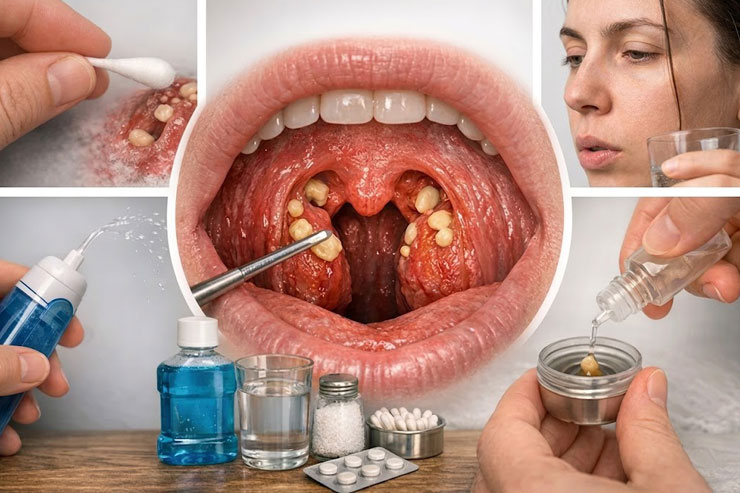
The safest way to remove tonsil stones at home is to flush and loosen them gently: gargle with warm salt water, rinse with a water flosser on its lowest setting, and use a damp cotton swab only on stones you can clearly see. Most small stones come out this way, or fall out on their own.
Deep or recurring stones are a different problem. Poking at them with sharp tools can tear tonsil tissue, and the only lasting fixes are procedures that smooth the tonsil crypts or remove the tonsils. Below are the home methods step by step, what to avoid, how to deal with deep stones, and when to see a dentist or an ENT.
Key Takeaways
- Tonsil stones form when food debris, bacteria, and dead cells collect in the tonsil crypts. Most stay soft; larger ones can harden as minerals build up.
- Warm salt water gargling and a water flosser on its lowest setting are the safest first-line methods for small stones.
- Sharp tools, toothbrushes, and fingernails can cut tonsil tissue and lead to bleeding or infection.
- Deep stones you can’t see belong with a dentist or ENT, not a cotton swab.
- Daily brushing, flossing, and tongue cleaning lower the bacteria that feed new stones.
- The only permanent options are laser or coblation cryptolysis and tonsillectomy, both done by an ENT.
- See a doctor for one-sided tonsil swelling, bleeding that won’t stop, fever, or trouble swallowing.
What Are the Symptoms of Tonsil Stones?
Tonsil stones often show up through changes in breath, throat comfort, and swallowing, even when the stones themselves are not clearly visible. Plenty of people have them with no symptoms at all and only find out when a stone turns up on a dental X-ray or a CT scan.
When they do cause symptoms, these are the usual ones:
- Bad breath (this is the most common sign)
- A sore or scratchy throat
- A feeling that something is stuck in the throat
- Discomfort or difficulty when swallowing
- Ear pain without a clear cause
- Small white or yellow spots on the tonsils
Bad breath is the strongest link. In a study of people with chronic caseous tonsillitis, 75% of those with abnormal bad-breath readings had tonsil stones, compared with 6% of those with normal readings. The bacteria inside a stone give off sulfur compounds, which is where the smell comes from.
One thing that often gets mistaken for a tonsil stone: a white or yellow lump on the gum behind your last molar. That spot sits in the mouth, not the throat, and it is usually trapped food or an inflamed flap of gum around a wisdom tooth. Swelling around a back tooth needs a dental exam, not a gargle.
If symptoms come with fever, drooling, or difficulty breathing rather than just throat discomfort, the cause may be a swollen epiglottis instead of tonsil stones, and that combination needs urgent medical attention rather than home care.
What Causes Tonsil Stones?
Tonsil stones form when debris such as food particles, bacteria, and dead cells become trapped in the small crevices of the tonsils (tonsil crypts). Most stones stay soft and cheese-like. When one sits in a crypt long enough, calcium and other minerals can collect in it and make it hard.
In many cases, the process becomes more likely when the tonsils naturally have deeper crypts or when oral hygiene is not optimal. Reduced saliva flow, chronic inflammation, or recurring throat issues can also make it easier for debris to stay trapped instead of being naturally cleared.
Certain common conditions and habits increase the risk of tonsil stones forming:
- Deep tonsil crypts: more space for debris to get trapped and stay there
- Poor oral hygiene: more bacteria and food particles feed the buildup
- Chronic tonsillitis: repeated inflammation creates deeper pockets over time
- Dry mouth or dehydration: less saliva means less natural cleaning
- Mucus buildup from allergies: thicker secretions can carry more debris into the tonsils
If you reduce the amount of bacteria and debris in your mouth, you directly lower the chances of stones forming in the first place.

Safe Ways to Get Rid of Tonsil Stones at Home
The safest approach to removing tonsil stones at home is to use gentle, non-invasive methods that help loosen debris instead of forcing it out. Start with salt water, move to a water flosser if a stone stays put, and save the cotton swab for stones you can see clearly.
Warm Salt Water
Warm salt water is the easiest and safest way to start loosening tonsil stones at home. It helps reduce inflammation in the tonsils and gently releases trapped debris without any force.
How to use it properly:
- Mix half a teaspoon of salt in 8 ounces (one cup) of warm water.
- Take a sip, tilt your head back, and gargle for 20 to 30 seconds.
- Spit it out and repeat 2 to 3 times, especially after meals.
Small stones near the surface often work loose after a few days of regular gargling. If one hasn’t moved after several days, try the water flosser instead of gargling harder.
Water Flosser
A water flosser helps flush out tonsil stones using a gentle stream of water, especially when they are slightly deeper in the tonsil crypts. It works best right after a salt water gargle, when the debris around the stone is already loosened.
How to use it safely:
- Fill the device with clean, lukewarm water.
- Set it to the lowest pressure setting.
- Aim the stream gently toward the tonsil area (not directly inside the crypts).
- Use short pulses instead of continuous pressure.
- Lean over the sink with your mouth open so the water drains forward, not down your throat.
Coughing
Coughing can sometimes help dislodge tonsil stones when they are already loose and close to the surface. In some situations, the body naturally pushes them out during mild throat movement, especially after hydration or gargling.
How to do it safely:
- Take a few gentle coughs after drinking warm water or gargling.
- Focus on natural pressure, not forceful or repeated coughing.
If nothing happens easily, don’t force it. This method only works when the stone is already ready to come out.
Cotton Swab
A cotton swab can help with tonsil stones that are clearly visible and sitting close to the surface. Anything you can’t see well is better left to the gargle and the flosser.
How to use it correctly:
- Stand in front of a mirror with good lighting.
- Wet the swab first so the cotton doesn’t stick to the tissue.
- Gently press around the stone, not into the tonsil.
- Use very light pressure and stop immediately if you feel discomfort.
If you gag easily, breathe slowly through your nose, try before a meal rather than after, and keep the swab on the tonsil itself, away from the back of your tongue and the roof of your mouth, which set off the gag reflex.
If the stone doesn’t move easily, it’s better to switch to safer methods instead of forcing it.
Apple Cider Vinegar
No clinical study shows that apple cider vinegar dissolves or prevents tonsil stones. Some people gargle with it anyway. If you do, mix 1 to 2 teaspoons into a full glass of water, gargle briefly, spit it out, and don’t make it a daily habit.
Its acid can sting tonsils that are already irritated and soften tooth enamel over time, so salt water is the better first choice.
How Do You Get Deep Tonsil Stones Out?
Deep tonsil stones are the ones to leave alone at home. If you can see only the tip of a stone, or can’t see it at all but feel it, a swab or a strong water jet can push it further into the crypt.
Keep up the salt water gargles and low-pressure rinsing, since deep stones sometimes work their way up over a few days. If one doesn’t, a dentist or ENT can lift it out with a small instrument called a curette and flush the crypt, usually in a short office visit, sometimes with a numbing spray.
Squeezing the tonsil from the side to pop a stone out is a common trick online. It bruises the tissue and can leave the crypt more inflamed, so skip it.
Can You Remove Tonsil Stones Yourself?
Yes, if the stone is small, visible, and comes out with a gargle, a gentle rinse, or a light touch. Most injuries from home removal happen when someone pushes harder after a stone refuses to move.
What to avoid:
- Toothbrushes, bobby pins, tweezers, toothpicks, and fingernails. They scrape or puncture the tonsil surface.
- Digging into the crypt. The part you see may be the tip of a much larger stone.
- Trying again and again in one session. Swollen tissue makes each attempt harder and more painful.
A little blood after removal can happen when the tonsil was already inflamed. Bleeding that keeps going, or pain that gets worse over the next day or two, needs a doctor.
What Are the Best Ways to Prevent Tonsil Stones?
Preventing tonsil stones comes down to leaving less debris and fewer bacteria in your mouth and throat. Daily oral care and enough water to keep saliva flowing do most of the work.
The habits that matter most:
- Brush twice daily and floss once daily to remove debris and reduce bacterial buildup
- Clean your tongue to reduce bacterial buildup and improve overall breath freshness
- Use an alcohol-free mouthwash to maintain a stable oral environment without irritation
- Stay well hydrated to support natural saliva cleansing and reduce dry mouth
- Gargle with plain or salt water after meals if you get stones often
- If stones keep coming back, ask your dentist about an antibacterial rinse, such as one with cetylpyridinium chloride, or a short course of prescription chlorhexidine
Routine professional dental cleaning helps reduce plaque buildup and bacterial load in the mouth. While it does not directly treat tonsil stones, cleaner teeth and gums may lower the amount of debris and bacteria that contribute to their formation. Regular preventive dentistry visits have another benefit: dentists often spot tonsil stones on panoramic X-rays before patients notice any symptoms.
When Should You See a Doctor for Tonsil Stones?
See a dentist or doctor when tonsil stones keep coming back, hurt, bleed, or come with signs of infection. A dentist can check your throat during a regular visit and remove a visible stone. An ENT (ear, nose, and throat doctor) handles deep stones, repeated tonsil infections, and anything that may need a procedure.
Get checked if you notice:
- Frequent recurrence
- Pain or swelling
- Bleeding that doesn’t stop
- Difficulty swallowing
- Signs of infection (fever, severe sore throat)
- One tonsil that is clearly larger than the other, a lump in your neck, or a sore throat lasting more than two weeks. These need an exam to rule out conditions other than tonsil stones.
Need help getting started? Our California-based offices in Culver City and Inglewood are ready to assist. Reach out by filling out the consultation form or calling 310-643-6221.
How Are Tonsil Stones Treated?
Tonsil stones are treated based on severity, ranging from simple removal to surgery. In most cases, doctors first assess how often they recur and whether there are any signs of infection before choosing a treatment approach.
- Professional removal in a clinical setting: a doctor or dentist removes visible or deep tonsil stones using sterile tools, especially when home methods don’t work, or symptoms persist.
- Pain management if needed: mild pain relief, soothing gargles, or anti-inflammatory support may be recommended when there is irritation, swelling, or throat discomfort.
- Antibiotics for infection: only prescribed when there is a confirmed bacterial infection, such as tonsillitis; they do not treat tonsil stones themselves.
- Preventive strategies for long-term control: focus on improving oral hygiene, hydration, and reducing bacterial buildup.
- Cryptolysis or tonsillectomy: procedures for stones that keep returning, covered in the next section.
| Option | What it does | Who does it | Typical recovery | Stops stones for good? |
|---|---|---|---|---|
| Professional removal | Lifts stones out and flushes the crypt | Dentist or ENT | Same day | No, stones can return |
| Antibacterial rinse | Lowers bacteria that feed new stones | Dentist recommends or prescribes | None | No |
| Laser or coblation cryptolysis | Smooths and shallows the crypts | ENT, usually in office with local anesthesia | A few days of soreness | Often, though some people need a second session |
| Tonsillectomy | Removes the tonsils | ENT, under general anesthesia | About 10 days to 2 weeks | Yes |
In practice, the goal of treatment is not only to remove existing stones but also to reduce how often they come back.
Can You Get Rid of Tonsil Stones Permanently?
Yes, but only with a procedure. Gargling, rinsing, and cleanings keep tonsil stones under control. They don’t change the deep crypts that trap debris, so for some people the stones keep coming back. Two procedures address the crypts themselves.
Laser or coblation cryptolysis. An ENT uses a laser or radiofrequency energy to smooth and shallow the crypts so debris has less room to collect. It is usually done in the office under local anesthesia, the tonsils stay in place, and some people need a second session.
Tonsillectomy. Tonsillectomy removes the tonsils completely, which eliminates the root cause of tonsil stones. It is performed by an ENT, not by a dentist or oral surgeon. However, it’s typically a last option when home care and other treatments no longer help.
When surgery is considered, it’s usually because one or more of these situations keep happening:
- Chronic or recurring tonsil stones that keep coming back despite good oral care
- Severe bad breath that doesn’t improve with hygiene or dental cleaning
- Difficulty swallowing or persistent throat discomfort
- Recurrent tonsillitis or repeated infections
Recovery usually takes about 10 days to 2 weeks for adults, and during this time, the throat can feel sore, especially when swallowing, so soft foods and rest are typically recommended.
Final Thoughts on Tonsil Stones
Tonsil stones are common and rarely dangerous, and most small ones clear up with salt water, a gentle rinse, and good daily oral care. The one real risk is forcing out a stone that isn’t ready, which is how tonsil tissue gets cut and infected.
If stones keep returning even though you brush, floss, and stay hydrated, the shape of your tonsil crypts is the likely cause. At that point an ENT visit to talk about cryptolysis or tonsillectomy will do more than another month of rinsing.
Common Questions About Tonsil Stones
Is it normal to get tonsil stones?
Yes, tonsil stones are common and not usually a serious condition. Estimates vary by study, but they show up in roughly 1 in 10 people, and many never notice them. Many people develop them due to natural tonsil structure and the buildup of bacteria or debris in the throat.
Do tonsil stones go away on their own?
Small tonsil stones may sometimes dislodge naturally through coughing, swallowing, or regular oral hygiene. However, larger or recurring stones often require gentle removal or preventive care.
What happens if you swallow a tonsil stone?
Swallowing a tonsil stone is generally not harmful. It may cause a mild bad taste or slight discomfort, but it will typically pass through the digestive system without any issue.
Are tonsil stones contagious?
No, tonsil stones are not contagious. They form due to internal factors such as bacteria, food particles, and tonsil structure, not from person-to-person transmission.
How long does it take for a tonsil stone to form?
There is no fixed timeline. Soft debris can collect in a crypt fairly quickly, while hard, calcified stones take much longer to build up. That’s why some people see a new stone soon after clearing one and others go months without any.
Can a dentist remove tonsil stones?
Yes, a dentist can often remove a visible tonsil stone during an exam, and many stones are first spotted on dental X-rays. Deep or recurring stones, and anything that needs a procedure, are handled by an ENT.
Is there anything that dissolves tonsil stones?
No rinse has been shown to dissolve tonsil stones. Salt water, water irrigation, and antibacterial mouthwash can loosen them and reduce the bacteria that feed them, but the stone itself has to come out or fall out.



0 Comments