

Yes, many people can see their epiglottis, and it is usually normal. A pale, smooth flap rising behind the tongue when you open wide or stick your tongue out is most often a high-rising epiglottis, a harmless anatomical variant seen in about 1.18% of adults in one anesthesia study and in 6 of 100 children aged 6 to 10 in another. How your throat feels matters more than what you see. Epiglottitis, an infection of that same flap, causes a severe sore throat, painful swallowing, drooling, a muffled voice, and fever, and it is a medical emergency. Here is why the flap shows up, how it changes as kids grow, and which symptoms mean you should stop reading and get help.
Key Takeaways
- A visible epiglottis with no pain, no fever, and normal swallowing is almost always a high-rising epiglottis, a benign anatomical variant.
- Epiglottitis symptoms include severe sore throat, painful or impossible swallowing, drooling, a muffled voice, fever, and stridor. A severe sore throat with drooling, a muffled voice, or noisy breathing means calling 911 or going to the ER.
- The clearest warning sign in adults is throat pain that feels much worse than the throat looks. About 90% of people with epiglottitis have a normal-looking mouth and throat on exam.
- In children, epiglottitis can narrow the airway within hours. In adults, symptoms usually build over a day or two.
- A high-rising epiglottis needs no treatment. In adults it is permanent; in children it often becomes less visible as the voice box drops with growth. The only symptom linked to it is an occasional feeling that something is at the back of the throat.
Is It Normal to See Your Epiglottis?
Yes, it can be. Seeing your epiglottis is normal when the flap looks pale pink and smooth and your throat feels fine. Doctors call this a high-rising epiglottis, and anesthesiologists gave it its own airway grade.
The epiglottis sits at the base of the tongue and folds over the windpipe every time you swallow, keeping food and liquid out of the airway. It does that thousands of times a day without you noticing. In most people it sits too low to see. In some, it sits higher and rises behind the tongue, especially when the tongue is pushed out or pressed down.
So is it bad if you can see your epiglottis? Not on its own. Look at color, pain, and swallowing instead of the flap itself. Pale, painless, and swallowing normally is the reassuring picture. Red, painful, and new, with trouble swallowing, is a different story.
Dentists sometimes spot it at routine checkups. A 2014 case report in the International Journal of Clinical Pediatric Dentistry described an 8-year-old girl whose visible epiglottis was found during a normal dental visit, and the authors noted that many dental professionals are unfamiliar with the variant.
Why Can I See My Epiglottis All of a Sudden?
Seeing your epiglottis for the first time usually means you looked more carefully than usual, not that anything changed. The structure was always there. Curiosity, a phone flashlight, a wider yawn, or a tongue stuck further out than normal is generally the whole explanation.
Tongue position matters most. Sticking your tongue out pulls its base forward, which is the same move doctors use in the airway exam where a visible epiglottis gets recorded. That is why so many people first notice it while brushing their tongue or checking their tonsils.
You might be thinking that "sudden" has to mean something. Not usually. A high-rising epiglottis is a fixed anatomical position, and people go decades without noticing theirs. What would count as a real change: the flap looking red rather than pale, throat pain arriving alongside it, a fever, or a voice that sounds different. Those are covered in the sore throat section below.
High-Rising Epiglottis in Adults
A high-rising epiglottis in adults is a benign anatomical variant in which the epiglottis sits higher than usual and becomes visible when the mouth is open. It is not a disease, and it does not turn into one.
Anesthesiologists have documented it for decades. Ezri and colleagues added a "class zero" airway to the Mallampati grading system specifically for patients whose epiglottis is visible on mouth opening, reporting an incidence of 1.18% in adults (Anesthesia & Analgesia, 2001). In children aged 6 to 10, Raghavendran and Vas found it in 6 of 100 examined.
The larynx moves down the neck as a child grows, from about the fourth neck vertebra at birth to the seventh by puberty, according to a case review in the Journal of the American Board of Family Medicine. That is why the variant is more common in kids. In some people, the epiglottis still sits high enough to see in adulthood.

Does a High-Rising Epiglottis Go Away?
In adults, no. Once you are fully grown, a high-rising epiglottis is a permanent part of your anatomy, like the shape of your ears. In children it can become less noticeable, because the larynx keeps descending until puberty. Either way, it does not need monitoring or treatment, and there is nothing to wait out.
Is a High-Rising Epiglottis Dangerous?
A high-rising epiglottis is not dangerous. Published case reports describe it as benign. The most it usually causes is an on-and-off feeling that something is at the back of the throat, which is exactly what brought the 3-year-old in the case below to a clinic.
The one practical context where it is worth mentioning is general anesthesia. In Ezri's study these patients usually had an easy view of the larynx, but a later case report described a difficult intubation despite a visible epiglottis. Telling an anesthesiologist about it is useful. Worrying about it day to day is not.
Visible Epiglottis in Children: What Parents Should Know
A visible epiglottis in a child is usually normal and is more common in children than in adults. Kids notice it, describe it as a flap or a "thing" at the back of the throat, and often report a foreign body sensation that comes and goes.
One published pediatric case (Petkar and colleagues, 2007) involved a three-year-old whose mother brought her to an ENT clinic after the child described a "googly" at the back of her throat when she stuck her tongue out. The finding was an elongated, high-rising epiglottis and nothing else. No investigation or treatment was needed.
The reassuring picture in a child looks like this: eating normally, drinking normally, no fever, playing as usual, and the flap looks pale rather than angry red. A child in that state does not have epiglottitis.
Sudden high fever, refusing to swallow, drooling, or leaning forward to breathe is a different situation. Call 911.
Why Can I Feel My Epiglottis, and Can I Touch It?
Feeling your epiglottis while swallowing or yawning is normal and happens because the flap moves over the windpipe with every swallow. Some people are simply more aware of the sensation, particularly those with a high-rising epiglottis.
Do not try to touch it with a finger. It sits deep enough that reaching it means triggering a strong gag reflex, and pushing on inflamed tissue in the rare case where something is actually wrong can make swelling worse. There is nothing you can learn by touching it that a mirror will not tell you more safely.
Persistent globus sensation, the feeling of a lump that will not clear, has plenty of other explanations. Acid reflux is a common one. So are tonsil stones, which can feel like something stuck in the throat, often with bad breath. A lump feeling that lasts more than a few weeks, or comes with hoarseness or harder swallowing, is worth an ENT visit.
Normal Epiglottis vs Epiglottitis: How to Tell the Difference
A normal epiglottis is a pale, smooth, leaf-shaped flap that causes no pain, no fever, and no swallowing trouble. In epiglottitis, it becomes red, swollen, and thickened, and it hurts.
| Feature | Normal epiglottis | Epiglottitis |
|---|---|---|
| Appearance | Pale pink, smooth, leaf or omega shaped | Red, thickened, swollen, sometimes described as cherry red |
| Pain | None | Severe, worse on swallowing |
| Onset | Long-standing, not new | Hours to a day or two, worsening steadily |
| Voice | Normal | Muffled, as if talking around something in the mouth |
| Swallowing | Normal, including saliva | Painful or impossible, saliva pools |
| Fever | Absent | Often present, sometimes high |
| What to do | Nothing | Emergency room now |
You rarely see epiglottitis by looking in a mirror. The inflammation sits below and behind what you can see with the mouth open, and about 90% of people with epiglottitis have a normal-looking mouth and throat on exam, according to an emergency medicine review on emDocs. That is why doctors get suspicious precisely when someone has terrible throat pain and a throat that looks fine. So if you spotted something at the back of your throat and felt alarmed, the very fact that you could see it calmly, without pain, argues against epiglottitis rather than for it.
Visible Epiglottis and Sore Throat: When It Actually Matters
A visible epiglottis combined with a sore throat matters when the pain is severe, swallowing is difficult, or breathing feels tight. A mild scratchy throat alongside an epiglottis you have always been able to see is a different situation entirely.
Most sore throats are viral and settle within a few days. The concerning combination is not "sore throat plus visible epiglottis." It is sore throat plus any of these:
- Pain out of proportion to what the throat looks like
- Trouble swallowing your own saliva, or drooling
- A muffled or altered voice
- Noisy breathing, especially a high-pitched sound on breathing in
- Fever with a rapidly worsening course over hours
Yes, epiglottitis is rare. But it is one of the few throat conditions where waiting to see how tomorrow goes carries real risk. Because the throat often looks normal, early cases can pass for an ordinary sore throat.
Throat discomfort after a dental procedure is a separate matter with its own timeline, and a sore throat following a tooth extraction usually comes from swelling near the extraction site, swallowed blood, mouth breathing, or a breathing tube used during sedation, and it typically settles within two to three days. If you are trying to work out whether an oral surgeon or an ENT specialist is the right person to call for a persistent throat problem, that decision depends heavily on where the symptom actually sits.

What Are the Key Epiglottitis Symptoms?
Epiglottitis symptoms are a severe sore throat, pain or inability to swallow, drooling, a muffled or hoarse voice, high fever, and noisy or difficult breathing. Symptoms escalate quickly, and the condition is treated as an airway emergency.
Emergency clinicians often teach the pattern as four warning signs that cluster together, sometimes called the "four Ds": drooling, dysphagia (trouble swallowing), dysphonia (voice change), and distress with breathing:
| Warning sign | What it looks like | Why it matters |
|---|---|---|
| Drooling | Saliva pooling or running out because swallowing hurts too much | Trouble handling saliva in 50% to 80% of adults |
| Difficulty swallowing | Refusing food, sipping and stopping, or unable to manage saliva | Painful swallowing in 90% to 100% of adults; difficulty swallowing in about 85% |
| Voice change | Muffled speech | Voice change in about 74% of adults; a clearly muffled voice in 50% to 65% |
| Breathing distress | Stridor, leaning forward, sitting upright to get air | Less common, but highly specific for a closing airway |
Fever is less reliable than people expect. Adult case series report it in anywhere from 26% to 90% of patients, so a normal temperature does not rule epiglottitis out.
Epiglottitis Symptoms in Adults
Epiglottitis symptoms in adults build more slowly than in children, usually over a day or two rather than a single afternoon. The adult airway is wider, so complete blockage is less sudden, though it still happens.
Adults typically describe it as the worst sore throat of their life. Painful swallowing dominates. The voice goes muffled. Fever may be modest or absent early on, which is part of why early adult cases can look like ordinary strep throat.
Since the Hib vaccine, adult cases come from a wider mix of germs. Haemophilus influenzae still causes some, while group A strep (Streptococcus pyogenes), Streptococcus pneumoniae, and Staphylococcus aureus account for many others. Reported incidence is roughly 1 to 4 adults per 100,000 per year in the US.
About 11% to 13% of adults need a breathing tube or another airway procedure, according to StatPearls and the emDocs review. That statistic reassures some people and misleads others. The 10% figure describes what happens after someone reaches a hospital with monitoring available, not what happens if you wait it out at home.
Epiglottitis Symptoms in Children
Epiglottitis symptoms in children come on fast and look dramatic: sudden high fever, refusal to swallow, drooling, muffled crying, and a child who insists on sitting upright and leaning forward. Fatal narrowing of the airway can occur within hours of the first symptom.
The tripod position is the classic tell. A child sits up, leans forward on their hands, extends the neck, and holds the jaw open to widen the airway. If a child in that posture is persuaded to lie flat, breathing can collapse.
Drooling without a barking cough is the distinguishing feature. Croup produces the barking cough; epiglottitis produces drooling and stillness. In infants under one year, fever and drooling and the upright posture may all be missing, which makes infant cases genuinely hard to identify.
Routine Hib vaccination made pediatric epiglottitis rare, at about 0.5 cases per 100,000 children per year in the US. Children who are unvaccinated or behind on the Hib series remain the higher-risk group.
Tip for parents: with a child you suspect has epiglottitis, keep them calm and upright and do nothing that upsets them. Crying and struggling worsen airway swelling. Emergency guidance is explicit that you should not examine the mouth, and should not separate the child from a parent, before help arrives.
What Causes a Swollen Epiglottis?
A swollen epiglottis is usually caused by a bacterial infection, but viruses, fungi, burns, and injury can all inflame it, and it almost always comes with pain.
Viral infections including varicella-zoster and herpes simplex, fungal infections such as Candida in people with weakened immunity, thermal burns from very hot liquids, chemical inhalation, smoking crack cocaine, swallowed foreign objects, and direct trauma to the throat can all inflame the epiglottis.
Some people are more likely to develop epiglottitis than others:
- Children who have not completed the Hib vaccine series
- Adults with diabetes or a weakened immune system, where Pseudomonas and Candida infections show up more often
- Smokers and people with high blood pressure, both flagged in adult case series
- Men, who outnumber women about 3 to 1 in adult cases, according to StatPearls
How Epiglottitis Is Diagnosed and Treated
Epiglottitis is diagnosed by direct visualization of the epiglottis and supraglottic structures, usually with a flexible scope, performed only where full airway support is available. Treatment starts with protecting the airway, then intravenous antibiotics. Airway safety takes priority over confirming the cause.
Typical steps once someone reaches the emergency department:
- Continuous monitoring of breathing and oxygen saturation, often in a setting where intubation can happen immediately
- Flexible laryngoscopy to see the epiglottis directly, sometimes performed in an operating room as a precaution
- Lateral neck radiograph, which can show the classic "thumbprint sign" of a swollen epiglottis
- CT imaging in selected adult cases, to assess extent and rule out abscess or other causes of obstruction
- Blood tests and throat cultures, taken once the airway is secure, to confirm infection and identify the organism
The order matters. In a child with suspected epiglottitis, standard guidance is to avoid anything stimulating, including mouth examination, blood draws, and IV placement, until the airway is protected.
Care usually involves:
- Supplemental oxygen, escalating to intubation if the airway is narrowing
- Intravenous antibiotics covering the likely organisms, adjusted once cultures return
- Corticosteroids in some cases to reduce swelling, though evidence on routine use is mixed
- ICU-level observation, since deterioration can be rapid even in patients who are not intubated
Most patients improve within 48 to 72 hours of treatment, and antibiotics usually continue for about 7 days. Children whose airway is secured in hospital now have a death rate under 1%. Adult figures vary more: StatPearls cites about 1% in one place and up to 7% to 10% in another, one more reason not to wait at home.
When to Seek Medical Help for Epiglottitis
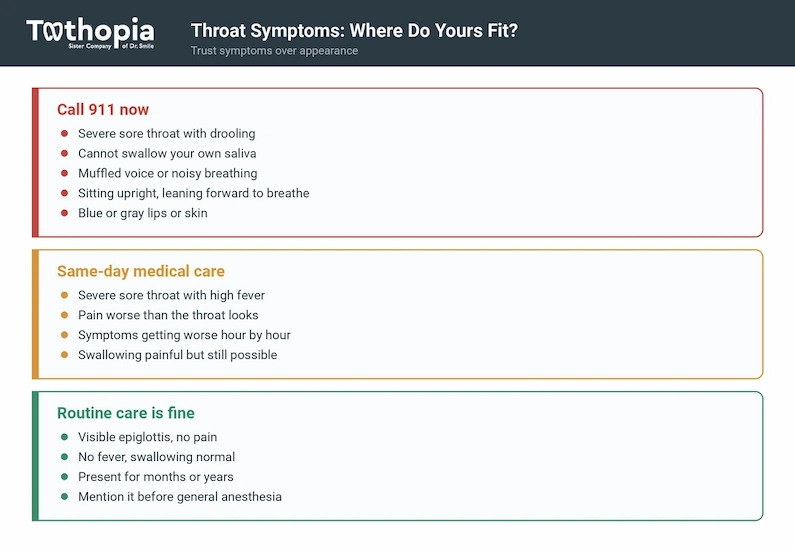
Call 911 or go to the nearest emergency room if you or your child has a severe sore throat with any of these: drooling, inability to swallow saliva, a muffled voice, noisy breathing, or a need to sit upright and lean forward to breathe. Do not drive yourself if breathing is affected.
If someone with a severe sore throat is sitting bolt upright, leaning forward with the chin pushed out, do not ask them to lie down and do not try to look inside the mouth with a spoon or flashlight. That posture is helping them breathe.
Same-day medical care is appropriate for a severe sore throat with high fever that is getting worse rather than better, especially if pain feels disproportionate to how the throat looks.
Routine care is fine for a visible epiglottis with no pain, no fever, and normal swallowing. Mention it at your next dental or medical visit if you want confirmation, and mention it before any procedure requiring general anesthesia.
Blue or gray discoloration of the lips or skin means oxygen is critically low. Call 911 instead of driving to the hospital.
Need help getting started? Our California-based offices in Culver City and Inglewood are ready to assist. Reach out by filling out the consultation form or calling 310-643-6221.
Final Thought on a Visible Epiglottis
The single most useful thing to hold onto is the mismatch rule. Epiglottitis hurts far more than it shows, and a normal visible epiglottis shows without hurting at all. Almost everyone who arrives at this topic worried about a flap they can see in the mirror belongs firmly in the second category.
Trust symptoms over appearance. A throat that looks unusual but feels fine rarely needs anything. A throat that feels catastrophic while looking ordinary needs an emergency room, and it needs one tonight rather than in the morning.
If you are unsure about something you noticed during a self-examination, a dental exam is a reasonable place to have it looked at. A dentist can check what is visible, tell you whether it matches a high-rising epiglottis, and refer you to an ENT if anything looks inflamed or unusual.
Common Questions About Visible Epiglottis and Epiglottitis
Is epiglottitis contagious?
Epiglottitis itself is not contagious, but the bacteria that cause it can be. Haemophilus influenzae type b spreads through respiratory droplets from coughing and sneezing. Close contacts of a confirmed Hib case are sometimes offered a short course of the antibiotic rifampin, though this is decided case by case by a physician, usually based on whether young or unvaccinated children live in the home.
Can epiglottitis go away on its own?
No, Bacterial epiglottitis requires intravenous antibiotics and airway monitoring in a hospital. Swelling can worsen quickly even while someone feels stable, which is why observation in a monitored setting is standard.
What does epiglottitis feel like?
Patients consistently describe throat pain far worse than an ordinary sore throat, with swallowing that hurts so much they avoid it entirely. Many report a sensation of the throat closing or of something blocking it. The voice sounds muffled, as if talking around something in the mouth, and lying flat feels worse than sitting up.
Can acid reflux cause a swollen epiglottis?
Reflux can irritate the tissue around the epiglottis and contribute to chronic throat symptoms including a lump sensation, hoarseness, and a raw feeling on waking. That is different from acute epiglottitis, which is an infection with fever and rapid onset. If throat symptoms persist for weeks without fever, reflux is worth investigating with a physician.



0 Comments