

Popping a gum abscess is unlikely to kill you by itself, but it can push a treatable infection into territory that does. Squeezing the pocket forces bacteria along soft tissue planes toward the jaw, the floor of the mouth, and the neck, and it leaves the real source of the infection sitting untouched. Fatal outcomes from dental infections are rare in the United States, yet they still happen through sepsis and airway swelling. Below is what actually occurs when someone drains a gum abscess at home, the warning signs that call for an emergency room instead of a dental chair, and the fastest safe route to relief.
Key Takeaways
- Popping a gum abscess rarely causes death directly, but it raises the odds of the complications that do: deep neck space infection, Ludwig angina, and sepsis.
- Popping a gum abscess rarely causes death directly, but it raises the odds of the complications that do: deep neck space infection, Ludwig angina, and sepsis.
- Popping a gum abscess rarely causes death directly, but it raises the odds of the complications that do: deep neck space infection, Ludwig angina, and sepsis.
- Trouble breathing, trouble swallowing, swelling under the tongue, or a fever with a racing pulse means an emergency room, not a dental appointment.
- Antibiotics buy time, not a cure. The 2019 American Dental Association guideline points to definitive dental treatment as the fix, which means drainage, root canal treatment, periodontal therapy, or extraction.
- A gum abscess that bursts on its own is not healed. Rinse gently, keep your hands out of your mouth, and get seen the same day.
What Popping a Gum Abscess Actually Does to the Infection
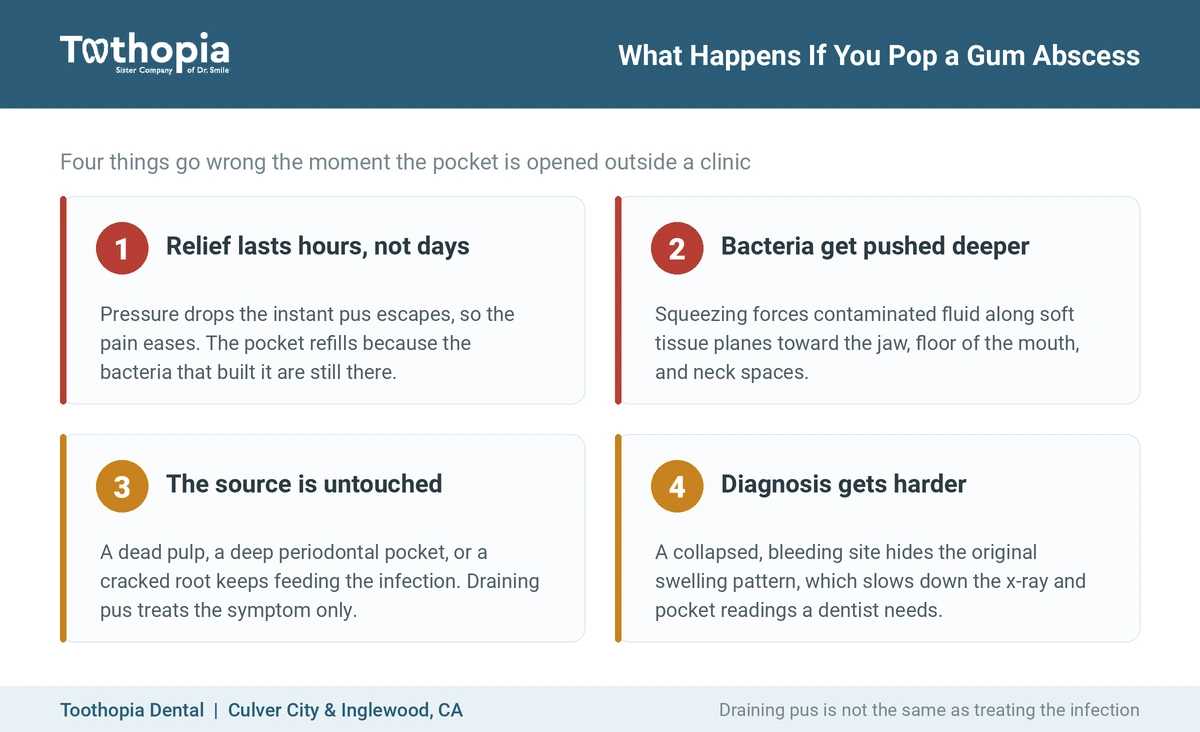
Popping a gum abscess empties the pus but leaves the infection running. The swelling you can see is only the overflow. The engine sits deeper, either inside a dead tooth nerve or inside a periodontal pocket packed with bacteria under the gum, and neither one is reachable through the bump on the surface.
That distinction matters more than most people expect. Pressure inside an abscess is what makes it throb, so the second pus escapes, the pain drops sharply. The relief is real, and it is also misleading. Within a day or two, the pocket refills, and the person who felt better on Tuesday is often in worse shape by Thursday.
There is a second problem that nobody feels happening. The tissue around a lower molar is not a sealed bag; it is a set of connected spaces. Firm squeezing pushes contaminated fluid into those spaces instead of out of the mouth. That is the mechanism behind the complications further down this page, and it is also why a swollen gum around one tooth in the back deserves a professional look rather than a fingernail.
If you have already popped it and the swelling went down, do not cancel the appointment. A collapsed abscess with no symptoms is the stage where people stop worrying and the infection quietly moves into the jawbone.
The Real Risk of Popping a Gum Abscess
So the question is not really whether the pus comes out. It is where it goes next.
Popping a gum abscess is very unlikely to kill you, and framing it as a death sentence would be dishonest. What it does is remove the two protections you have: a contained pocket and a clear reason to seek treatment. Nearly every fatal dental infection on record followed the same pattern, which is a localized abscess that spread because nobody removed the source.
The scale is worth knowing. A nine-year analysis published in the Journal of Endodontics counted 61,439 United States hospitalizations attributed primarily to periapical abscess, with an average patient age of 37 and 66 in-hospital deaths across the full period. Rare, then, but not zero. If you want the full progression timeline, our article on how long until a tooth infection kills you walks through it stage by stage.
The complications that turn a gum abscess deadly
Four pathways account for almost all serious outcomes, and squeezing a pocket makes each one more likely:
- Ludwig angina. A fast-moving cellulitis of the floor of the mouth that lifts the tongue and closes the airway. Mortality ran above 50 percent before antibiotics and sits near 8 percent today with prompt treatment, according to StatPearls.
- Sepsis. The body's overwhelming response to infection reaching the bloodstream. It escalates in hours, not days.
- Deep neck space infection. Odontogenic infections are the primary cause of deep neck infections in adults, and from the neck the infection can descend into the chest.
- Mediastinitis. Rare, and the most lethal of the group once infection reaches the chest cavity.
None of these start as emergencies. They all start as a bump on the gum that somebody decided to handle at home.
Who faces the highest risk?
Some patients move through those stages far faster than others. Diabetes, immunosuppression, chemotherapy, heavy alcohol use, and age over 65 all shorten the runway, and StatPearls lists each of them among the risk factors for Ludwig angina specifically. Pregnancy and poorly controlled blood sugar deserve the same caution.
You might be thinking that a gum problem cannot possibly reach the rest of your body. It can, and the link between chronic gum infection and systemic health is well documented, which we cover separately in can gum disease kill you.
What Happens If a Gum Abscess Bursts on Its Own
A gum abscess that bursts on its own drains through a small channel in the gum, and most people notice a sudden salty or metallic taste, a foul odor, and a drop in pain. That channel is your body improvising a pressure valve. It is not a cure, and it usually closes again within a day or two.
Spontaneous drainage is actually the better version of this scenario, because the tissue opened along its own weakest path instead of being forced. The follow-up is identical though. The tooth or the pocket still needs definitive treatment, and the longer that channel keeps opening and closing, the more bone is lost around the root.
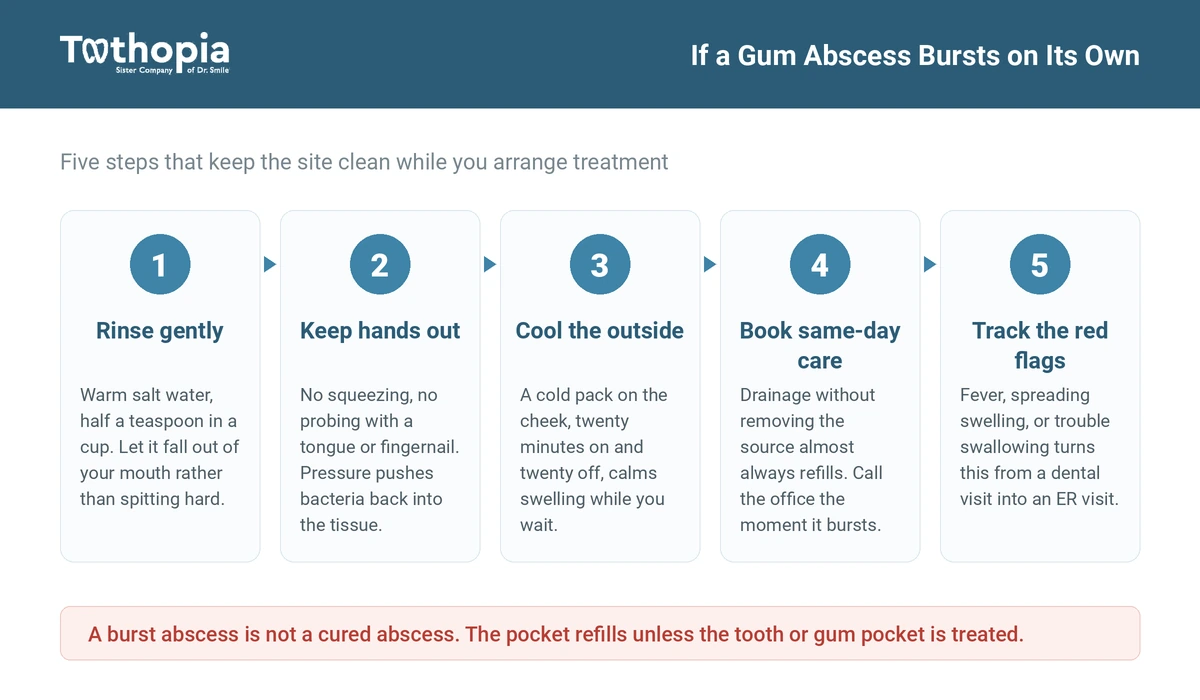
If it bursts while you are at home, work through these steps in order:
- Rinse gently with warm salt water, roughly half a teaspoon in a cup. Let the water fall out of your mouth rather than spitting with force.
- Keep your hands and tongue away from the site. Repeated probing reopens the wound and pushes bacteria back into the tissue.
- Apply a cold pack to the outside of the cheek, twenty minutes on and twenty minutes off, to control swelling.
- Call the dental office the same day and describe what happened, including whether you have a fever.
- Check yourself against the red flags in the next section every few hours until you are seen.
Do not attempt to finish the drainage yourself.
Applying pressure to empty the remaining pus is the single most common piece of bad advice online, and it is the exact action that drives bacteria into the fascial planes of the neck.
Red Flags That Mean the Emergency Room, Not a Dental Appointment
Any gum abscess combined with trouble breathing, trouble swallowing, or swelling under the tongue is an airway emergency and belongs in an emergency room immediately. Those three signs sit at the top of the list because they indicate the infection has left the gum and entered the spaces that hold your airway open.
The classic presentation of Ludwig angina is respiratory distress, drooling, and a firm swelling across the front of the neck. Trismus, meaning you cannot open your mouth more than a finger or two, is another sign that the infection has moved into the muscles of chewing.
The Centers for Disease Control and Prevention lists a specific set of sepsis warning signs, and any of them alongside a dental infection changes the plan entirely:
- High heart rate or a weak pulse
- Confusion or disorientation
- Extreme pain or discomfort
- Fever, shivering, or feeling very cold
- Shortness of breath
- Clammy or sweaty skin
Here is what most people miss. Pain is a poor guide at this stage. Once the nerve inside a tooth dies completely, the toothache can fade even while the infection expands, so a patient walks in saying the pain got better and the swelling got worse. Believe the swelling.
| Symptom | What it usually means | Where to go | How fast |
|---|---|---|---|
| Pimple-like bump, mild ache | Localized abscess, still contained | Dental office | Within 24 hours |
| Throbbing that wakes you up | Rising internal pressure | Dental office | Same day |
| Cheek or jaw swelling, no fever | Infection entering soft tissue | Dental office | Same day, urgent |
| Fever with facial swelling | Systemic involvement beginning | Urgent care or ER | Immediately |
| Trouble swallowing or breathing | Possible airway compromise | Emergency room or 911 | Immediately |
| Confusion, racing pulse, chills | Possible sepsis | Emergency room or 911 | Immediately |
How a Dentist Drains a Gum Abscess Safely
A dentist drains a gum abscess under local anesthesia through a controlled incision, irrigates the space, and then treats whatever is feeding it in the same visit or shortly after. The whole appointment usually runs 30 to 60 minutes, and most patients feel meaningfully better within a few hours. If you are dealing with facial swelling right now, an emergency dentist can assess and drain it the same day.
The clinical sequence is straightforward:
- Examination and a periapical X-ray, sometimes a 3D cone beam scan when swelling suggests the infection has spread beyond one root.
- Periodontal probing around the tooth to separate a gum pocket problem from a dead nerve.
- Local anesthesia, which can be harder to achieve in inflamed tissue and may need a different injection technique.
- Incision and drainage, with irrigation to flush the space rather than squeeze it.
- Treatment of the source in the same visit where possible, or an urgent follow-up within a day or two.
Periodontal abscess or periapical abscess: why the treatment differs
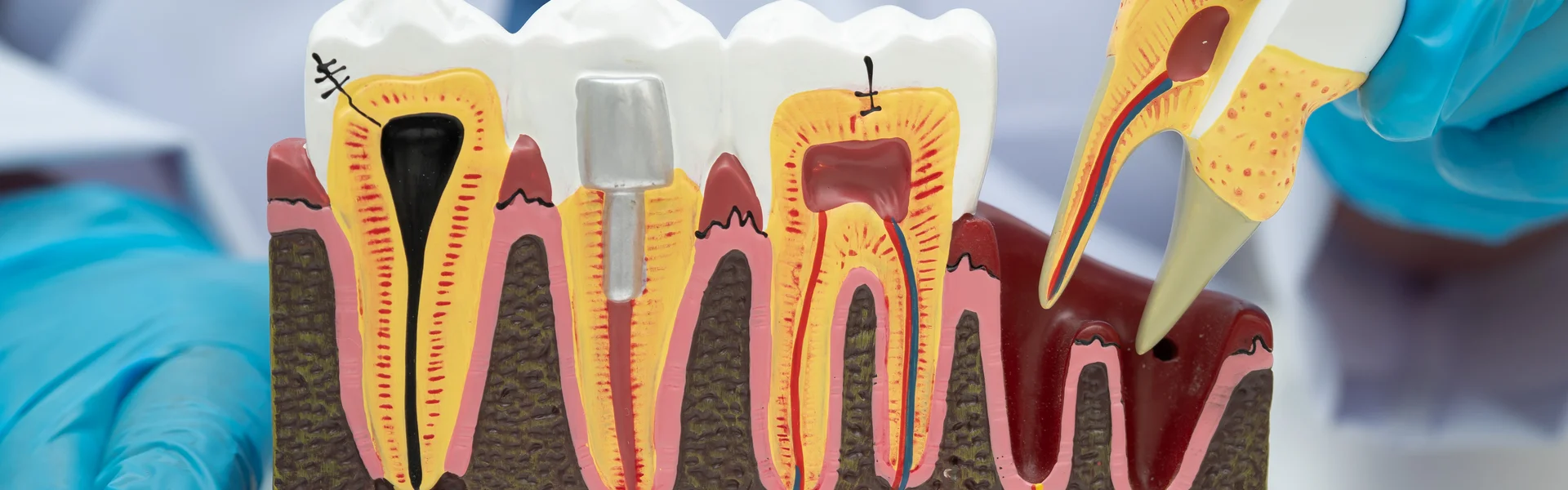
The bump looks similar either way, but the origin changes everything. A periapical abscess starts inside a dead or dying pulp and is resolved by root canal treatment or by removing the tooth. A periodontal abscess starts in a deep gum pocket and is resolved by debriding that pocket, which is why a periodontist is often the right person to look at it.
| Periodontal abscess | Periapical abscess | |
|---|---|---|
| Where it starts | Deep pocket between gum and root | Inside the pulp chamber of the tooth |
| Tooth vitality | Usually still alive and responsive | Usually non-vital, no response to cold |
| Typical trigger | Advanced gum disease, trapped debris | Untreated decay, crack, failed root canal |
| Main treatment | Debridement of the pocket, periodontal therapy | Root canal treatment or extraction |
| Drainage route | Through the pocket opening | Through a sinus tract in the gum or the tooth |
Why Antibiotics Alone Will Not Fix a Gum Abscess
Antibiotics reduce the bacterial load around an abscess, but they cannot reach the dead tissue inside a tooth or scrub out a periodontal pocket, so the infection returns once the course ends. This is the point where a lot of people lose weeks.
The 2019 American Dental Association clinical practice guideline, which the American College of Emergency Physicians endorsed, recommends against antibiotics for most pulpal and periapical conditions in healthy adults and points instead to definitive conservative dental treatment. In that guideline, definitive conservative dental treatment specifically means pulpotomy, pulpectomy, non-surgical root canal treatment, or incision for drainage.
Yes, antibiotics have a place, but a narrower one than most patients assume. They are appropriate when the infection has spread beyond the local area, when there are systemic signs such as fever or malaise, and when the patient is immunocompromised. Even then, the guideline treats them as an adjunct while definitive treatment is arranged, not as a substitute for it.
Leftover antibiotics from an old prescription are one of the fastest routes to a resistant infection and a masked emergency. A half course can quiet the fever just enough to hide swelling that is still spreading.
Safe Ways to Ease Gum Abscess Pain Before Your Appointment
You can manage gum abscess pain safely for a short window using over-the-counter pain relief, warm salt water rinses, and a cold pack on the outside of the cheek. The Centers for Disease Control and Prevention notes that acetaminophen and ibuprofen are what the ADA guideline points to for dental pain rather than antibiotics.
What follows works well enough to get you through a night, and none of it treats the infection:
- Warm salt water rinses, several times a day, letting the water fall from your mouth rather than forceful spitting.
- A cold compress against the cheek in twenty-minute cycles for swelling.
- Sleeping with your head elevated on an extra pillow, which reduces overnight throbbing.
- Chewing on the opposite side and avoiding very hot, very cold, or hard foods.
- Over-the-counter pain relief taken according to the label and any medical advice you already follow.
Skip the folk remedies that damage tissue. Aspirin held against the gum causes a chemical burn, hydrogen peroxide used undiluted irritates healing tissue, and heat applied directly to the outside of a swollen face can encourage the swelling to spread. Our guide to the fastest way to heal swollen gums covers what genuinely helps between visits.
How to Stop a Gum Abscess From Coming Back
A gum abscess comes back when the pocket or the dead nerve that produced it is never fully treated, so prevention is mostly about closing that gap and then keeping the tissue healthy. Recurrence is common enough that many patients assume abscesses simply happen to them, when in reality the same tooth is failing repeatedly.
For gum-origin abscesses, deep cleaning below the gumline is the core treatment. Scaling and root planing removes the bacterial deposits inside the pocket, and periodontal maintenance visits keep the pocket from reforming. For tooth-origin abscesses, completing the root canal treatment and placing the final crown matters as much as the initial drainage.
Day-to-day, the habits that hold the result are unglamorous and effective:
- Cleaning between teeth once a day, since a toothbrush reaches roughly 60 percent of the tooth surface.
- Professional cleanings on the interval your dentist sets, which is often every three to four months after periodontal treatment rather than every six.
- Treating cracks and failing fillings early, before bacteria reach the pulp.
- Managing blood sugar if you have diabetes, because periodontal infection and glucose control push each other in both directions.
- Getting any recurring bump checked, even a painless one.
A painless, recurring pimple on the gum is a sinus tract, and it is the most commonly ignored sign in dentistry because it does not hurt. We break down what different lesions look like in our article on a bump on your gums.
Final Thought on Popping a Gum Abscess
The honest answer is that popping a gum abscess rarely kills anyone, and that is exactly why it is dangerous. It works well enough to feel like a solution; it removes the symptom that would have driven you to a dentist, and it quietly increases the odds of the airway and bloodstream complications that actually do kill people.
Treat the pus as information rather than the problem. The pocket is telling you that a tooth nerve has died or a gum pocket has gone too deep, and both have well-established treatments that end the cycle in one or two visits. Draining without treating the source only resets the clock.
If you have a bump on your gum right now, the useful next step is not a decision about squeezing it. It is a phone call, today, while the infection is still local and the treatment is still simple.
Common Questions About Popping a Gum Abscess
What happens if you pop an abscess in your mouth and swallow the pus?
Swallowing a small amount of pus from a gum abscess rarely causes harm, because stomach acid handles the bacteria. Some people feel nauseated or notice a foul taste for a few hours. The concern is not the swallowing; it is that the abscess drained without the source being treated, so the pocket will refill.
How long can you leave a gum abscess untreated?
There is no safe waiting period, and the risk is not linear. A gum abscess can stay quiet for weeks and then spread within a day, especially in people with diabetes or a weakened immune system. The practical answer is that treatment should be arranged within 24 hours of noticing swelling, and immediately if a fever appears.
Does a gum abscess go away on its own after it drains?
No. Drainage relieves the pressure and often ends the pain, which makes it feel resolved. The bacteria feeding the abscess sit inside a dead pulp or a deep periodontal pocket that drainage cannot reach, so the swelling returns once the drainage channel closes.
Can a burst gum abscess cause sepsis?
It can, though it is uncommon. Sepsis develops when bacteria from the infection enter the bloodstream and trigger a body-wide response. Bursting the abscess by squeezing raises that risk because it drives bacteria into tissue rather than out of the mouth. Fever with a racing pulse, confusion, or clammy skin alongside a dental infection needs emergency care.


0 Comments