

For most people, teeth whitening does not hurt during the treatment itself. What you may notice is short-term sensitivity afterward, usually a few quick zaps or a dull ache when your teeth meet something hot, cold, or sweet. That reaction is normal; it passes, and it is not a sign your teeth are being harmed. Below we walk through why whitening can sting, how long the sensitivity tends to last, which methods are gentler, and the simple steps that keep discomfort low. If sensitivity is the thing holding you back, you have more control over it than you might expect.
Key takeaways
- Whitening itself is painless for most people. Any discomfort shows up afterward as temporary sensitivity, not during the gel application.
- Sensitivity happens because peroxide passes through the enamel and briefly irritates the nerve inside the tooth.
- Most sensitivity fades within 24 to 72 hours, and often sooner than that.
- Professional whitening does not permanently damage healthy enamel when it is done correctly.
- A desensitizing toothpaste used before and after whitening is the most reliable way to cut down on pain.
- Dentist-supervised whitening is easier to keep comfortable than random store kits.
- Sharp pain in a single tooth, or sensitivity lasting more than a week, is worth a quick dental check.
Does teeth whitening hurt during the treatment?
No. The whitening process itself is not painful. You sit with a gel resting on your teeth, and there are no needles and no drilling involved. Whether the gel is applied in the dentist’s chair or in a tray at home, the actual application is something you feel very little of.
The thing people describe as “pain” almost always comes later, once the treatment is over and the teeth react to the bleaching. Dentists have a nickname for the most common version of it: “zingers,” those quick, sharp little jolts that hit and then vanish a second later. They can be surprising, but they are brief.
Real example. A patient came in convinced whitening would be as bad as a filling. She left the chair feeling nothing, then texted the next morning about two quick cold-air zaps on her front teeth. By day two, gone. That arc is the norm, not the exception.
So the honest answer to “is teeth whitening painful?” is that the treatment is comfortable and the aftermath is usually mild. The next question is the one everyone actually wants answered: why does it happen at all?
Why does teeth whitening make your teeth hurt?
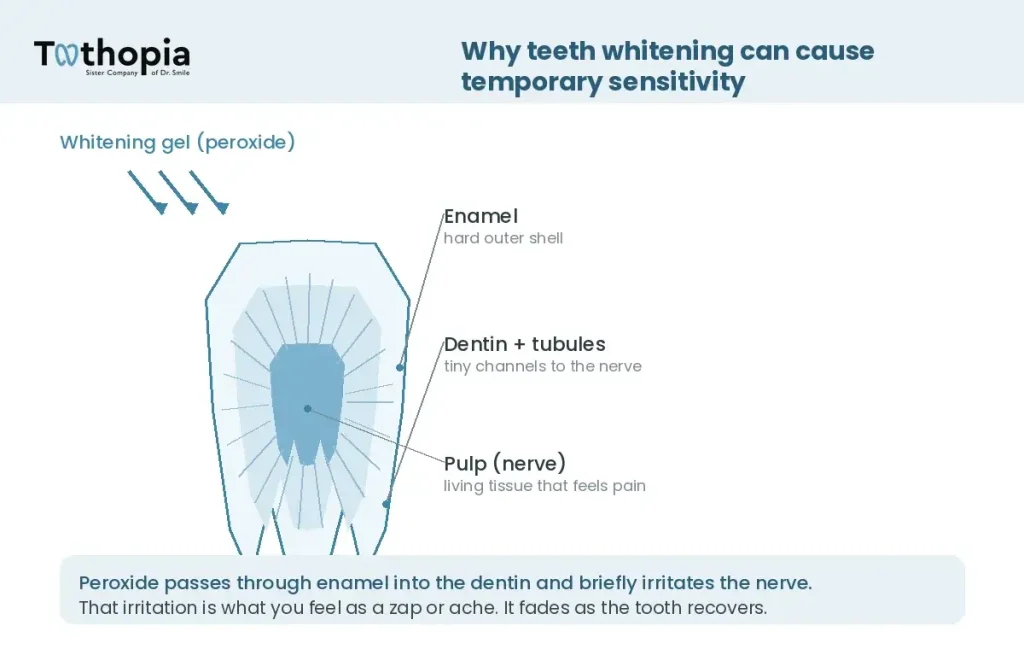
Whitening gel works because of peroxide, either hydrogen peroxide or carbamide peroxide. To lift stains, that peroxide passes through the outer enamel and into the dentin, the softer layer underneath. The dentin is threaded with microscopic channels that lead straight to the pulp, the living center of the tooth where the nerve lives.
When peroxide reaches that nerve, it causes a brief, low-grade inflammation. Your nerve responds by overreacting to cold, heat, air, and sweetness for a day or two. That is the whole story behind teeth whitening sensitivity: an irritated nerve, not a wounded tooth.
Does teeth whitening damage your teeth or enamel?
No. Professional whitening does not permanently damage healthy enamel or wear it down when it is used as directed. Clinical evidence backs this up: supervised whitening changes the color of your teeth without changing the hardness or structure of the enamel.
The sensitivity you feel is a passing reaction, not proof of harm. If you want the deeper version of whether whitening can weaken tooth enamel, we cover the science of it separately, including where the real risks come from.
You might be thinking: if peroxide reaches the nerve, surely it must be hurting the tooth. It is a fair worry. The difference is that irritation and damage are two separate things. A tooth can be briefly irritated and completely undamaged at the same time, the way your eyes can sting from chlorine and be perfectly fine an hour later. Where whitening does need care is the gums. If gel sits on gum tissue, it can leave a temporary white patch or tenderness, which also settles within a few days.
How long does teeth whitening sensitivity last?
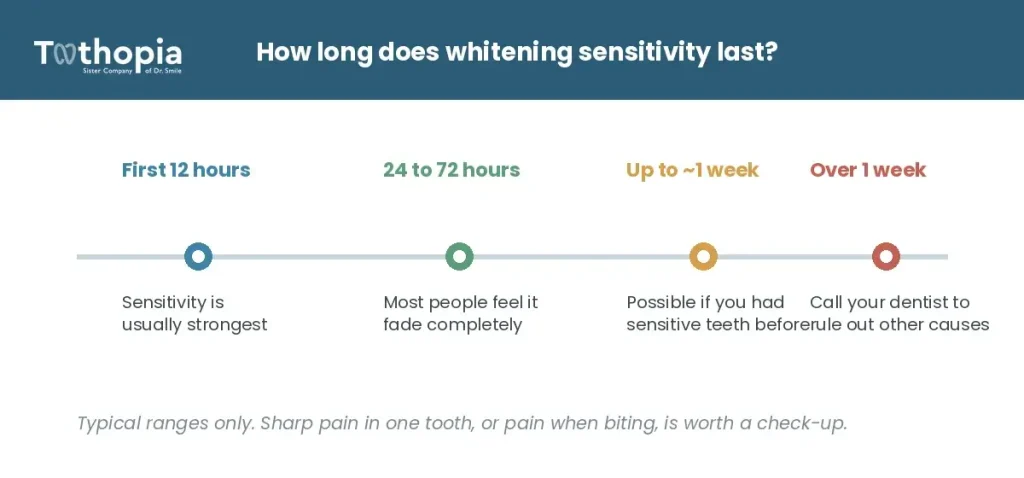
For most people, whitening sensitivity lasts 24 to 72 hours and then disappears on its own. After in-office whitening, the reaction is often strongest in the first 12 hours and eases steadily after that.
If you already had sensitive teeth, thin enamel, or exposed roots before whitening, the sensitivity can linger for a week, usually fading in intensity the whole time. That is still normal. What is not typical is pain that is severe, focused on one specific tooth, or triggered by biting down.
Sensitivity that lasts more than a week, a sharp ache in a single tooth, or pain when you bite can point to a cavity, a crack, or gum recession rather than the whitening. Get it checked so the real cause is treated.
Does professional whitening hurt more than at-home kits?
Not usually. Professional whitening uses stronger gel, but it tends to cause less trouble because a dentist controls the concentration, protects your gums, and has desensitizers ready. Store kits are weaker per use, yet they cause plenty of sensitivity because they are easy to overuse and the gel often touches the gums.
| Method | Peroxide Strength | How Comfort Is Managed |
|---|---|---|
| In-office, dentist applied | Strongest, but timed and monitored | Gums shielded with a barrier; desensitizer on hand |
| Custom take-home trays | Moderate, dentist prescribed | Trays fit your teeth, so less gel hits the gums |
| Store strips and kits | Lower, one-size for everyone | No gum protection; easy to overuse |
So stronger gel does not mean more pain. Control is what matters. If your teeth run sensitive to begin with, ask about whitening built around sensitive teeth, which uses gentler formulas and a slower pace.
Signs of tooth sensitivity after whitening
Knowing what normal sensitivity feels like keeps you from panicking over something harmless. The usual signs are:
- Quick, sharp zaps when cold air, cold water, or something sweet hits the teeth.
- A dull ache in one or more teeth that comes and goes for a day or two.
- Mild tenderness along the gum line if any gel touched your gums.
All three are temporary. Reach out to your dentist if the ache turns into steady, throbbing pain, settles into one tooth, or refuses to ease after several days.
How to reduce teeth whitening sensitivity
You can prevent most whitening pain before it starts, and calm the rest quickly. The single most effective move is a desensitizing toothpaste with potassium nitrate, used for about two weeks before you whiten. From there, a few small habits do the heavy lifting.
Before you whiten
- Use a desensitizing toothpaste for roughly two weeks so the nerve is calmer going in.
- Have a quick check-up first, so an untreated cavity is not mistaken for whitening pain.
- Brush and floss gently beforehand, not straight after the gel.
During and after
- Choose a lower-peroxide gel and shorter sessions rather than long, high-strength ones.
- Skip very hot, very cold, and acidic food and drinks for a day or two.
- Sip coffee, tea, or soda through a straw to keep it off your teeth.
- Space treatments out instead of whitening several days in a row.
- Keep using a fluoride, sensitive-formula toothpaste; an ibuprofen can settle a flare-up if your dentist agrees.
If a tooth is already zinging, our guidance on how to calm a sensitive tooth quickly walks through fast relief you can use at home.
Starting the desensitizing toothpaste two weeks early, not the night before, is what separates people who barely notice sensitivity from those who dread it. Give it time to work.
Gentler alternatives if your teeth are very sensitive
If bleaching is not for you, a few milder options can brighten a smile with less risk of sensitivity. They work slowly and suit mild staining rather than dramatic change.
- Whitening toothpaste with gentle ingredients. Formulas built around baking soda, aloe vera, or hydroxyapatite lift surface stains without harsh bleaching.
- Baking soda, used sparingly. A mildly abrasive paste can buff away surface stains. Use it occasionally, since overuse wears on enamel.
- Oil pulling. Swishing coconut oil for several minutes may reduce plaque and freshen the mouth over time, with brightening as a slow side effect.
- Fruit-forward habits, with caution. Crunchy fruits and vegetables help keep teeth clean, but acidic peels and vinegar can erode enamel, so go easy.
These help at the margins. For a real color change, professional whitening is still the safest, most predictable route, and the easiest to keep comfortable.
Is teeth whitening right for you?
The best way to whiten without pain is to start with a short consultation. Our dentists check your enamel, gums, and any existing dental work, then match you with the gentlest approach that will actually get results. That check is also how we rule out cavities or cracks that could turn a routine whitening into a sore one. If you want a supervised, comfortable option, professional teeth whitening gives you the strongest, best-controlled result.
Need help getting started? Our California-based offices in Culver City and Inglewood are ready to assist. Reach out by filling out the consultation form or calling 310-643-6221.
Final Thoughts on Teeth Whitening Pain and Sensitivity
Teeth whitening is not the painful ordeal many people brace for. The treatment is comfortable, and the short burst of sensitivity that can follow is temporary, harmless, and largely preventable. Understanding why it happens takes most of the fear out of it: an irritated nerve settles, and a healthy tooth stays healthy.
Whiten with a plan rather than a gamble. Prep your teeth with a desensitizing toothpaste, keep the gel controlled, and lean on a dentist when your teeth already run sensitive. Do that, and a brighter smile costs you very little discomfort.
Frequently Asked Questions About Teeth Whitening Pain and Sensitivity
Is tooth sensitivity normal after whitening treatments?
Yes, mild sensitivity is common and usually resolves within a few days.
How can I reduce discomfort during or after whitening?
Use sensitive toothpaste, avoid extreme temperatures, and space out treatments.
Does teeth whitening hurt your gums?
It can, if whitening gel touches the gum tissue. That usually shows up as a temporary white patch or tenderness that clears within a few days. Dentist-applied whitening protects the gums to avoid it.
Can teeth whitening permanently damage your teeth?
No. Used correctly, professional whitening does not permanently harm healthy enamel. The sensitivity is a passing reaction, and the enamel keeps its strength and structure.
Which teeth whitening method hurts the least?
Dentist-supervised whitening tends to be the most comfortable, because the strength is controlled, the gums are protected, and desensitizers are available. Custom take-home trays are the gentlest at-home option.



0 Comments