
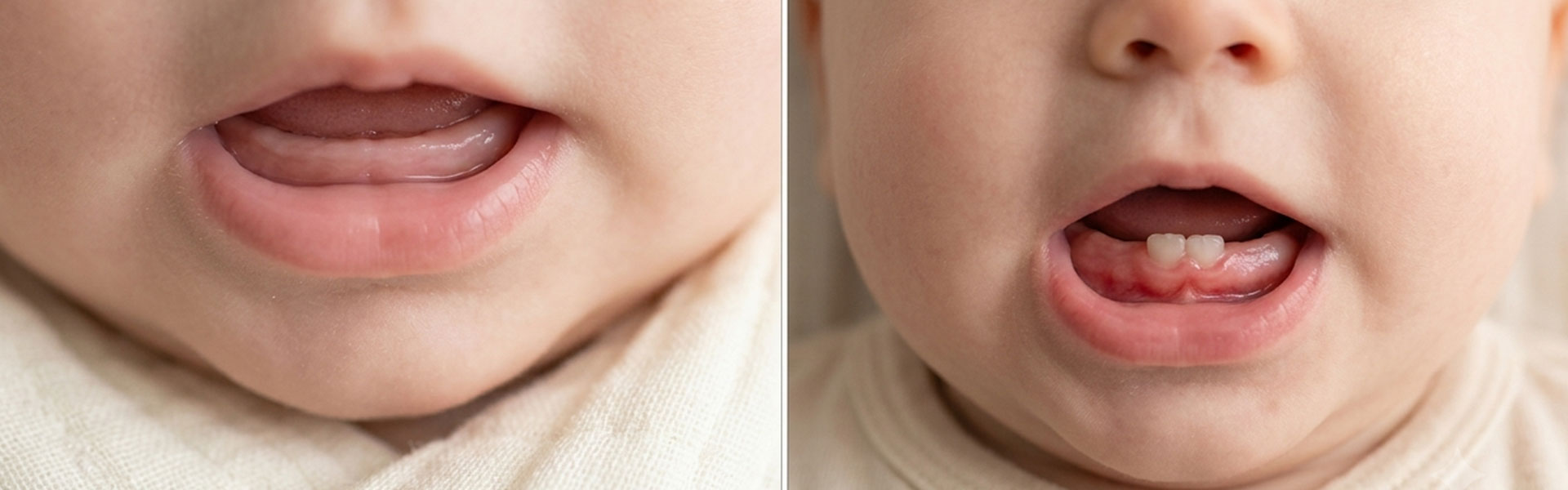
The fastest way to tell normal baby gums vs teething gums apart is by color and texture. Normal baby gums are smooth, soft, and an even pale pink. Teething gums look swollen and red, feel tender, and usually show a small white bump where a tooth is about to break through. Most babies start teething around 6 months, though anywhere from 3 to 12 months is normal. Below you will find what healthy gums actually look like, the real early signs of teething, and the few changes that are not teething at all and deserve a call to your dentist or paediatrician.
Key Takeaways
- Normal baby gums are smooth, firm, and evenly pale pink, with no swelling or warmth.
- Teething gums look red and puffy, feel tender, and often show a white bump or ridge where a tooth is erupting.
- Most babies start teething around 6 months, with a normal range of about 3 to 12 months.
- The two bottom front teeth, the lower central incisors, usually come in first.
- Common teething signs include drooling, chewing on everything, fussiness, and sore gums, often starting 3 to 5 days before a tooth appears.
- Teething does not cause a true fever (100.4 F / 38 C or higher), diarrhoea, or vomiting. Those point to illness, not teeth.
- A bluish bump (an eruption cyst) is usually harmless, but pus, heavy bleeding, or gums that stay angry-red for days should be checked.
What Do Normal Baby Gums Look Like?
Normal baby gums are smooth, soft, and an even pale pink, with a gently rounded ridge along the top and bottom where teeth will later appear. They are not warm, not puffy, and not sore to a light touch.
In the first months, before any tooth shows, these gum pads stay calm and uniform. This is your baseline. Many parents inspect their baby's gums before teething and worry that the firm ridges feel hard or that they can see faint, pale spots underneath. Those ridges are exactly where the tooth buds sit, waiting their turn, and a baby's mouth holds a full set of 20 baby teeth that will arrive over the next two to three years.
Run a clean, slightly damp finger or soft cloth along the gums once a day from the early weeks. You learn what your baby's normal feels like, and good oral care can start long before the first tooth.
You might be thinking that small white spots under the gum mean something is wrong. Most of the time, they are just tooth buds sitting close to the surface, especially in the lower front. So if smooth and pink is the baseline, what changes once a tooth starts to move?
What Do Teething Gums Look Like?
Teething gums look swollen, redder than usual, and feel tender, usually with a small white or pale bump where the tooth is pushing up. The change is the opposite of the calm, even pink you saw before.
The redness is usually concentrated over the erupting tooth rather than spread across the whole mouth, and the swelling is local, often just a single puffy spot. Sometimes you will see a bluish-purple bump instead. That is an eruption cyst, a little pocket of fluid sitting over the tooth, and it is almost always harmless and clears on its own as the tooth comes through.
Here is what most parents miss: teething inflammation is patchy and local. If every gum surface is bright red, bleeding, or covered in sores, that looks more like irritation, thrush, or infection than a tooth coming in. A typical teething flare also has a short lifespan, often 3 to 5 days, then it settles once the tooth breaks the surface.
Do not pick at or try to pop a bluish teething blister. Leave it alone and let the tooth do the work. If it grows large, looks painful, or does not resolve, have it checked.
Normal Baby Gums vs Teething Gums: Side by Side
At a glance, the difference comes down to colour, texture, and tenderness in one specific spot. This table sums up what to look for.
| Feature | Normal baby gums | Teething gums |
|---|---|---|
| Color | Even, pale pink throughout | Red or pink-red, patchy over one spot |
| Texture | Smooth, firm, gently rounded ridge | Swollen, puffy, sometimes ridged or bumpy |
| Sensitivity | Comfortable to touch | Tender; baby may flinch or pull away |
| Tooth visible? | None showing | Small white cap or ridge under the surface |
| Drooling | Typical amount | Often noticeably increased |
| Mood | Usual for your baby | Fussier, especially right before a tooth cuts |
| When you see it | Any time in the first months | Clustered around eruptions, roughly 3 to 12 months |
If you can point to one local red, puffy area with a tooth tip under it, you are almost certainly looking at teething. If the whole mouth looks inflamed or nothing has changed in texture at all, look elsewhere for the cause.
What Is Happening Under the Gums as Teeth Erupt
Erupting baby teeth form inside the jaw and slowly push up through the bone and gum tissue. As a tooth nears the surface, the gum right above it stretches, thins, and inflames, which is why that one spot looks puffy and feels sore in the days before the tooth appears.
Think of it like a seedling pushing up through soil. The ground has to give way at one point, and that point looks disturbed right before it opens. That same pressure is why babies suddenly want to chew on everything. Counter-pressure from biting helps relieve the ache under the gum.
This is also why discomfort tends to come in waves. Each new tooth brings its own short flare, and the bigger back teeth push against a wider stretch of gum, so they often feel worse than the small front ones.
Early Signs of Teething Beyond the Gums
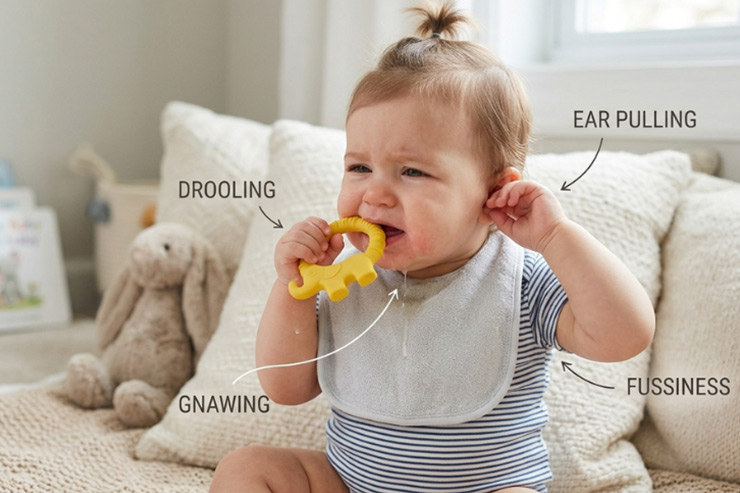
The gums tell part of the story, but infant teething signs usually show up in behaviour, too. Watch for a cluster of these, not just one:
- Heavy drooling, sometimes with a mild drool rash on the chin
- Chewing or gnawing on fingers, toys, and crib rails
- Fussiness and harder-to-settle naps and nights
- Rubbing a cheek or pulling at the ear on the side of a tooth that is coming in
- Briefly eating less or fussing at the bottle or breast
- A slightly raised temperature around 99 F, which is not a true fever
These early signs of teething often appear 3 to 5 days before the tooth breaks through, then fade once it does. One thing to keep on your radar: ear pulling can also signal an ear infection, so if it comes with a real fever or lasts, check with your paediatrician rather than chalking it up to teeth.
When Do Babies Start Teething?
Most babies start teething around 6 months. The normal range is wide, roughly 3 to 12 months, and late teething up to about 12 months is usually fine as long as growth and feeding are on track. A small number of babies are even born with a tooth already showing, called a natal tooth, which is uncommon but not dangerous.
This is why a 3-month-old normal baby's gums vs teething gums is so common. At 3 or 4 months, a baby may drool and chew, and the gum pads may look slightly puffy, even though an actual tooth is still weeks away. The clear signs, a firm white bump and a single red, swollen spot, tend to show closer to the 6-month mark.
Baby Teething Stages, Month by Month
- About 3 to 6 months: more drooling and chewing, gum pads may puff slightly, often before any tooth
- About 6 to 12 months: the first teeth arrive, bottom front first, then the top front
- About 12 to 18 months: the rest of the incisors and the first molars come in
- About 16 to 23 months: the canines (the pointed teeth) erupt
- About 23 to 33 months: the second molars, often called the two-year molars, which tend to be the most uncomfortable of all
By around age 3, your child should have a complete set of 20 baby teeth.
Which Baby Teeth Come In First?
The lower central incisors, the two bottom front teeth, almost always come in first, followed by the two top front teeth. From there, teeth generally fill in from front to back and often arrive in matching pairs. Some teeth show up slightly out of order, which usually corrects itself as the mouth grows. If no teeth at all have appeared by about 15 to 18 months, it is worth a dental check to be safe.
Teething vs Normal Baby Behaviour: How to Tell the Difference
Teething usually shows up as gum changes plus chewing and drooling, all clustered around an erupting tooth, and it eases within a few days. Plain fussiness with no gum changes or symptoms that drag on for more than a week is more likely something other than teeth.
So how do you tell if your baby is teething? Look at the gums first. A local red, swollen spot with a tooth tip under it points to teething, and it should settle once the tooth cuts through. If the gums look normal and the mood swing has no clear pattern, the cause is probably elsewhere.
It is tempting to blame teething for everything from colds to rashes to every rough night. In reality, teething causes teeth, local gum soreness, and the drooling and fussiness that come with it. When symptoms stretch well beyond that, treat them as their own issue, not a side effect of a tooth.
Teething vs Normal Baby Behavior: How to Tell the Difference
Teething usually shows up as gum changes plus chewing and drooling, all clustered around an erupting tooth, and it eases within a few days. Plain fussiness with no gum changes or symptoms that drag on for more than a week is more likely something other than teeth.
So how do you tell if your baby is teething? Look at the gums first. A local red, swollen spot with a tooth tip under it points to teething, and it should settle once the tooth cuts through. If the gums look normal and the mood swing has no clear pattern, the cause is probably elsewhere, and a family dentist can check the gums and settle it quickly.
It is tempting to blame teething for everything from colds to rashes to every rough night. In reality, teething causes teeth, local gum soreness, and the drooling and fussiness that come with it. When symptoms stretch well beyond that, treat them as their own issue, not a side effect of a tooth.
Abnormal Baby Gums: Signs That Are Not Teething
Call your paediatrician or dentist if you notice any of these, because they are not part of normal teething:
- Gums that bleed heavily or repeatedly
- White or yellow patches, ulcers, or sores on the gums or inner cheeks
- Gums that look pale or white rather than pink
- Swelling that stays for more than a week or keeps getting worse
- Gum changes alongside a fever of 100.4 F (38 C) or higher, diarrhoea, or vomiting
White patches that resist wiping away can be a sign of oral thrush, a common and treatable yeast issue, and a fever with gum pain may point to a virus rather than a tooth. None of these means something is seriously wrong, but they do mean a quick professional look is smarter than waiting. Plan that first dental visit early. The recommendation is to begin pediatric dentistry by your child's first birthday or within six months of the first tooth. Building good habits this early is the heart of a healthy smile from the start.

How to Soothe Sore Teething Gums Safely
Most teething discomfort responds well to simple, safe comfort measures. A few that work:
- Massage the sore spot with a clean finger or a cool, damp washcloth for a minute or two.
- Offer a chilled (not frozen) teething ring made of solid silicone or natural rubber.
- Let your baby chew on a clean, cold spoon or a chilled washcloth.
- For a baby already on solids, cold purees or plain yoghurt can calm the gums.
- For a rough night, ask your paediatrician about infant acetaminophen, used exactly as directed for your baby's age and weight.
Skip the products that do more harm than good: numbing gels with benzocaine (the FDA warns against them for children under 2), teething necklaces and amber beads (a choking and strangulation risk), and anything frozen solid, which can bruise the gums. Once a tooth appears, keep brushing twice a day with a soft baby brush and a rice-grain smear of fluoride toothpaste. Steady daily care is the foundation of keeping your child's teeth healthy as the rest of the set comes in.
Need help getting started? Our California-based offices in Culver City and Inglewood are ready to assist. Reach out by filling out the consultation form or calling 310-643-6221.
Final Thoughts on Baby Gums and Teething
The simplest test is still your eyes and a clean finger. Smooth, even, pale pink means healthy. Red, puffy, and tender over one spot, with a hint of white showing through, means a tooth is on the way. Teething is uncomfortable but completely normal, and each round passes within a few days.
Trust the pattern. When the change is local to one area and eases after the tooth cuts through, that is teething doing exactly what it should. When something looks off, lasts more than a week, or comes with a real fever, that is your cue to check with a professional instead of waiting it out.
Frequently Asked Questions About Baby Gums and Teething
What do teething gums look like in a 3-month-old?
At 3 months, a tooth is usually still weeks away, but the gums may look slightly puffy, and your baby may drool and chew more. True teething swelling and a visible white bump tend to show up closer to 6 months, so early puffiness at this age is often normal pre-teething rather than a tooth about to erupt.
Can teething cause a fever?
Not a true fever. Teething may raise your baby's temperature very slightly, to around 99 F, because of mild gum inflammation. A reading of 100.4 F (38 C) or higher points to an illness, not a tooth, so call your pediatrician if your baby's temperature reaches that level.
How long do teething gums stay swollen?
Usually, a few days, often 3 to 5, and then the gum settles once the tooth breaks through. Swelling can return when the next tooth comes in, and the larger molars can stay sore a little longer than the small front teeth.
Is a blue or purple bump on my baby’s gum normal?
Often, yes. A bluish or purple bump is usually an eruption cyst, a small pocket of fluid sitting over the tooth, and it typically clears on its own as the tooth comes through. Have it looked at if it is large, painful, or does not resolve.
When should I worry about my baby’s gums?
Heavy or repeated bleeding, white or yellow sores, gums that stay swollen beyond a week, or gum changes paired with a high fever, diarrhea, or vomiting are not teething. Any of these is a good reason to call your dentist or paediatrician.



0 Comments