

The first signs of wisdom teeth coming in are usually a dull ache at the very back of the jaw, tender or swollen gums behind your last molars, and a feeling of pressure as the tooth pushes upward. Most people notice these between the ages of 17 and 25, often on one side before the other. The tricky part is that the same symptoms can also signal infection, decay, or an impacted tooth. This guide walks you through the early warning signs, how to tell a normal eruption from a real problem, and exactly when that ache means it is time to call a dentist.
Key Takeaways
- Wisdom teeth, your third molars, typically erupt between ages 17 and 25, though some appear earlier or never at all.
- The earliest signs are a dull back-of-jaw ache, swollen gums behind the molars, and a tight, crowded pressure.
- Normal eruption pain comes and goes and stays mild. Constant, worsening pain points to a problem.
- Pus, a foul taste, fever, or a jaw you cannot open fully are red flags for infection or an impacted tooth.
- About 35 percent of people are missing one or more wisdom teeth, so not everyone goes through this.
- Only an exam and an X-ray can confirm position, so persistent symptoms are worth a dental visit even when they feel minor.
What Are the First Signs of Wisdom Teeth Coming In?
The first signs are mild and easy to brush off: a dull ache behind your back molars, gums that feel puffy or tender, and a low-grade pressure in the jaw. These usually show up on one side first and tend to fade in and out over days or weeks rather than hitting all at once.
That on-and-off pattern is the giveaway. Wisdom teeth do not erupt overnight. They inch upward through bone and gum, and each small movement irritates the tissue around them. Your body registers that as soreness, and then it quiets down until the tooth shifts again.
Here is the part most people miss: pain can start before the tooth is even visible. The pressure of a tooth pushing against its neighbor sets off discomfort while everything is still hidden under the gum, which is why a sore jaw with nothing to see can still be a wisdom tooth.
Below are the seven early signs to watch for, roughly in the order most people notice them, with what each one actually feels like and why it happens.
1. A dull ache at the back of the jaw
This is usually the very first thing people feel: a low, throbbing soreness right behind your last molar, often on one side before the other. It tends to come and go rather than stay constant, flaring when the tooth shifts and quieting down in between.
The ache happens because the tooth is pressing upward against the bone and the tooth in front of it. That pressure irritates the surrounding tissue even while the tooth is still hidden. At this stage, the pain should be manageable and respond to a warm salt rinse or an over-the-counter pain reliever. An ache that is sharp, constant, or steadily worsening is a different story and points to a problem rather than a normal eruption.
2. Swollen or red gums behind the molars
As the tooth pushes toward the surface, the gum over it becomes inflamed. You may see a patch of red, slightly puffy tissue behind your last molar, and it often feels tender when you brush or eat on that side.
Mild, settling swelling is part of normal eruption. The concern is swelling that spreads, bleeds easily, or refuses to calm down over several days, which can signal that bacteria have taken hold under the gum. Gently feeling the area with a clean fingertip or your tongue often reveals a firm ridge or a small flap of gum forming over the emerging tooth.
3. Pressure or tightness in the jaw
Many people describe an early wisdom tooth as a crowded, full feeling at the back of the mouth rather than outright pain. It can feel like your back teeth are being gently pushed together, sometimes before there is anything visible at all.
That sensation comes from the tooth competing for space that the jaw may not fully have. In a smaller jaw, the erupting tooth presses on its neighbors, and you feel it as tightness. If that pressure turns into a feeling that your bite has shifted or that teeth are moving, it is worth having a dentist check the angle of the tooth.
4. Trouble opening wide or chewing
You might notice it is harder to open your mouth fully, or that biting down on the back tooth sends a twinge through the area. Chewing on that side can feel awkward or sore.
This stiffness comes from inflamed gum tissue and irritated jaw muscles near the new tooth. It is common and usually mild during normal eruption. But real difficulty opening your mouth, sometimes called trismus, is a stronger warning sign. When the jaw genuinely locks up or opening becomes painful, that often points to infection or an impacted tooth and deserves prompt attention.
5. A bad taste or breath that will not clear
When a wisdom tooth only partly breaks through, it leaves a small flap of gum over the chewing surface. Food and bacteria slip underneath, and because the spot is nearly impossible to clean, you get a lingering bad taste or breath that brushing does not fix.
This is one of the more telling early signs because it points to the exact mechanism behind most wisdom tooth trouble. A partly erupted tooth that traps debris is the setup for a gum infection called pericoronitis. If the bad taste comes with a salty or foul discharge, treat that as a reason to see a dentist rather than wait.
6. A white speck breaking through the gum
At some point, you may notice a small, hard white point at the back of the gum line. That is the cusp, the very tip of the tooth, finally reaching the surface.
Seeing it can be reassuring because it confirms the soreness was a wisdom tooth all along. The tooth will continue to emerge gradually over weeks or months. Keep the area clean as it comes through, since the gap between a partly erupted tooth and the gum is exactly where food and bacteria like to collect.
7. Mild headache or ear pressure
Less obvious, but common, is a dull headache or a feeling of fullness near the ear on the same side as the erupting tooth. Some people mistake it for a tension headache or a minor earache.
This is referred pain. The nerves around an erupting or impacted wisdom tooth share pathways with areas of the head and ear, so pressure on the tooth can register elsewhere. If you have unexplained, recurring headaches or ear pressure with no other cause, your wisdom teeth are worth ruling in or out, especially if back-of-jaw soreness is present too.
Run your tongue along the gum behind your last molar. A firm bump, a small flap of gum, or a hard white speck breaking the surface often means a wisdom tooth is on its way up. Track which signs you have and how long they last; that pattern is the most useful thing you can bring to a dental visit.
One thing worth ruling out early: not all back-of-mouth pain is dental at all. Jaw-joint strain can mimic these symptoms, so if the ache centers in the joint near your ear rather than the gum line, it is worth reading up on why your jaw hurts before assuming it is your wisdom teeth.
So you know what the early signs feel like. The next question is the one that actually keeps people up at night: is this normal, or is something going wrong?
How Do I Know If My Wisdom Teeth Are Coming In Correctly?
Wisdom teeth are coming in correctly when the discomfort is mild, comes and goes, and eases within a few days, with no fever, pus, or spreading swelling. Healthy eruption is annoying, not alarming.
Think of it like a bruise that flares when you press it and calms down when you leave it alone. A tooth erupting on schedule, with enough room and at a normal angle, follows that same rhythm. The trouble starts when the pain stops following any rhythm at all and simply gets worse.
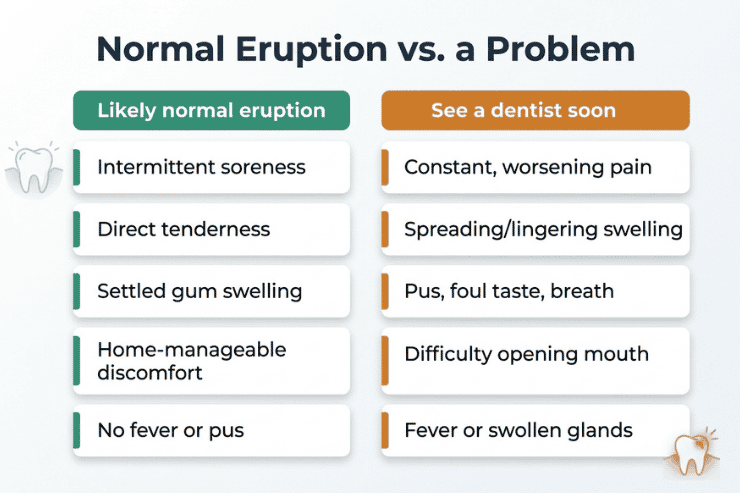
The clearest dividing line is duration and direction. Normal eruption discomfort trends down over time. Problem pain trends up, or refuses to leave. The table below sorts the same symptoms into reassuring versus worth a visit.
| Signal | Likely normal eruption | Worth a dental visit |
|---|---|---|
| Pain pattern | Mild, comes and goes | Constant or getting worse |
| Swelling | Slight, settles in days | Spreads or will not go down |
| Taste and breath | Normal | Foul taste or pus |
| Jaw movement | Slightly stiff | Cannot open the mouth fully |
| Whole-body signs | None | Fever or swollen glands |
You might be thinking: Can I just wait it out? Often, yes. But if a partly erupted tooth is trapping food and bacteria, waiting lets a small irritation grow into a gum infection called pericoronitis. According to dental clinicians, the flap of gum over a half-erupted wisdom tooth is one of the most common reasons young adults end up in an urgent visit for tooth pain.
Knowing the difference is half the battle. The other half is understanding what your tooth is actually doing under the gum, because that is what decides whether it erupts cleanly or gets stuck.
Impacted Wisdom Teeth Symptoms: When the Tooth Gets Stuck
An impacted wisdom tooth cannot fully erupt because it is blocked by bone, gum, or a neighboring tooth. The symptoms are stronger and more stubborn than normal eruption: persistent pain, swelling that lingers, and sometimes a tooth that you can feel angled sideways.
Impaction happens for a simple reason. The modern jaw is often too small for a full set of third molars, so the tooth runs out of room and gets wedged. It may push forward into the molar in front of it, tilt backward, or stay buried under the gum entirely.
Watch for these impacted wisdom teeth symptoms:
- Pain in the back of the mouth that returns again and again in the same spot
- Swollen, red, or bleeding gums around the back molars that do not settle
- Stiffness or difficulty opening the jaw fully
- A bad taste, persistent bad breath, or food that constantly gets trapped in one spot
- Referred jaw pain, headaches, or pressure near the ear

Press gently on the gum behind your last molar. If a partially erupted tooth leaks fluid or feels swollen and squishy, that is a sign that bacteria are pooling under the gum flap, and a dentist should take a look.
Here is the contrarian point worth making: an impacted tooth is not automatically an emergency, and it does not always need to come out. Plenty of impacted wisdom teeth sit quietly for years and only need monitoring. Removal becomes the answer when the tooth causes pain, infection, decay, or threatens the teeth around it.
A wisdom tooth that hurts for three days is usually erupting. A wisdom tooth that hurts for three weeks is usually impacted.
Impaction explains a lot of the worst symptoms. But there is one complication that turns ordinary eruption pain into something you should not ignore, and it deserves its own section.
Is it an eruption or an infection? Spotting the Difference
Eruption is the tooth moving through the gum. Infection is bacteria taking hold around it. The fastest way to tell them apart is to look for pus, fever, and a bad taste, because the eruption alone does not cause any of those.
When a wisdom tooth only partly breaks through, it leaves a small flap of gum over the chewing surface. Food and bacteria slip underneath; the area is nearly impossible to clean, and the gum becomes inflamed. That condition, pericoronitis, is the single most common infection tied to erupting wisdom teeth.
Signs that point to infection rather than simple eruption include:
- Pus or a salty, foul-tasting discharge near the back molar
- A fever or generally feeling unwell
- Swelling that spreads toward the cheek or under the jaw
- Swollen, tender glands in the neck
- Trouble swallowing or opening your mouth wide
A real-world example: a college student we hear about often feels a sore spot behind the last molar, ignores it through finals, and shows up two weeks later with a swollen cheek and a fever. The tooth was erupting normally, but the gum flap got infected because the area could not be cleaned. Catching that flap early, sometimes with nothing more than careful rinsing and a cleaning, prevents the whole cascade. If you do end up needing the tooth out, knowing what not to do after oral surgery makes recovery far smoother.
Once you can tell eruption from infection, the practical question becomes what to actually do about the pain while you sort it out.
First Signs of Wisdom Teeth Coming In: Pain Relief That Works
You can ease early wisdom tooth pain at home with salt-water rinses, a cold compress, over-the-counter anti-inflammatories, and careful cleaning around the area. These calm the gum while the tooth does its thing, but they manage symptoms rather than fix the underlying cause.
Work through these steps in order, from gentlest to most active:
- Rinse with warm salt water. Dissolve half a teaspoon of salt in a cup of warm water and swish for 30 seconds, two to three times a day, to reduce bacteria and soothe inflamed gums.
- Apply a cold compress. Hold a wrapped ice pack against your cheek for 15 minutes at a time to numb the area and bring down swelling.
- Use an anti-inflammatory. An over-the-counter option like ibuprofen targets both pain and swelling; follow the label and check with a pharmacist if you take other medications.
- Clean the area gently. Brush carefully around the back molar and rinse after meals so food does not pack under the gum flap.
- Try a numbing gel. A dental gel with benzocaine can dull a sharp spot short-term, though it wears off quickly.
- Stick to softer foods. Give the irritated side a break with soups, yogurt, and other soft foods until the flare settles.
Skip the old trick of placing an aspirin directly on the gum. It does not work that way and can burn the tissue. Swallow pain relievers as directed instead.
If you have been leaning on these remedies for more than a week with no improvement, that is your signal the tooth needs professional eyes. Lasting pain almost always means there is something a rinse cannot reach. Anxiety about that visit is normal too, and there are real ways to make it easier, which we cover in resources on
managing dental anxiety so the appointment itself is not the thing holding you back.
Home relief buys you comfort. What it cannot tell you is exactly where your tooth is headed, and that brings us to the bigger timeline.
Wisdom Teeth Age Range: When to Expect Them
Most wisdom teeth erupt between the ages of 17 and 25, which is why they earned the nickname “teeth of wisdom.” Some people see early signs around 15, others not until their late twenties, and a sizable share never develop them at all.
The timing is driven mostly by genetics and jaw development, not by anything you do. The teeth form gradually in the bone, then erupt over months to a few years rather than in one quick push. Each of the four can also arrive on its own schedule, so it is common to feel one side long before the other.
| Age range | What is usually happening |
|---|---|
| 15 to 16 | Early development; symptoms possible but less common |
| 17 to 21 | Most typical eruption window |
| 22 to 25 | Later eruption; common for delayed or partial teeth |
| 26 and up | Less common, but late eruption still happens |
A point most people find surprising: studies suggest roughly 35 percent of people are born without one or more wisdom teeth. So if you sail through your early twenties with no back-of-jaw ache, you may simply be in that group, and that is completely normal, not a sign that something is missing.
Even if you have zero symptoms, ask your dentist to check your wisdom teeth on a routine X-ray in your late teens. Seeing the angle early makes it far easier to plan than reacting to a painful flare later.
Knowing the window helps you anticipate what is coming. The final piece is recognizing the moment when watchful waiting should turn into a phone call.
When to See a Dentist About Wisdom Teeth
See a dentist when wisdom tooth pain is constant or worsening, when swelling spreads or lingers, or when you notice pus, fever, or a jaw you cannot fully open. In cases where removal is needed, wisdom teeth removal may be recommended to safely resolve impacted or infected teeth.
Even without dramatic symptoms, an evaluation is worthwhile. A dentist can see what you cannot: the angle of the tooth, whether there is room for it, and whether it is starting to damage the molar in front of it. That is the difference between a simple plan and an avoidable complication.
Book a visit if you notice any of the following:
- Pain that lasts more than a week or keeps coming back to the same spot
- Swelling, redness, or bleeding around the back gums that will not settle
- Pus, a persistent foul taste, or ongoing bad breath
- Difficulty opening your mouth, chewing, or swallowing
- A tooth that you can feel coming in crooked or pushing against its neighbor
At the visit, expect a quick exam, a dental X-ray to map the tooth, and a clear conversation about whether to monitor it or plan removal. Not every wisdom tooth comes out. The goal is to catch problems early, while they are still small and easy to handle.
Need help getting started? Our California-based offices in Culver City and Inglewood are ready to assist. Reach out by filling out the consultation form or calling 310-643-6221.
Final Thoughts on First Signs of Wisdom Teeth
The first signs of wisdom teeth coming in are rarely dramatic, and that is exactly why they are easy to misread. A dull ache and puffy gums that come and go usually mean a tooth is erupting normally. Pain that climbs, swelling that spreads, or any sign of pus or fever means the situation has shifted from normal to needing attention.
The smartest move is also the simplest: pay attention to the pattern. Discomfort that fades is doing what it should. Discomfort that lingers or worsens is asking for a professional look, and catching it early almost always means an easier fix. When in doubt, an exam and an X-ray turn guesswork into a clear answer.
Frequently Asked Questions About Wisdom Teeth Coming In
Can wisdom teeth hurt before they break through the gum?
Yes. Pain can start before the tooth is visible because it presses against the bone and neighboring teeth as it moves upward. That pressure alone is enough to cause soreness, which is why a sore jaw with nothing to see can still be an erupting wisdom tooth.
How long does wisdom tooth eruption pain last?
Normal eruption discomfort often lasts a few days at a time and flares on and off as the tooth shifts, sometimes over several months. The pain itself should stay mild and fade between flares. Pain that is constant or lasts beyond a week or two suggests a problem like impaction or infection.
Do all wisdom teeth need to be removed?
No. Wisdom teeth that erupt straight, have enough room, and stay healthy can be left in place and simply monitored. Removal is recommended when a tooth is impacted, causing pain or repeated infections, crowding other teeth, or is hard to keep clean. A dentist confirms the right call with an exam and X-ray.



0 Comments