

The difference between a dentist and an oral surgeon comes down to training and the kind of care each one provides. A general dentist manages routine and preventive treatment such as cleanings, fillings, and crowns, while an oral surgeon handles complex surgery of the mouth, jaw, and face after years of extra training. If you are weighing an oral surgeon vs. a dentist for your own situation, this guide breaks down who treats what, how their qualifications differ, and the clear signs that point to one over the other. The answer is usually simpler than patients expect, and in many cases, you will end up working with both.
Key Takeaways
- A general dentist handles routine and preventive care, while an oral surgeon performs complex surgery of the mouth, jaw, and face.
- Both earn a DDS or DMD degree, but oral surgeons complete an extra 4 to 6 years of hospital-based surgical residency.
- Your general dentist is almost always the right first stop and will refer you to an oral surgeon when a case needs surgical expertise.
- A dentist can handle simple extractions, while impacted, broken, or surgical extractions usually go to an oral surgeon.
- Oral surgeons are trained in IV and general anesthesia, which matters for anxious patients and longer procedures.
- For most people, the two are a team rather than an either-or choice, which is why one clinic can coordinate both.
What Is the Difference Between a Dentist and an Oral Surgeon?
A dentist is a general oral health provider who treats everyday problems like cavities, gum disease, and worn teeth. An oral surgeon is a dental specialist who completes additional surgical training to operate on the teeth, jaws, and surrounding facial structures. Put simply, your dentist keeps your mouth healthy day to day, and an oral surgeon steps in when a problem needs surgery.
Both start from the same foundation, which is part of what makes the difference between dentist and oral surgeon roles confusing. They share the same dental degree and the same early training. The split happens after dental school, when an oral surgeon spends years in a surgical residency that a general dentist does not pursue. The table below shows the contrast at a glance.
| Factor | General Dentist | Oral Surgeon |
|---|---|---|
| Primary focus | Prevention and routine, restorative care | Complex surgery of the mouth, jaw, and face |
| Training after college | 4 years of dental school (DDS or DMD) | Dental school plus 4 to 6 years of surgical residency |
| Common procedures | Cleanings, fillings, crowns, simple extractions | Impacted teeth, implants, jaw surgery, biopsies |
| Anesthesia | Local anesthesia and mild sedation | Local, IV sedation, and general anesthesia |
| Tooth extractions | Simple, fully erupted teeth | Impacted, broken, or surgical extractions |
| When you see them | Regular visits and the first point of contact | By referral, or for urgent surgical needs |
Pro tip: If you are not sure which column your problem falls into, book with a general dentist first. They can treat the issue or refer you to the right specialist, which saves you from guessing and booking the wrong appointment.
What Does a Dentist Do?
Dentists are the primary oral healthcare providers who protect the overall health of your teeth and gums. They are your first point of contact for routine care and for most non-surgical problems. A general dentist also acts as the gatekeeper who decides when a case should move to a specialist.
General Dentistry Services
Most of what happens in a dental office falls under general dentistry. These are the visits that keep small problems from turning into surgical ones.
- Routine checkups and cleanings: regular exams plus professional cleaning to remove plaque and tartar.
- Cavity fillings: treating decay with composite resin or other materials.
- Teeth whitening: cosmetic treatment to brighten your smile.
- Crowns and bridges: restoring damaged or missing teeth.
- Root canals: clearing infection inside the tooth pulp to save the tooth.
- Early gum care: treating gum disease before it threatens the bone.
Dentists also perform many tooth extractions themselves. For a deeper look at when teeth come out and what to expect, Toothopia's overview of tooth extractions walks through the routine cases a general dentist handles in the chair.

Dentist Training and the DDS vs DMD Question
A dentist completes a bachelor's degree, then four years of dental school, and then passes national and state board exams to get licensed. Dental school awards one of two degrees, and patients often ask which is better.
Here is the part most people miss: DDS and DMD are the same degree. A Doctor of Dental Surgery (DDS) and a Doctor of Dental Medicine (DMD) follow the same curriculum and meet the same standards. The only difference is what the individual school chose to call it. So when you compare DDS vs DMD vs oral surgeon, the DDS and DMD are general dentists, and the oral surgeon is the one who added surgical residency on top.
What Does an Oral Surgeon Do?
Oral surgeons, formally called oral and maxillofacial surgeons, handle surgical problems of the mouth, jaw, and face that go beyond general dentistry. They operate, manage advanced anesthesia, and treat conditions that need precision around nerves, bone, and facial anatomy.
Specialized Surgical Procedures
These procedures share one trait: they involve cutting, bone, or anesthesia depth that routine dental care does not require.
- Wisdom tooth removal: extracting impacted or problematic third molars.
- Dental implant placement: surgically anchoring artificial tooth roots in the jawbone.
- Corrective jaw surgery: realigning the jaws or repairing facial trauma.
- Oral pathology: diagnosing and removing cysts, lesions, and oral cancers.
- TMJ surgery: treating severe temporomandibular joint disorders that do not respond to conservative care.
- Reconstruction: rebuilding bone and soft tissue, including cleft repair.
Impacted wisdom teeth are the most common reason a patient meets an oral surgeon for the first time. If a third molar is trapped under the gum or bone, wisdom teeth removal is a surgical procedure rather than a simple pull, which is why it lands on this list and not the dentists.
Oral Surgeon Training, Residency, and Board Certification
An oral surgeon walks the same path as a dentist at first, then keeps going. After dental school and a DDS or DMD, they enter a hospital-based residency that lasts four to six years and focuses on surgery, anesthesia, and pain management.
Many oral surgeons also pursue board certification through the American Board of Oral and Maxillofacial Surgery. Certification is optional, but it signals that the surgeon has met an advanced standard for complex surgical care.
That extra training is also why anesthesia differs so much between the two. A general dentist typically offers local anesthesia and mild sedation, while an oral surgeon is trained to deliver IV and general anesthesia safely. For nervous patients, sedation dentistry options are often decided based on which provider feels right for a given procedure.
Are Oral Surgeons Dentists or Doctors?
Oral surgeons are both. Every oral surgeon starts as a dentist, earns a DDS or DMD, and then specializes through surgical residency, so they remain licensed dental professionals while practicing as surgeons. In some programs, oral surgeons also earn a medical (MD) degree alongside their surgical training.
This is why the labels feel slippery. An oral surgeon is a dentist by foundation, a doctor by degree, and a surgeon by specialty. None of those facts cancel each other out. The practical takeaway is that an oral surgeon can do everything a general dentist is licensed to do, plus the surgical work a general dentist refers out.
You might be thinking that this means you should skip the dentist and go straight to a surgeon. For routine care, that is rarely worth it. A general dentist's time and tools are built for prevention and everyday treatment, and they will flag surgical needs early.
Is Oral Surgery Medical or Dental?
Oral surgery sits at the intersection of dentistry and medicine. Most procedures are considered dental care because they treat the teeth and supporting structures, but some, such as facial trauma repair, jaw reconstruction, and the management of oral pathology, can be classified as medical.
The classification usually depends on the reason for treatment rather than the procedure name. A wisdom tooth extraction for crowding is typically dental, while jaw surgery after an accident may be handled as medical. Your provider's office can tell you how a specific case is categorized before treatment begins.
What most people miss: The same procedure can be classified differently depending on why it is needed. That is why it helps to ask the office how your case will be coded before you schedule, rather than assuming it falls into one bucket.
Need help getting started? Our California-based offices in Culver City and Inglewood are ready to assist. Reach out by filling out the consultation form or calling 310-643-6221.
Dentist vs Oral Surgeon vs Orthodontist
These three roles are easy to mix up because all three are dental professionals, yet each solves a different problem. A dentist manages overall oral health, an orthodontist straightens teeth and corrects bite alignment, and an oral surgeon operates on the teeth, jaw, and face.
Think of it by goal. If your concern is crowded or crooked teeth, an orthodontist and treatments like orthodontics and braces are the right fit. If your concern is decay or a routine repair, that is a dentist. If your concern needs surgery, bone work, or deep sedation, that is an oral surgeon.
The three overlap in real cases. A patient correcting a severe bite might see an orthodontist for alignment and an oral surgeon for jaw surgery, with the general dentist coordinating the plan. Comparing an orthodontist vs. an oral surgeon is less about who is better and more about which problem you actually have.
Dentist vs Oral Surgeon for Tooth Extraction
Whether you see a dentist or an oral surgeon for a tooth extraction depends on how complex the tooth is. A general dentist can remove a fully erupted, visible tooth with simple techniques, while an oral surgeon handles teeth that are impacted, broken below the gumline, or surrounded by dense bone.
The deciding factors are visibility, root shape, and risk. A loose or straightforward tooth is a quick in-office procedure for a dentist. A tooth wrapped around a nerve, fused to bone, or buried under tissue calls for surgical tools and deeper anesthesia, which points to an oral surgeon vs. a dentist for extractions in favor of the surgeon.
Wisdom teeth are the classic split. People often search whether wisdom teeth go to a dentist or an oral surgeon, and the honest answer is: it depends on the tooth. A wisdom tooth that has erupted normally may come out at a general dental visit, while an impacted one almost always needs an oral surgeon.
Pro tip: Ask for a panoramic or 3D scan before any tricky extraction. Seeing the root angle and nerve position ahead of time is the single best way to know whether your case is simple enough for a dentist or better suited to a surgeon.
When Should You See a Dentist or an Oral Surgeon?
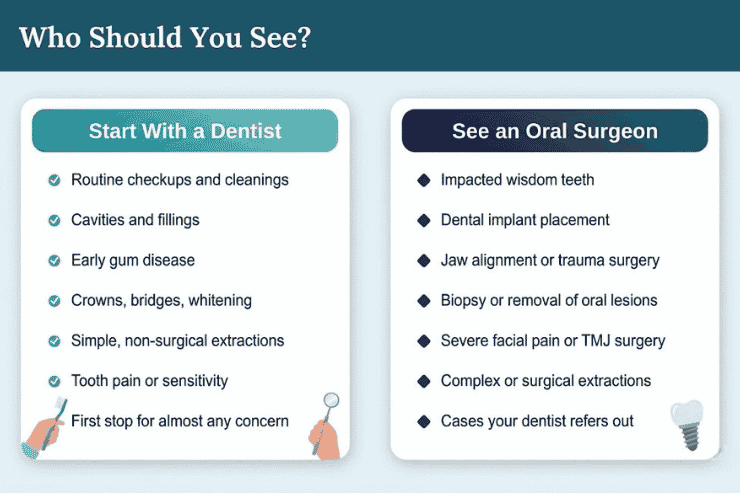
Start with your general dentist for almost everything, and move to an oral surgeon when a case needs surgery, bone work, or deeper anesthesia. Knowing where the line sits saves you time, money, and an unnecessary referral. So if you are asking, should I see a dentist or an oral surgeon, the scenarios below make the choice clear.
Common Scenarios for a Dentist
See a general dentist when the problem is routine, preventive, or non-surgical:
- Regular checkups and cleanings
- Cavities that need fillings
- Early-stage gum disease
- Simple, non-surgical tooth extractions
- Crowns, bridges, or dentures
- Whitening and other cosmetic treatments
Cases That Require an Oral Surgeon
See an oral surgeon when the case is surgical or complex:
- Impacted wisdom teeth
- Dental implant placement
- Jaw alignment surgery or repair after injury
- Biopsy or removal of oral lesions
- Severe facial pain or surgical TMJ treatment
- Complex or surgical extractions
Patients and referring dentists alike often wonder who to send a complex dental case to, and the answer is the oral surgeon. In many cases, your dentist will make that referral for you. For example, persistent jaw pain that does not settle with conservative care may point toward Toothopia's TMJ evaluation, where advanced imaging helps uncover the real source of the discomfort.
If your symptoms sit in the sinuses, throat, or ears rather than the teeth and jaw, the comparison shifts to oral surgeon vs ENT, since those areas fall outside dental care.
Final Thoughts on Choosing Between an Oral Surgeon vs Dentist
Choosing between a dentist and an oral surgeon is rarely an either-or decision. A general dentist protects your everyday oral health and is the right starting point for nearly every concern, while an oral surgeon brings the surgical training that complex cases demand. The two roles are built to work together, not to compete.
When you understand that, the choice becomes simple. Begin with a dentist you trust, lean on their judgment about when a specialist is needed, and look for a practice that can keep both kinds of care connected. That continuity is what protects both your comfort and the long-term health of your smile.
Frequently Asked Questions About Oral Surgeon vs Dentist
Can a dentist perform surgery?
Yes, within limits. A general dentist can perform minor surgical procedures such as simple tooth extractions, but complex or impacted cases are usually referred to an oral surgeon who has the training and anesthesia tools for them.
Are oral surgeons dentists or doctors?
They are both. An oral surgeon first qualifies as a dentist with a DDS or DMD, then completes a surgical residency to specialize, so they hold a doctoral dental degree and practice as a surgical specialist.
Do oral surgeons do fillings and crowns?
Oral surgeons are licensed to do general dental work, but they rarely do fillings or crowns in practice. Those routine restorations are handled by general dentists, while oral surgeons focus on surgical procedures.
How do I know if I need an oral surgeon?
If your dentist identifies a condition requiring specialized care, they will refer you to an oral surgeon



0 Comments