

You cannot get rid of a tooth abscess without going to the dentist, and no home remedy will cure one. An abscess is a sealed pocket of pus fed by an infected nerve or a deep gum pocket, so the infection keeps producing pus until a dentist removes the source. What you can do at home is control pain and swelling safely while you arrange care. Below you will find the home remedies that genuinely help, the five mistakes that make an abscess worse, what antibiotics really do, and the warning signs that mean you should skip the dental chair and head straight to an emergency room.
Key Takeaways
- A tooth abscess is a bacterial infection sealed inside bone or gum tissue, and it will not resolve without dental treatment.
- Salt water rinses, cold compresses, and over-the-counter pain relievers ease symptoms for a few hours at a time. They do not clear the infection.
- Never cut, squeeze, or pop an abscess. Pressure pushes bacteria into the deeper spaces of the jaw and neck.
- The American Dental Association advises against using antibiotics as a stand-alone treatment for most abscesses in healthy adults and recommends dental treatment instead.
- Pain that suddenly disappears usually means the nerve has died, not that the infection has cleared.
- Trouble breathing or swallowing, swelling that crosses the jawline, or a fever above 101 F means emergency care the same day.
- Definitive treatment is drainage, root canal therapy, or extraction, and it usually takes one or two visits.
Can You Actually Get Rid of a Tooth Abscess at Home?
No. Home treatment can lower pain and swelling for a few hours at a time, but it cannot remove the infection. A tooth abscess is a walled-off pocket of pus caused by bacteria at the root of a tooth or in the gum beside it, and that pocket keeps refilling as long as the source remains.
The source is almost always one of four things: a dead or dying nerve inside the tooth, decay deep enough to reach the pulp, a fracture that lets bacteria in, or a deep periodontal pocket. None of those are reachable from the outside of your mouth. Rinses reach the surface of your gums. The infection sits below them, inside bone or sealed under tissue.
Think of it like a flooded room with a broken pipe behind the wall. You can bail water all day, and the floor will look better for a while. Until somebody opens the wall and fixes the pipe, the water keeps coming back.
That is the honest answer to how to get rid of a dental abscess: the pus has to come out, and the source has to be treated. Everything else buys time. The useful question is not whether home care cures an abscess, but how to use it well while you get an appointment. If the pain is currently unbearable, the same principles that apply to tooth nerve pain apply here, with one difference that matters a great deal.
Can a Tooth Abscess Go Away on Its Own?
A tooth abscess does not go away on its own. It can appear to, and that appearance is the single most common reason people delay care until the infection has spread.
Under pressure, an abscess sometimes carves a channel through the gum and drains into the mouth. A small pimple-like bump on the gums appears, a salty or metallic taste follows, and the throbbing stops within minutes. Nothing has been cured. The abscess has simply found a release valve, and it will keep discharging on and off for months while the bone around the root slowly dissolves.
Why the Pain Stops but the Infection Keeps Going
Pain comes from live nerve tissue. Once the infection kills the pulp inside the tooth, that nerve stops sending signals and the tooth goes quiet. Patients read the silence as healing. In reality, the tooth has become a sealed container of bacteria with a direct route into the jawbone, and the next flare-up is usually larger than the first.
You might be thinking that a quiet tooth can wait until you have more time. That is exactly the window in which a straightforward root canal turns into an extraction.
Write down the date your pain started and the date it stopped. If a dentist knows the tooth was painful for six days and then went silent, that timeline points straight to a dead pulp and shortens the diagnostic appointment considerably.
Home Remedies for a Tooth Abscess That Are Actually Safe
Safe tooth abscess home treatment does three things: it reduces bacteria on the gum surface, it calms inflammation, and it controls pain well enough for you to eat and sleep. Here is how to treat a tooth abscess at home without making it worse, and what realistic tooth abscess pain relief looks like in the days before your appointment.
- Rinse with warm salt water. Dissolve half a teaspoon of table salt in eight ounces of warm water, swish gently for about 30 seconds, and let it fall out of your mouth rather than spitting hard. Repeat three or four times a day, especially after meals.
- Use a cold compress, never a warm one. Hold a cloth-wrapped ice pack against the outside of your cheek for 15 to 20 minutes, then leave it off for at least 20 minutes. Cold narrows the blood vessels and slows the swelling. Heat does the opposite, which is why a warm compress is a mistake here.
- Choose the right over-the-counter pain reliever. For dental pain, an over-the-counter anti-inflammatory such as ibuprofen usually outperforms acetaminophen alone, and many people get better relief by alternating or combining the two within the doses printed on the label. Check with a pharmacist first if you take blood thinners, have kidney or stomach problems, or are pregnant.
- Sleep with your head elevated. Lying flat raises blood pressure in the head and makes abscess pain noticeably worse at night. An extra pillow or two often turns an impossible night into a tolerable one.
- Protect the tooth while you wait. Chew on the opposite side, skip very hot, very cold, and very sweet foods, and keep brushing the rest of your mouth normally with a soft brush. A clean mouth gives the infection less fuel.
Notice what is missing from that list. Garlic paste, clove oil packed into the cavity, oregano oil, and hydrogen peroxide swishing all show up in articles about home remedies for tooth abscess symptoms. Some are harmless, several irritate the gum tissue, and none of them reach the infection. Clove oil in particular numbs the surface while the abscess continues to expand underneath, which is a bad trade when your only warning system is pain.
| Home remedy | What it genuinely does | What it cannot do |
|---|---|---|
| Warm salt water rinse | Reduces surface bacteria and soothes inflamed gum tissue for a few hours | Reach pus sealed inside bone or under the gum |
| Cold compress | Slows swelling and dulls pain in the surrounding tissue | Stop the infection from spreading |
| Ibuprofen or acetaminophen | Controls pain and lowers inflammation so you can eat and sleep | Treat the cause, and it can mask a worsening infection |
| Head elevation at night | Lowers throbbing pressure in the affected side | Change anything about the abscess itself |
| Clove oil or garlic paste | May numb or irritate the gum surface, depending on strength | Kill the bacteria inside the root or drain the pocket |
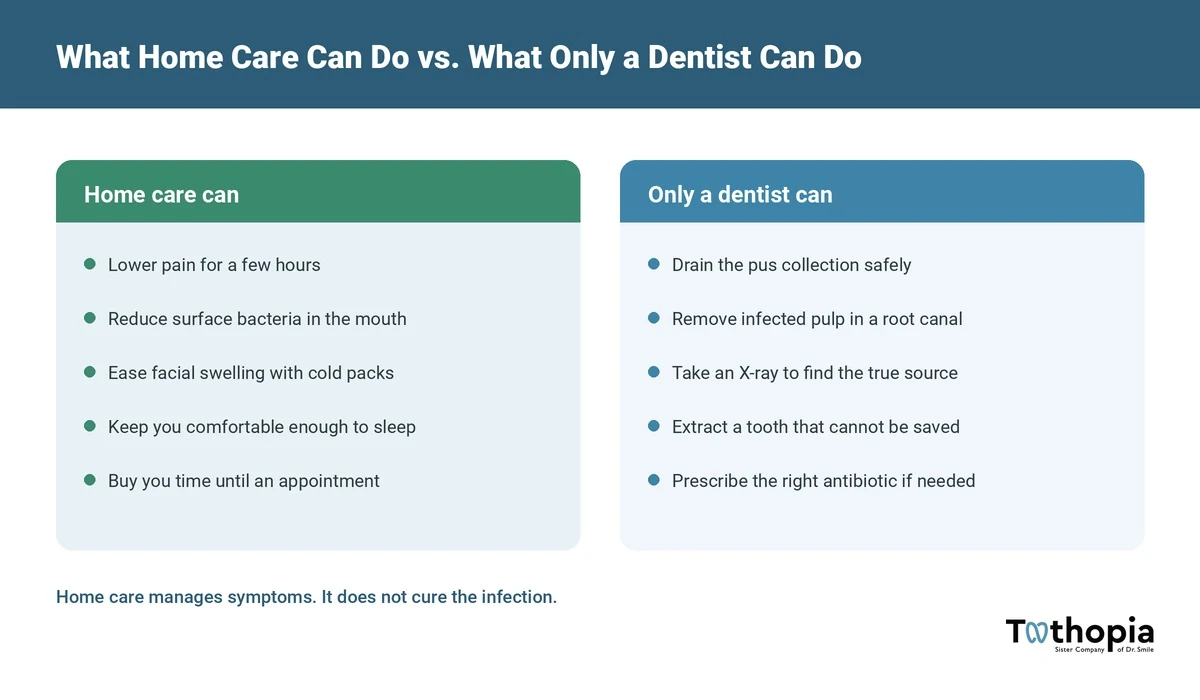
Used properly, tooth abscess treatment at home is a holding pattern, not a cure. Which raises the question almost everyone eventually asks: can you just drain it yourself?
How to Drain a Tooth Abscess at Home, and Why You Should Never Try
Do not drain a tooth abscess at home. Cutting, squeezing, or piercing an abscess forces bacteria out of the contained pocket and into the loose tissue planes of the face and neck, which is precisely the route that turns a local problem into a hospital admission.
A dentist draining an abscess is not doing the same thing you would be doing with a sterilized needle. They anesthetize the area, make a controlled incision at a planned point, irrigate the space, and often place a small drain so the pocket empties in the right direction. Then they treat the source. A kitchen-table version skips every one of those steps and adds new bacteria from your hands and the instrument.
The five items in that list are worth expanding, because each one shows up repeatedly in emergency dental visits:
- Popping or squeezing. Pressure has one place to go, and it is inward toward the floor of the mouth and the neck spaces.
- Aspirin held against the gum. This is a chemical burn waiting to happen. Aspirin works through the bloodstream, not through contact, so all you get is an ulcer on top of an abscess.
- Leftover antibiotics. A partial course from an old prescription rarely matches the bacteria involved, rarely runs long enough, and can quiet symptoms just enough for you to stop paying attention.
- Waiting for the pain to stop. Covered above, and worth repeating, because silence is usually the nerve dying rather than the infection clearing.
- Heat on the swelling. A warm compress encourages spread through the facial spaces. Cold on the outside, never heat.
If an abscess drains on its own, do not try to help it along by pressing on the area. Rinse gently with warm salt water, keep the outside cool, and call a dentist that day. Spontaneous drainage means the pocket has already found a path through tissue, and that path deserves a professional look.
Do Antibiotics for a Tooth Abscess Fix It Without a Dentist?
Antibiotics can slow a spreading infection, but they do not cure a tooth abscess on their own. The bacteria live inside a dead pulp chamber or a sealed pocket with almost no blood supply, and an oral antibiotic travels through the bloodstream. It cannot reach the place it needs to reach in useful concentrations.
This is where most people are surprised. The assumption is that antibiotics are the medical answer and dental treatment is the optional extra. Current guidance says close to the opposite.
“Antibiotics are not needed for the urgent management of most dental pain.”
The 2019 American Dental Association guideline on antibiotic use for pulpal and periapical infections, published in the Journal of the American Dental Association and endorsed by the American College of Emergency Physicians, recommends definitive dental treatment first for healthy adults, with over-the-counter acetaminophen or ibuprofen for pain. Antibiotics enter the picture when the infection becomes systemic, with fever or malaise, or when the patient is immunocompromised. You can read the guideline summary on the American Dental Association website.
A dentist may still prescribe amoxicillin or penicillin alongside treatment, and in a spreading infection that prescription matters enormously. But the drug is the escort, not the cure. Taking antibiotics for a tooth abscess and skipping the appointment is the version of this that ends badly, because symptoms fade, the course finishes, and the untreated tooth relapses within weeks.
How Long Does a Tooth Abscess Last and How Long Can You Wait?
A tooth abscess lasts until it is treated. There is no natural end point. What changes over time is how far the infection has traveled and how much of the tooth and bone can still be saved.
Timelines vary with your immune system, the tooth involved, and whether the pocket has found a drainage path. The table below reflects the general pattern of how these infections behave and how quickly each stage needs attention.
| Stage | What you notice | How fast to act |
|---|---|---|
| Early inflammation | Sensitivity to hot food, pain when biting, tenderness in one spot | Book within a few days |
| Established abscess | Constant throbbing, a bad taste, tenderness under the jaw | Same week, sooner if it worsens |
| Draining abscess | A gum pimple, pus, sudden relief from pressure | Within a day or two |
| Facial swelling | Visible puffiness of the cheek, lip, or under the eye | Same day |
| Spreading infection | Fever, difficulty swallowing, limited mouth opening | Emergency room now |
The stages do not always progress neatly, and a tooth can sit quietly at stage two for months before jumping to stage five in 24 hours. If yours followed a recent extraction rather than a decayed tooth, the causes and the aftercare differ, and abscess following tooth extraction covers that situation specifically.
Signs of a Serious Tooth Abscess and What Happens if It Is Left Untreated
Certain signs mean the infection has left the tooth and entered the surrounding spaces. At that point, you need medical care within hours, not a dental appointment next week.
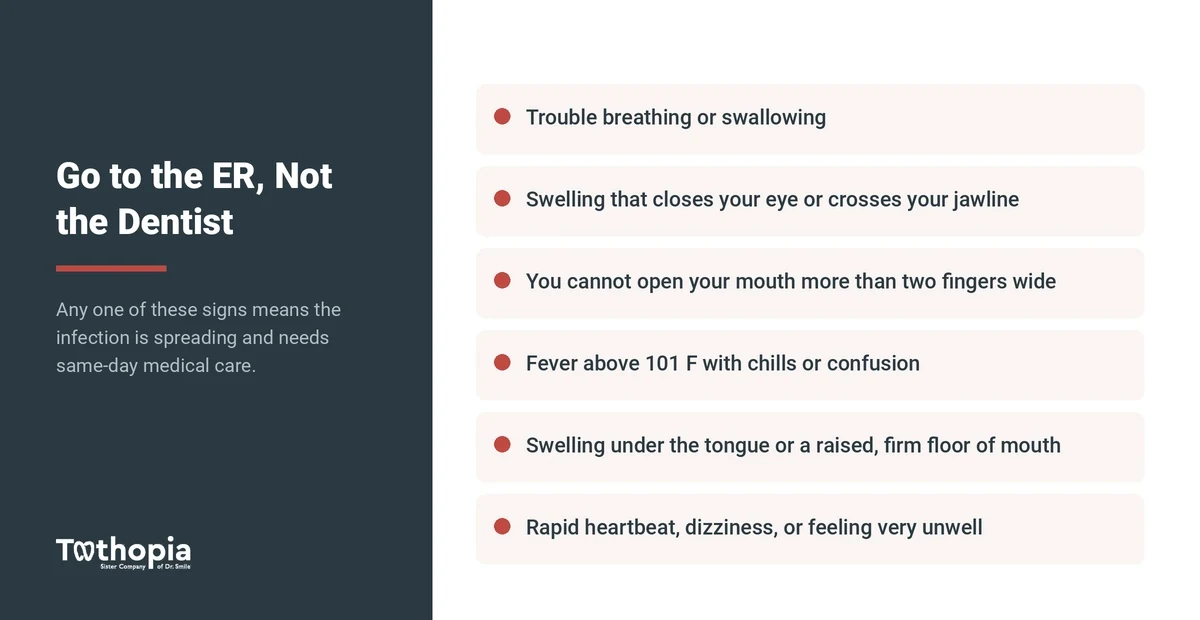
These are the signs of a serious tooth abscess that should send you to an emergency room rather than a dental office:
- Any difficulty breathing or swallowing, or a change in your voice
- Swelling that crosses the jawline into the neck, or closes the eye
- Inability to open your mouth more than about two fingers wide
- Fever above 101 F, chills, confusion, or a racing heartbeat
- Firm swelling under the tongue or a raised floor of the mouth
What happens if a tooth abscess is left untreated is not theoretical. According to the StatPearls clinical reference maintained by the National Institutes of Health, dental infections were the cause in over 90 percent of patients presenting with Ludwig angina, a rapidly progressing infection of the floor of the mouth that can obstruct the airway, and dental sources accounted for nearly half of deep neck abscesses in one study. Infections that reach this stage are managed with airway protection, intravenous antibiotics, and surgical drainage.
Those outcomes are uncommon, and they start from something extremely common: a decayed molar somebody decided to ride out. If you want the fuller picture of how these infections escalate, how long a tooth infection can go untreated walks through the progression in detail. A similar pattern applies to a wisdom tooth infection, where the lower third molars sit close to the same tissue spaces.
What a Dentist Does That Home Treatment Cannot
Definitive treatment removes the pus and eliminates the source, usually in one or two visits. Which route applies depends on an X-ray and an examination, not on how the tooth feels.
- Incision and drainage. The pocket is anesthetized, opened at a controlled point, irrigated, and sometimes fitted with a small drain. Pressure relief is usually immediate.
- Root canal treatment. The infected pulp is removed, the canals are cleaned and shaped, and the space is sealed. The tooth stays. A crown normally follows to protect it.
- Extraction. When the tooth is cracked below the bone or too decayed to restore, removing it takes the infection with it.
- Antibiotics. Prescribed alongside treatment when the infection has spread beyond the local area or when there are medical risk factors.
If the tooth can be saved, root canal treatment is the usual route, and modern technique makes the appointment far less eventful than its reputation suggests. When swelling or severe pain arrives outside a normal appointment slot, emergency dentistry exists for exactly this, and same-day slots are held open for infections.
You might be thinking that none of this helps if cost or insurance is the reason you are searching for a home solution. That is a real barrier, and it is worth knowing that community health centers, dental school clinics, and in-house payment arrangements all exist precisely for infections like this one. Nearly every one of them is cheaper and simpler than the emergency room visit an untreated abscess eventually forces.
Need help getting started? Our California-based offices in Culver City and Inglewood are ready to assist. Reach out by filling out the consultation form or calling 310-643-6221.
Final Thought on Treating a Tooth Abscess
The honest answer to how to get rid of a tooth abscess without going to the dentist is that you cannot, and the most useful thing home care does is keep you comfortable and safe until treatment. Salt water, cold packs, careful use of over-the-counter pain relievers, and an elevated pillow are genuinely worth doing. Cutting the abscess, packing it with clove oil, or reaching for old antibiotics are not.
The one judgment call that matters is timing. Book while the problem is still local and treatment is straightforward. Watch for swelling, fever, and limited mouth opening, and treat any of them as a same-day emergency. A tooth abscess responds well to treatment at almost every stage, and the outcome depends far more on when you act than on which remedy you tried first.
Common Questions About Tooth Abscesses
Is it safe to keep taking ibuprofen until my appointment?
Within the doses printed on the package, short-term use is generally safe for healthy adults, and it is what dental guidance points to for this kind of pain. Speak to a pharmacist first if you take blood thinners or have kidney, liver, or stomach conditions. If you need it around the clock just to function, that is a sign the appointment should move up rather than a sign the dose should.
Can I use a hydrogen peroxide rinse for a tooth abscess?
A diluted hydrogen peroxide rinse is sometimes suggested for oral infections and it can reduce surface bacteria. It is not stronger medicine than salt water for an abscess, and used undiluted or too often it irritates the gum tissue. If you use it, dilute it heavily with water, keep it brief, and treat it as a comfort measure rather than treatment.
Why does my tooth abscess hurt so much more at night?
Lying flat increases blood flow and pressure in the head, and an abscess is a confined space where extra pressure has nowhere to go. Fewer distractions at night make the same pain feel sharper. Sleeping propped up on two pillows and timing your pain reliever for bedtime usually makes the biggest difference.
Can a tooth abscess come back after it has drained?
Yes, and this is the usual pattern when the tooth itself is not treated. Drainage relieves pressure but leaves the infected pulp or gum pocket in place, so the abscess refills and flares again, often at longer intervals but with more bone loss each time. Each cycle also makes saving the tooth less likely.


0 Comments