
Jaw pain most commonly results from a temporomandibular disorder (TMD), teeth grinding (bruxism), a dental nfection, or an impacted wisdom tooth. Less often, the cause sits outside the mouth: a sinus infection, an irritated nerve, or, rarely, the heart. The location, timing, and type of pain all point to different underlying causes, which is why identifying the pattern matters before jumping to treatment.
Below, we go through one-sided pain near the ear, pain when you chew or open wide, the warning signs that can't wait, and the treatments that actually help.
Key Takeaways
- Temporomandibular disorders (TMDs) are the most common cause of jaw pain, according to the National Institute of Dental and Craniofacial Research (NIDCR), and they are about twice as common in women as in men.
- Jaw pain on only one side usually has a local cause on that side: the jaw joint, a chewing muscle, an infected or cracked tooth, or an impacted wisdom tooth.
- Pain that worsens when chewing points to a jaw joint problem, a cracked tooth, or a dental abscess, all of which need an exam to tell apart.
- Bruxism (teeth grinding) causes jaw tension that typically peaks in the morning, and many people who grind their teeth at night are unaware they do it.
- Jaw pain with chest pain, shortness of breath, nausea, or sweating can be a heart attack. Call 911, not a dentist.
- See a dentist if jaw pain lasts more than a week, keeps coming back, or makes it hard to eat or open your mouth. Get same-day care for facial swelling or fever.
What Causes Jaw Pain?
Jaw pain usually starts in one of four places: the jaw joint, the chewing muscles, the teeth and gums, or a nerve. Sometimes two of these are involved at once, which is why the same ache can have different causes in different people.
The temporomandibular joint (TMJ) connects your lower jaw (mandible) to your skull, one on each side, just in front of the ear. You use it every time you chew, speak, swallow, or yawnThat load, combined with stress, clenching, or dental disease, makes it vulnerable to overlapping problems.
TMJ Disorders: The Leading Cause of Jaw Pain
TMJ is the name of the joint. The conditions that make it hurt are called temporomandibular disorders, or TMDs. NIDCR names TMDs as the most common cause of jaw pain. The disorder affects the joint itself, the surrounding muscles, or both, producing pain that ranges from a dull ache to sharppain that makes eating hard.
NIDCR reports that TMDs are about twice as common in women as in men. It also notes that for many people, TMJ pain is not a sign of a serious problem and often settles without aggressive treatment.
Common symptoms of TMJ disorders:
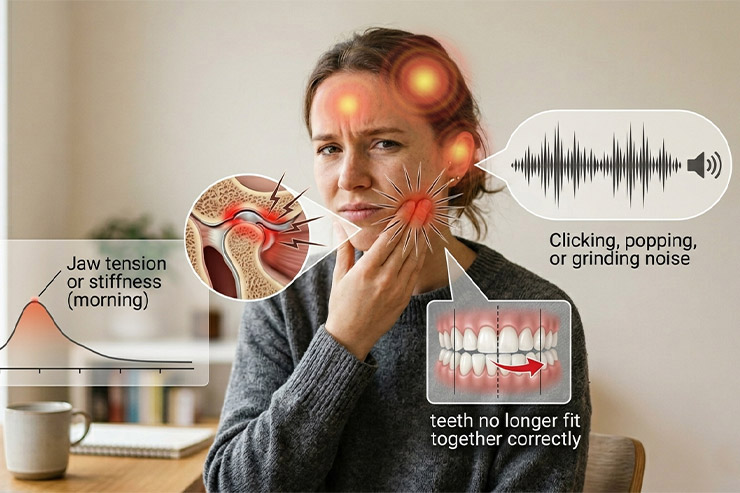
- Clicking, popping, or grinding noise when opening or closing the mouth
- Jaw tension or stiffness, especially in the morning
- Pain in front of the ear, on one or both sides
- Difficulty opening the mouth fully (trismus)
- Headaches, neck aches, or earache with no clear ear cause
- A feeling that your upper and lower teeth no longer fit together correctly
A general dentist manages most TMDs. For complex or long-lasting cases, an orofacial pain specialist can help; the American Dental Association recognized orofacial pain as a dental specialty in 2020. Our TMJ treatment usually starts with a custom splint, jaw exercises, and habit changes before anything more involved.
Teeth Grinding (Bruxism): The Silent Cause of Jaw Tension
Bruxism is the habitual clenching or grinding of teeth, most often during sleep, though some people clench during the day too. It's one of the most common causes of jaw tension and morning jaw pain, yet many people who grind at night have no idea until a partner hears it or a dentist spots the wear.
Bruxism-related jaw pain is often misattributed to stress or tension headaches. The telltale signs (worn enamel, flattened tooth surfaces, and morning jaw soreness) are frequently identified only during routine dental exams.
Grinding and clenching keep the jaw muscles working for far longer than normal chewing does. Over weeks and months, that leads to muscle fatigue, a sore joint, and tension that is still there when you wake up.
Signs to watch for:
- Jaw soreness or stiffness that's worst first thing in the morning
- Worn, flattened, or chipped teeth
- Tooth sensitivity with no visible decay
- Waking with headaches, particularly around the temples
- A partner reports grinding noises during sleep
If you notice two or more of these signs consistently, it's likely that bruxism is contributing to your jaw pain, especially if symptoms are worse in the morning and improve as the day goes on.
A dental exam can confirm grinding, and a custom night guard protects your teeth while you work on the triggers. A guard is only one part of how teeth grinding is treated; stress and sleep problems often matter just as much.
Dental Problems That Cause Jaw Pain
Several common dental conditions can lead to jaw pain, either directly or as a referred symptom from infection or structural damage. In many cases, the pain doesn't feel like it's coming from a single tooth; instead, it spreads into the jaw, ear, or surrounding muscles, which makes the underlying cause less obvious at first.
- Dental abscess: A bacterial infection at the root of a tooth or in the surrounding gum. Abscesses cause throbbing, intense pain that can radiate into the jaw, ear, and neck, and it is often constant and worse when you lie down. Treatment is endodontics (root canal therapy) or an extraction, because antibiotics alone don't remove the source. If left untreated, the infection can spread to surrounding tissue , bone, and in severe cases the neck and airway.
- Cracked or fractured tooth: A hairline crack can cause sharp jaw pain, specifically when biting down on food or releasing the bite. The pain comes and goes, which is why cracks are hard to find without bite testing and a close exam.
- Impacted wisdom teeth: Third molars that don't fully erupt can press against neighboring teeth. When one is partly through, the flap of gum over it traps food and bacteria and becomes infected (pericoronitis), which causes throbbing pain at the back of the jaw that can spread to the ear and throat. Wisdom tooth extraction is typically recommended when impaction causes recurring pain or infection, and a wisdom tooth infection that keeps flaring up is one of the most common reasons to take the tooth out.
- A filling or crown that sits too high: A new restoration that hits first when you bite can make the jaw and tooth sore within days. A quick adjustment usually fixes it, so call if your bite feels off after a filling that is too high. A crooked bite in general is a different story: research has not shown that it causes TMDs.
If jaw pain keeps coming back or seems to move around, ask for an exam with X-rays so the source can be pinned down.
Why Does My Jaw Hurt on Only One Side?
One-sided jaw pain usually points to a localized cause, something affecting that specific side of the jaw, joint, or dental structures, rather than a body-wide condition.
The most common culprits for unilateral (one-sided) jaw pain include a single-sided TMJ disorder, a dental abscess or cracked tooth on that side, an impacted wisdom tooth, a sinus infection above the upper back teeth, a parotid gland issue, or referred pain from a trigger point in the surrounding muscles.
Jaw Pain Right Side Near Ear
Pain near the ear on the right side has the same causes as pain near the ear on the left. The most common source is the TMJ on that side, or referred pain from the masseter muscle (the thick chewing muscle just in front of the ear). Pain in this location that increases when you open wide, chew, or press on the area suggests the joint or surrounding muscles are is inflamed or overloaded.
Other causes on either side include:
- Parotid gland inflammation or infection (parotitis): The parotid salivary gland sits directly in front of and below the ear on each side. Infection causes swelling and pain that's often confused with TMJ or jaw pain.
- Ear infections: Middle and outer ear infections can send pain forward into the jaw joint area, mimicking TMJ pain.
- Dental abscess in a back tooth: Molar abscesses, often send pain toward the ear, and lower molars do this most.
If you have persistent jaw pain near the ear lasting more than one week, it's worth ruling out dental infection with an X-ray before assuming it's purely a joint problem.
Pain Under Ear Behind Jaw Bone on the Left Side
Pain under the ear behind the jawbone has the same local causes on the left as on the right. What makes the left side worth a closer look is that left-sided jaw pain is one way a heart attack can show up, so the symptoms around it matter.
The lymph nodes in this region (submandibular and jugulodigastric nodes) become swollen and tender with dental infections, throat infections, and certain body-wide conditions. Persistent jaw and neck pain, particularly if accompanied by difficulty swallowing or a lump you can feel, should be evaluated promptly.
If the pain spreads into the neck, shoulder, or arm, or comes with chest tightness, nausea, or sweating, call 911. The full list of heart warning signs is further down this page.
Why Does My Jaw Hurt When I Chew?
Jaw pain that gets worse specifically when chewing is one of the clearest diagnostic signals in dentistry. Chewing loads the jaw joint, the teeth, and the surrounding muscles at the same time, so pain on chewing points to a problem in one of those three.
The most common causes of jaw pain while chewing include TMJ dysfunction, a cracked tooth, a dental abscess, or a loose /or failing dental restoration. Less commonly, it can indicate bone loss from periodontal (gum) disease or jawbone disease.
Food Textures That Aggravate Jaw Pain
The type of food that triggers pain often narrows the diagnosis. Many people notice that specific textures consistently make the pain worse, which helps tell between joint, muscle, or dental issues.
- Hard foods (nuts, raw carrots, crusty bread): Pain from hard foods suggests joint involvement (TMJ) or a cracked tooth, both of which are aggravated by high bite force.
- Chewy foods (meat, bagels, chewing gum): Pain during prolonged chewing with chewy textures points more to muscular overload, common in bruxism and myofascial pain, rather than a tooth-specific problem.
- Any chewing causes pain: If even soft foods cause jaw pain, this suggests an acute dental infection, an inflamed joint, or significant muscle spasm requiring early professional evaluation.
When Is Jaw Pain While Chewing a Sign of Something Serious?
Jaw pain while chewing that is getting progressively worse over days, or that's accompanied by swelling, fever, or difficulty opening the mouth, suggests an active dental infection. This requires urgent treatment. In severe, untreated cases, a dental infection can spread into the floor of the mouth and neck (Ludwig's angina), which can block the airway and is a medical emergency.
If chewing pain has lasted more than a week without getting worse, book a regular dental exam with X-rays. Don't manage this with over-the-counter pain relief alone.
One pattern belongs to your doctor, not your dentist: if you are over 50 and your jaw starts to ache after a minute or two of chewing and eases when you stop, get seen the same day. That can be a sign of giant cell arteritis, covered below.
Why Does My Jaw Hurt When I Open My Mouth?
Pain that occurs specifically when opening the mouth wide (during yawning, eating a large bite of food, or at the dentist) is a classic sign of TMJ involvement. The joint is placed under its greatest load at a wide opening, and an inflamed or damaged joint will respond with sharp or aching pain at that range of motion.
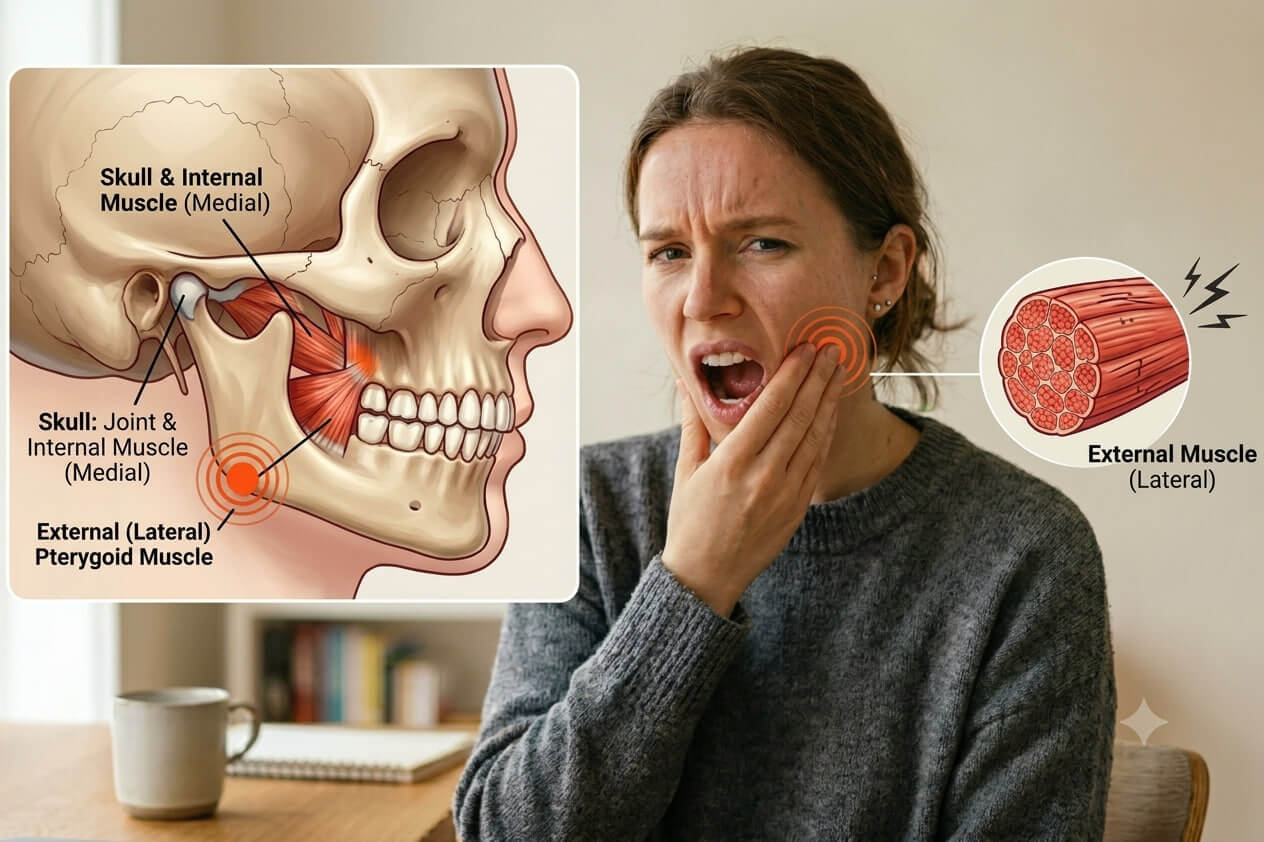
Muscles are also a common culprit. The lateral pterygoid muscle helps open the jaw and slide it forward, while the masseter and temporalis close it. Any of them can tighten from clenching, stress, or holding your mouth open through a long dental visit, and the pain shows up most when you open wide.
Limited Jaw Opening: A Key Warning Sign
Most adults can open about 40 to 50 mm between the upper and lower front teeth, roughly the width of three fingers stacked on top of each other. Opening of less than about 35 mm is usually treated as trismus, and when it comes with pain it points to a real joint or muscle problem.
Trismus can result from:
- Acute TMJ inflammation or disc displacement
- Infection in or around the jaw (particularly
apericoronitis around an impacted wisdom tooth) - Post-surgical swelling following wisdom tooth extraction or other oral surgery
- Tetanus (rare, but trismus is the hallmark symptom)
Trismus that develops suddenly, particularly alongside difficulty swallowing or breathing, is a medical emergency. Call 911 or go to the ER.
Less Common but Serious Causes of Jaw Pain You Shouldn’t Overlook
TMDs and dental problems cause most jaw pain. The conditions below are much rarer, but missing them has bigger consequences.
Trigeminal Neuralgia: Electric Shock Jaw Pain
Trigeminal neuralgia is a chronic pain condition affecting the trigeminal nerve, which carries sensation from the face to the brain. It produces sudden, severe, electric shock-like jolts of pain in the face and jaw, often triggered by the lightest touch, chewing, or even a breeze on the face.
Unlike TMJ pain, trigeminal neuralgia pain is typically on one side, extremely intense, and lasts only seconds to a few minutes per episode. It mostly affects people over 50 and requires neurological evaluation and specialist management, not standard dental treatment. Because the pain can feel like it's coming from a tooth, some people end up with dental work that doesn't help. If X-rays and tests show healthy teeth, a neurologist is the right next step.
Giant Cell Arteritis: Jaw Pain When Chewing After 50
Giant cell arteritis (GCA) is inflammation of the arteries, often the ones at the temples. One of its classic signs is jaw claudication: an ache in the jaw muscles that starts after a short time of chewing and fades with rest. Other signs include a new headache, a tender scalp, and changes in vision.
GCA mostly affects people over 50. It needs same-day medical care, because without treatment it can cause permanent vision loss.
Jaw Pain as a Warning Sign of a Heart Attack
Jaw pain, particularly on the left side, or pain radiating from the chest upward, can be a symptom of a heart attack. Women are more likely than men to have these less typical symptoms, according to the American Heart Association. This is called referred pain. It happens because the heart's sensory nerves share pathways with those from the jaw and neck.
If jaw pain appears suddenly alongside any of the following, call 911 immediately:
- Chest tightness, pressure, or pain
- Shortness of breath
- Nausea or vomiting
- Cold sweat
- Pain spreading to one or both arms, the back, or the neck
- Dizziness or lightheadedness
Don't drive yourself, and don't wait to find out whether it's dental.
When Is Jaw Pain a Dental Emergency?
If the pain is intense, worsening quickly, or affecting basic functions like eating, breathing, or opening your mouth, it's more likely to be a dental emergency rather than a minor issue that can wait.
Call 911 or go to the ER first if you have:
- Difficulty breathing or swallowing
- Swelling that spreads toward the eye, under the jaw, or down the neck
- Any of the heart attack warning signs above
Seek emergency dental treatment the same day if you have:
- Severe, throbbing jaw pain with visible facial swelling
- Fever combined with jaw or tooth pain
- Jaw pain that over-the-counter pain relievers don't control
- Sudden inability to open or close your mouth
- A tooth knocked out, cracked, or broken, with accompanying jaw pain
Book a routine appointment (within 1 to 2 weeks) if:
- Jaw pain is mild to moderate and improves with over-the-counter pain relief
- You have clicking or popping without significant pain
- You have morning jaw stiffness that improves through the day
These symptoms are often related to TMJ issues or mild muscle tension and are typically not urgent, but they should still be evaluated to prevent progression over time.
Need help getting started? Our California-based offices in Culver City and Inglewood are ready to assist. Reach out by filling out the consultation form or calling 310-643-6221.
How Jaw Pain Is Diagnosed
Diagnosing jaw pain accurately requires combining a clinical exam with imaging, because so many conditions overlap in their symptoms.
During a jaw pain exam, a dentist or specialist will typically:
- Take a full medical and dental history, including when the pain started, what makes it worse, and whether you've had recent dental treatment or trauma.
- Press on the TMJ directly in front of each ear and check for tenderness, clicking, or crepitus (grinding sensation).
- Measure your maximum mouth opening in millimeters and check whether it's symmetrical.
- Examine all teeth for signs of cracking, wear, decay, or failed restorations, including bite-wing and periapical X-rays.
- Check the bite using articulating paper to
iind high spots or uneven contacts. - Order a cone beam CT (CBCT) scan to look at bone and teeth, or an MRI to see the joint disc, needed.
If an infected or dying tooth nerve is suspected, the dentist will test how the tooth responds to cold and may refer you to an endodontist (root canal specialist).
Treatment Options for Jaw Pain
Treatment for jaw pain depends entirely on the underlying cause. What helps a TMJ issue may have little effect on an infection or a cracked tooth For TMJ pain, most TMJ relief options start with the simplest care and step up only if needed.
Home Remedies for Jaw Pain Relief
For mild to moderate jaw pain, especially when it's related to muscle tension or suspected TMJ issues, simple at-home strategies can often help reduce discomfort
- Soft diet: Eating soft foods (yogurt, scrambled eggs, mashed vegetables, soups) reduces joint and muscle strain.
- Warm or cold compress: A warm compress applied for 15 to 20 minutes helps relax jaw muscles; a cold pack reduces acute inflammation. Alternating between them can be helpful depending on symptoms.
- Over-the-counter pain relievers: Ibuprofen or naproxen reduces both pain and inflammation. Acetaminophen helps with pain but does not address inflammation. them as the label directs, and check with your doctor first if you have stomach, kidney, or heart problems or take a blood thinner.
- Jaw exercises: Gentle controlled opening, chin tucks, and side-to-side glides, often recommended by a physical therapist or dentist, help restore mobility and reduce muscle tightness over time.
- Stress reduction: Since bruxism and jaw tension are often stress-related, mindfulness, better sleep habits, and relaxation exercises can reduce nighttime grinding.
While these methods can provide relief, they mainly manage symptoms rather than fixing the root cause. If pain persists or keeps returning, professional treatment is usually required Professional Treatments for TMJ and Jaw Disorders.
When self-care is not enough or symptoms are more severe, targeted dental or medical treatments are needed. The choice depends on whether the problem is in the joint, the muscles, or a tooth.
- Occlusal splint (night guard): A custom-fitted device worn at night that protects the teeth from grinding and eases muscle pain for many people. It's removable and changes nothing permanently, which is why it's a common first step.
- Physical therapy: Focuses on jaw muscles, posture, and neck alignment using manual therapy, dry needling, and guided exercises to restore normal function.
- Bite adjustment (occlusal equilibration): Reshaping tooth surfaces is permanent. NIDCR advises against it, and against orthodontics, as a treatment for TMD. It still makes sense when a specific new filling or crown clearly sits too high.
- Botulinum toxin (Botox) injections: Injected into jaw muscles like the masseter to reduce overactivity. This can relieve severe muscle-driven jaw pain, with effects lasting several months. In the U.S. this is an off-label use, since the FDA has not approved Botox for TMD, and it is usually saved for cases that don't respond to a splint and exercises.
- Root canal therapy (endodontics): Used when jaw pain is caused by an infected tooth nerve. The procedure removes infection inside the tooth and saves the tooth.
After professional treatment starts, many patients notice gradual improvement rather than immediate relief, because jaw-related conditions often involve both the joint and the muscles
When Surgery Is Needed for Jaw Pain
Surgery is only considered when non-surgical treatments have failed, and jaw pain or dysfunction remains severe over time.
The main procedures are:
- Arthrocentesis: A minimally invasive procedure that flushes the TMJ with sterile solution under local anesthetic, reducing inflammation and improving disc mobility.
- Arthroscopy: A keyhole procedure using a small camera and instruments to remove scar tissue, reposition the disc, or treat arthritic changes within the joint.
- Open joint surgery (arthroplasty or total joint replacement): Reserved for severe structural damage, ankylosis (joint fusion), or tumors involving the jaw joint.
Even after surgery, recovery usually requires rehabilitation to restore normal jaw movement.
How Long Does Jaw Pain Last?
Jaw pain usually improves within a few days to a few weeks, but the timeline depends on the cause. Muscle-related pain from stress or bruxism often settles within 1 to 2 weeks once triggers are reduced. A mild TMJ flare-up can calm down within a few days, while a more stubborn episode can take several weeks.
Dental-related pain tends to improve faster after treatment, often within 24 to 72 hours once the infection is treated or the tooth is managed. After procedures like wisdom tooth removal, discomfort usually peaks in the first 2 to 3 days and improves within 7 to 10 days.
SomeTMJ problems do linger. In a large study cited in the National Academies' 2020 report on TMD, about half of new cases were still present six months later. Treatment, habits, and the cause all change how long TMJ takes to heal.
How to Prevent Jaw Pain from Coming Back
Preventing jaw pain from returning is mainly about fixing the root causes rather than just managing symptoms. Once the underlying issue is controlled, most people have fewer flare-ups.
- Wear your night guard consistently: If bruxism is confirmed, wearing a custom splint every night helps protect the teeth and jaw joint from grinding forces. It doesn't stop grinding itself, but it reduces the damage it causes.
- Drop habits that strain the jaw: Chewing gum, nail biting, pen chewing, or resting your chin on your hand all place extra strain on the jaw joint and should be cut back.
- Keep up regular dental checkups: Routine exams help detect cracked teeth, early decay, or bite changes before they lead to jaw pain. A 6-month recall is commonly recommended.
- Address stress early: Stress is a major trigger for jaw clenching and grinding, so managing it through sleep, exercise, or therapy can directly reduce jaw tension.
- Treat dental problems early: Untreated decay or cracks can shift bite forces and overload the jaw joint over time
Final Thoughts on Jaw Pain and When to Take It Seriously
Most jaw pain traces back to the joint, the chewing muscles, or a tooth. The key to getting the right outcome is ecognizing the pattern: where the pain is located, when it appears, and what makes it worse all point toward the right kind of care.
Most jaw pain responds well to conservative treatment when caught early. The real risk is waiting too long, or missing the rare case where jaw pain comes from the heart, an artery, or a spreading infection.
If your jaw pain is new, worsening, preventing normal eating, or accompanied by swelling, or fever, get it assessed. A thorough clinical exam and a set of dental X-rays can rule out serious causes and give you a clear picture of what's actually happening.
Common Questions About Jaw Pain
Why does my jaw hurt when I wake up?
Morning jaw pain is often a sign of nighttime bruxism (teeth grinding or clenching). During sleep, the jaw muscles may clench repeatedly without you noticing, leading to muscle fatigue and joint irritation that becomes most noticeable in the morning. If you also snore or wake up tired, mention it to your dentist, since night grinding and sleep apnea often show up together.
Can a sinus infection cause jaw pain?
Yes. The maxillary sinuses sit right above the roots of the upper back teeth, so a sinus infection can feel like an ache in the upper jaw or in several upper teeth on one side. It is usually worse when you bend forward and comes with congestion. If the ache stays after the congestion clears, see a dentist to rule out a tooth problem.
Should I see a dentist or a doctor for jaw pain?
Start with a dentist for pain tied to a tooth, your gums, chewing, or the jaw joint, including clicking and morning soreness. See a doctor for jaw pain with sinus congestion and fever, a new headache after 50, or sharp electric jolts when your teeth test healthy. Call 911 for jaw pain with chest pressure, shortness of breath, or sweating.
Why does my jaw hurt after a dental visit?
Holding your mouth open for a long appointment can strain the jaw muscles and joint, and the numbing injection for lower teeth can leave the inside of the jaw sore and stiff for a few days. A new filling or crown that sits too high can also make your jaw ache when you bite. Call your dentist if the pain gets worse after three days, you notice swelling, or your bite feels off.



0 Comments