

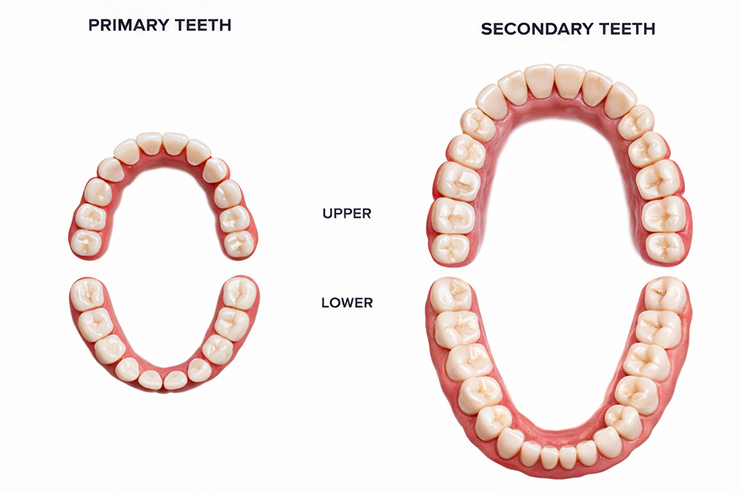
Humans have 20 baby teeth in childhood and up to 32 permanent teeth in adulthood, although most adults end up with 28 once wisdom teeth are removed or never develop. The number of teeth in humans changes with age and varies between individuals because of genetics, extractions, and gum health, so there is rarely one fixed answer. This guide breaks down baby versus adult tooth counts, when each set erupts, the four tooth types and what they do, and what an unusual count can reveal about oral health. The twist is that a flawless set of 32 is less common than most people assume.
Key Takeaways
- Children have 20 primary (baby) teeth, while adults have up to 32 permanent teeth, including 4 wisdom teeth.
- Most adults function with 28 to 32 teeth, and wisdom teeth are the main reason the total varies.
- Baby teeth start erupting around 6 months, and the full set of 32 permanent teeth usually arrives by about age 21.
- Roughly 20% of people are missing at least one wisdom tooth, and about 6% are missing another permanent tooth from birth.
- Human teeth fall into four types: incisors, canines, premolars, and molars, each shaped for a specific job.
- Having 24 to 28 teeth can be completely normal after wisdom tooth removal, but unexplained tooth loss deserves a dental exam.
How Many Teeth Do Humans Have in Total?
Humans develop two full sets of teeth in a lifetime: 20 primary teeth in childhood and up to 32 permanent teeth in adulthood. The exact total depends on the stage of life and, in adults, on whether the four wisdom teeth ever arrive.
Tooth development follows a steady biological pattern. A child's mouth is built for a smaller jaw and a softer diet, while the adult set is built for higher bite forces and a wider range of foods. That is why the number of teeth in humans nearly doubles between early childhood and the early twenties.
Baby teeth vs. adult teeth: total count and breakdown by tooth type
| Tooth Type | Baby Teeth | Adult Teeth |
|---|---|---|
| Incisors | 8 | 8 |
| Canines | 4 | 4 |
| Premolars | 0 | 8 |
| Molars | 8 | 12 (includes wisdom teeth) |
| Total | 20 | 32 |
Primary (Baby) Teeth
Children have 20 primary teeth in total. These teeth are temporary, but they are essential for chewing, speech, and guiding permanent teeth into the correct position as they develop.
- Incisors: 8 teeth (4 upper and 4 lower) used for cutting and biting food into small pieces.
- Canines: 4 teeth (2 upper and 2 lower) designed for tearing food and helping stabilise the bite.
- Molars: 8 teeth (4 upper and 4 lower) that grind softer foods into a form that is easy to swallow.
This set also holds space in the jaw so that permanent teeth can erupt in proper alignment, which is why early loss of a baby tooth can crowd the teeth that follow.
Permanent (Adult) Teeth
Adults develop up to 32 permanent teeth. These teeth are stronger, larger, and built for decades of continuous function.
- Incisors: 8 teeth for precise cutting and initial food intake.
- Canines: 4 teeth that support tearing and help guide bite alignment.
- Premolars: 8 transition teeth that crush food between the front and back of the mouth.
- Molars: 12 teeth, including the wisdom teeth, are responsible for powerful grinding.
In practice, many adults end up with 28 teeth because the wisdom teeth never erupt or are removed. That gap between 28 and 32 is the single biggest reason the count differs from person to person, which is exactly what the next section covers.
Why Does the Number of Teeth Vary From Person to Person?
The number of teeth varies mainly because of wisdom teeth, genetics, and dental history. The basic blueprint is the same for everyone, but the final count is shaped by what develops, what erupts, and what is later lost.
Some people never form certain teeth, while others lose teeth over time to decay or gum disease, which may call for periodontal treatment to protect the surrounding bone. Wisdom teeth add the most variation of all, since they are the least predictable teeth in the human mouth.
- About 20% of people are missing at least one wisdom tooth from birth.
- Roughly 6% of people are missing another permanent tooth (excluding wisdom teeth), a pattern dentists call hypodontia.
- A smaller group, around 1% to 4%, develop one or more extra teeth, known as supernumerary teeth.
What matters more than the exact number is whether the teeth you have work together, hold a stable bite, and let you chew without discomfort.
Yes, a full set of 32 is the textbook answer, but a healthy, well-aligned set of 28 often functions better than a crowded set of 32 that never had room for the wisdom teeth. A clean count is not the same as a healthy mouth, and the rest of this guide shows where the differences come from.
Pro tip: If you want a quick human teeth count at home, run your tongue along one side of the upper jaw and multiply by four. A complete adult quadrant has 8 teeth, which totals 32 across all four corners.
How Many Teeth Do Children Have?
Children have 20 primary teeth once the full baby set is in place, usually by about age 3. This is the complete set during early childhood, before permanent teeth begin to replace them.
The teeth are split evenly between the upper and lower jaw and support early chewing, speech development, and the spacing that permanent teeth will later need.
- 8 incisors for cutting food
- 4 canines for tearing and stabilising the bite
- 8 molars for grinding softer food
Most children follow this pattern unless there is a delayed eruption or a developmental difference. A parent who notices missing, late, or doubled-up teeth can have it checked during routine pediatric dental care, where an X-ray can confirm whether the permanent teeth are forming on schedule.
Example: Parents often count only the visible front teeth and worry that the back ones are “missing.” In most toddlers, the second molars are simply the last baby teeth to arrive, frequently between ages 2 and 3, so the set looks incomplete for a while before it fills in.
When Do Teeth Come In? Baby and Adult Eruption Timeline
Baby teeth usually start erupting around 6 months of age, and the full set of permanent teeth is typically complete by about age 21. Eruption follows a predictable order, though the exact timing varies with genetics and nutrition.
A typical eruption timeline from the first baby tooth to the wisdom teeth:
- Around 6 months, the first baby teeth appear, usually the lower front incisors.
- By about age 3, all 20 primary teeth are typically in place.
- Around age 6, the first permanent molars erupt behind the baby teeth, and the front baby teeth begin to fall out.
- By about age 12, most of the 28 non-wisdom permanent teeth have come in.
- Between 17 and 25, the four wisdom teeth may erupt, completing the set at 32 for those who develop and keep them.
Because the schedule spans two decades, a child can look “behind” or “ahead” and still be perfectly normal. The order matters more than the calendar, which leads to a question parents ask surprisingly often.
Are Babies Born With Teeth?
A small number of babies are born with teeth, but it is rare, occurring in roughly 1 in every 2,000 to 3,500 births. These are called natal teeth, and they most often appear as one or two teeth along the lower front gum.
Natal teeth are usually part of the normal primary set rather than extra teeth, and the cause is not fully understood. They tend to have thin enamel and shallow roots, so a dentist checks whether they are stable or loose enough to need attention.
Pro tip: If a newborn has a tooth, do not try to remove it at home. A pediatric dentist can decide whether to monitor it, smooth a sharp edge, or remove a loose tooth that poses a choking or feeding risk.
Natal teeth do not change the lifetime count, since the body still works toward the usual 20 primary and up to 32 permanent teeth. They simply arrive ahead of schedule.
Types of Baby Teeth and Their Functions
Baby teeth are arranged in a set pattern, and each type has its own shape, position, and job. Together, they form a simple, efficient system for cutting, tearing, and grinding food during childhood.
- Incisors (front teeth): 8 in total, with 4 upper and 4 lower. Flat and slightly sharp-edged, they cut food into small pieces and are usually the first teeth visible when a child smiles.
- Canines (corner teeth): 4 in total, with 2 upper and 2 lower. More pointed and stronger than incisors, they grip and tear tougher food.
- Molars (back teeth): 8 in total, with 4 upper and 4 lower. Their wide, ridged surfaces grind food into a softer texture that is easier to swallow.
Each type works in sequence from front to back, which is the same logic the larger adult set follows once it arrives.
How Many Teeth Do Adults Have?
Adults have up to 32 permanent teeth in a complete set, though many people naturally have 28 when the wisdom teeth are missing or removed. The adult teeth count is built for stronger, more complex chewing than the baby set.
A full adult dentition breaks down like this:
- 8 incisors for cutting food
- 4 canines for tearing and stabilising the bite
- 8 premolars for crushing and transitioning food between front and back teeth
- 12 molars, including wisdom teeth, for grinding food into a finer texture
Compared with the 20-tooth baby set, the adult set adds premolars and third molars to handle higher bite forces and a broader diet.
What Is the Normal Number of Adult Teeth?
The normal number of adult teeth is 28 to 32. The difference comes almost entirely from the wisdom teeth, which are the last to erupt and are often removed or never develop. Both 28 and 32 are considered within the normal range.
How Many Wisdom Teeth Do Humans Have?
Humans have up to 4 wisdom teeth, one in each back corner of the mouth. Also called third molars, they are the last teeth to erupt, usually between ages 17 and 25, and they are the main reason adult counts range from 28 to 32.
Not everyone develops all four. Some people grow one, two, three, or none, and many who do develop them lack the jaw space to fit them in safely. When wisdom teeth press against neighboring teeth or stay trapped under the gum, they can crowd the bite or trap bacteria.
When there is not enough room or a tooth becomes impacted, a dentist may recommend wisdom teeth removal to protect the surrounding molars and keep the bite aligned. After removal, an adult set of 28 is completely normal.
What most people miss: There is no such thing as a standard 36-tooth human set. The maximum is 32, including all four wisdom teeth. The “36” figure usually comes from miscounting or confusing humans with animals that have larger dentitions.
Why Do Some Adults Have Fewer Teeth?
Reduced tooth count in adults usually traces back to dental history and natural variation. The most common causes include:
- Wisdom tooth extraction
- Tooth decay that leads to removal
- Gum disease and the bone loss that follows
- Congenital absence, where certain teeth never form
Each situation is evaluated on its own. A planned tooth extraction for crowding has a very different impact than tooth loss from advanced decay, so the right response depends on which teeth are gone and why.
Is Having 24 Teeth Normal in Adults?
Having 24 teeth can be normal in some cases, but it depends on the reason. If wisdom teeth and a few crowded teeth were removed for orthodontic reasons, a stable 24-tooth bite can function well.
If the teeth were lost to decay, gum disease, or trauma, a count that low can signal an underlying problem worth evaluating, since missing teeth can shift neighbouring teeth and weaken the bite over time.
What Are the Different Types of Teeth, and What Does Each One Do?
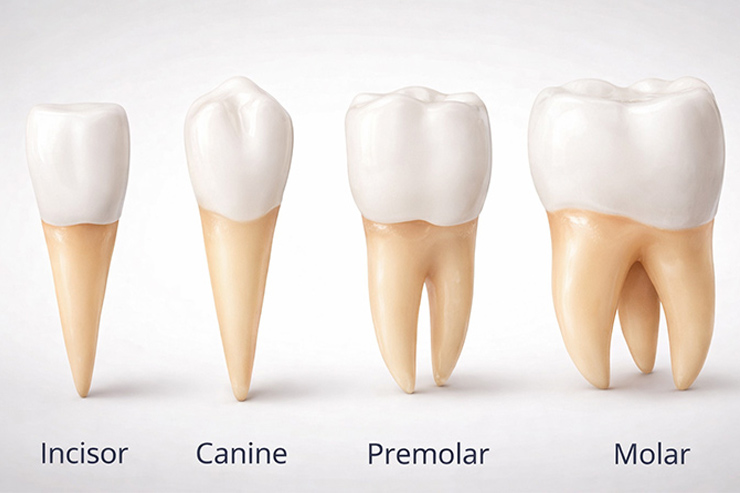
Human teeth fall into four types based on shape and function: incisors, canines, premolars, and molars. Each type handles a specific stage of breaking down food, and together they form one coordinated chewing system.
The four tooth types, from cutting to grinding.
- Incisors: the front teeth that cut and bite food into smaller, manageable pieces and control how food enters the mouth.
- Canines: pointed teeth that grip and tear tougher textures while helping stabilise the bite.
- Premolars: transition teeth that crush food and bridge the cutting and grinding functions.
- Molars: large back teeth, including the wisdom teeth, that do most of the heavy grinding and final breakdown.
This front-to-back system is why losing even one tooth type can change how efficiently you chew, and why dentists weigh function, not just the raw number, when assessing a mouth.
Teeth Anatomy: What Are Teeth Made Of?
Each tooth is built from several layers, and damage to any one of them can affect the whole tooth. Understanding the structure makes it clear why daily care matters so much.
| Structure | What it does |
|---|---|
| Enamel | Hard outer layer that protects against wear and decay |
| Dentin | The middle layer that supports the enamel and transmits sensation |
| Pulp | Inner core containing nerves and blood vessels |
| Cementum | Layer covering the root that anchors the tooth |
| Periodontal ligament | Connective tissue that holds the tooth to the bone |
These layers work together for strength, sensitivity control, and stability. Once you can picture them, it is easy to see why decay or trauma can lead to real discomfort or tooth loss.
How to Take Care of Your Teeth and Prevent Tooth Loss
Protecting your tooth count comes down to consistent daily habits supported by preventive dental care. The fundamentals are simple and effective:
- Brush twice daily with fluoride toothpaste
- Clean between teeth daily to remove plaque that the brush misses
- Limit frequent sugar to reduce decay risk
- Keep regular checkups so problems are caught early
Professional support, including routine teeth cleaning, early cavity detection, and gum monitoring, lowers the long-term risk of tooth loss. Early intervention matters most in children and teens, while the permanent set is still settling in.
Need help getting started? Our California-based offices in Culver City and Inglewood are ready to assist. Reach out by filling out the consultation form or calling 310-643-6221.
Treatment Options for Missing Teeth
When teeth are missing, the goal is to restore chewing, keep the bite stable, and protect the surrounding teeth and bone. The right choice depends on how many teeth are gone and the condition of the area around them.
- Dental implants: an artificial root that supports a fixed replacement. Dental implants help preserve jawbone and offer strong, long-term stability, especially for single-tooth gaps.
- Dental bridges: replacements anchored to the healthy teeth on either side of a gap. A dental bridge suits shorter gaps where the neighbouring teeth are strong enough to share the load.
- Dentures: removable replacements for multiple missing teeth. Partial dentures restore chewing and appearance when fixed options are not the best fit.
The best option depends on the bone condition, the number and position of missing teeth, and how much long-term stability the bite needs.
Final Thoughts on Human Teeth Throughout Life
The honest answer to how many teeth humans have is a range, not a single number: 20 baby teeth in childhood and 28 to 32 permanent teeth in adulthood, with wisdom teeth driving most of the difference. The count alone never tells the full story.
What protects your smile is function and upkeep, not hitting a perfect 32. A well-aligned set that you clean daily and have checked regularly will serve you far better than a complete count left unattended. If your number seems off or your teeth feel loose, crowded, or missing, a dental exam can pinpoint the cause and the right next step.
Frequently Asked Questions About Human Teeth Count
How many incisors, canines, and molars does a person have?
Adults typically have 8 incisors, 4 canines, and 12 molars, including wisdom teeth when present.
Do people with smaller jaws have fewer teeth?
Tooth count does not usually change, but smaller jaws may prevent the full eruption of certain teeth, especially wisdom teeth.
Do humans have 32 or 36 teeth?
Humans have a maximum of 32 permanent teeth, including all four wisdom teeth. There is no standard 36-tooth human set; the 36 figure usually comes from miscounting or confusing human dentition with animals that have more teeth.
How many teeth does a child develop?
A child develops 20 primary teeth, usually complete by about age 3. These include 8 incisors, 4 canines, and 8 molars, evenly split between the upper and lower jaw.



0 Comments