
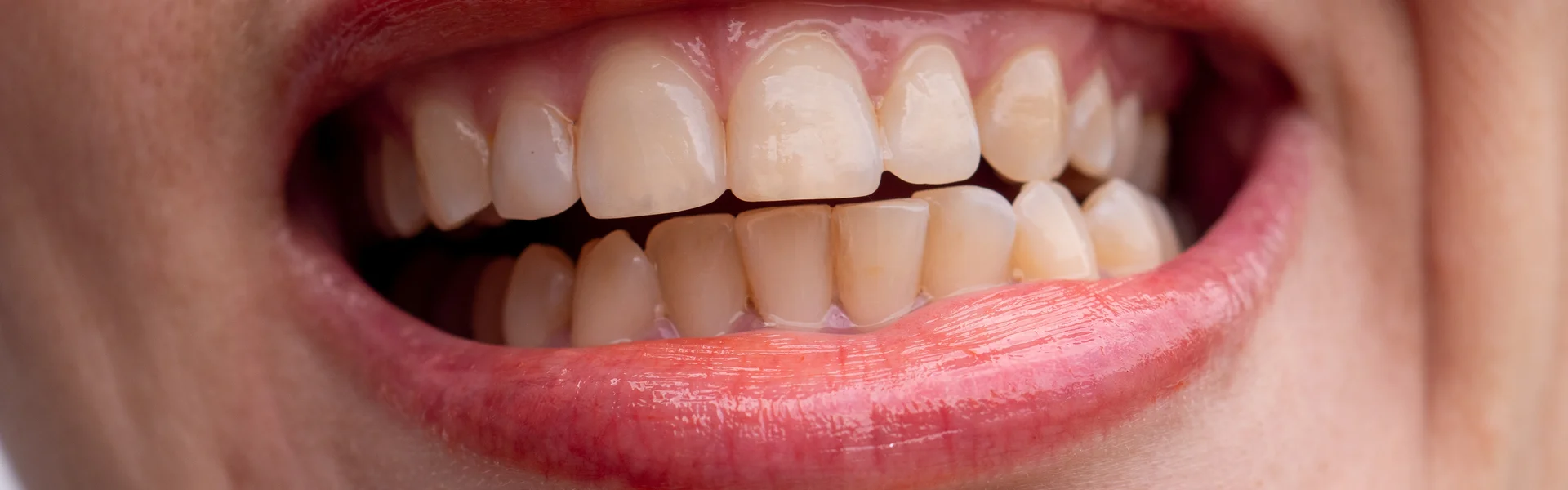
If your teeth are yellow when you brush them every day, the brushing itself is rarely the problem. Daily brushing lifts plaque, but it cannot thicken your enamel, pull out stains that have already soaked in, or hide the naturally yellow dentin sitting underneath. Most yellow teeth come from a mix of surface stains, thinning enamel, genetics, and habits like coffee or tobacco. A smaller share points to a dental issue worth checking. Below you will find every common cause, a clear answer on whether yellow teeth can turn white again, and the safe ways to brighten a dull smile. First, the part almost everyone gets wrong.
Key Takeaways
- Brushing removes plaque and prevents new stains, but it does not bleach teeth or reverse discolouration that has set in.
- Tooth color has two sources: surface (extrinsic) stains you can often lift, and internal (intrinsic) color you usually cannot brush away.
- Enamel thins with age and lets the yellow dentin underneath show through, which is why teeth look more yellow over time.
- Braces and teen years both raise the risk of yellowing because plaque hides around brackets and enamel is still maturing.
- Most surface yellowing responds well to a professional cleaning and dentist-supervised whitening; deep stains may need bonding or veneers.
- Sudden yellow patches, a single dark tooth, or spots that appear overnight deserve a dental exam, not a whitening kit.
Why Brushing Alone Won’t Whiten Teeth
Your teeth stay yellow because brushing controls plaque, and plaque is only one piece of tooth color. Enamel, the hard outer shell, is slightly translucent. Under it sits dentin, which is naturally yellow to gray. As enamel wears thinner with age and acid exposure, more of that dentin shows through, so teeth look darker even when they are spotless.
Brushing also cannot reach stains that have already worked past the surface. Coffee, tea, and tobacco leave pigment that seeps into tiny pores in the enamel. A toothbrush cannot scrub that out. A clean tooth and a white tooth are simply not the same thing.
Here is what most people miss: whitening toothpaste does not bleach anything. It carries a mild abrasive that polishes off fresh surface stains, which helps at the edges, but it does not affect dentin color or deep stains. People brush harder expecting a brighter result and instead wear their enamel down, which makes teeth look more yellow, not less.
Extrinsic vs. Intrinsic Stains
Yellow teeth come from two very different sources, and telling them apart tells you whether brushing or whitening will help. Extrinsic stains sit on the surface and come from food, drink, and tobacco. Intrinsic color comes from inside the tooth, driven by genetics, aging, medication, or trauma.
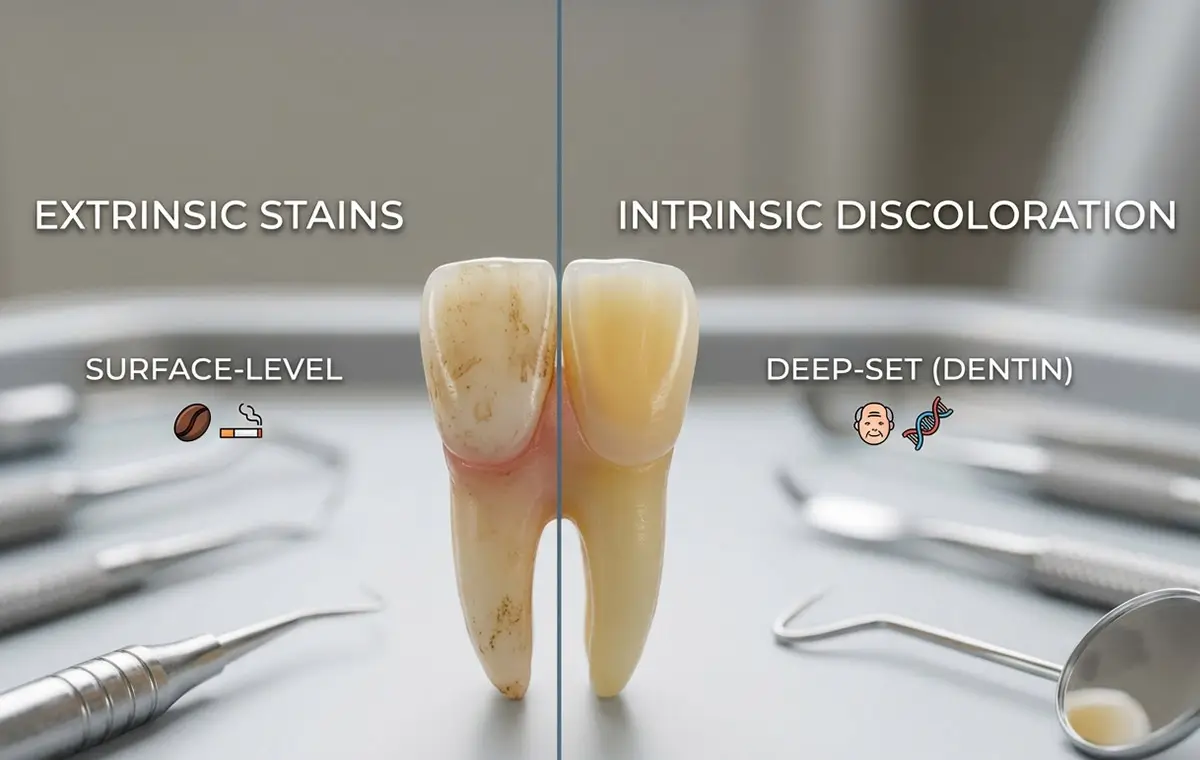
Extrinsic stains are the good news. They respond to cleaning and whitening because they live on the outer enamel. Intrinsic discoloration is stubborn, since the color is baked into the dentin or the enamel structure itself. Bleaching helps some intrinsic cases and does little for others, which is why a dentist checks the cause before recommending a treatment.
| Feature | Extrinsic (Surface) Stains | Intrinsic (Internal) Colour |
|---|---|---|
| Where it sits | On the outer enamel | Inside dentin or enamel |
| Common causes | Coffee, tea, wine, soda, tobacco, plaque | Aging, genetics, fluorosis, trauma, tetracycline |
| Does brushing help? | Helps prevent buildup, not remove set stains | No significant effect |
| Best fix | Cleaning, whitening toothpaste, professional whitening | Bonding, veneers, or internal bleaching |
| Typical response | Often lightens several shades | Results vary and may not bleach |
A patient who drank three cups of coffee a day had heavy extrinsic staining that lifted almost completely after one cleaning and a whitening session. Another patient with childhood antibiotic staining saw very little change from bleaching and did far better with veneers. Same complaint, two different problems.
Once you know which type you have, the next question is whether your daily routine is quietly working against you.
Is Your Brushing Technique the Problem of Yellow Teeth?
Good habits and good technique are not the same thing, and technique is where most people lose ground. The recommendation is two minutes, twice a day, yet studies of real brushing put the average closer to 45 seconds. That gap leaves plaque behind, and plaque both stains and hardens into tartar that only a professional can remove.
The way you brush matters as much as the time. Plaque loves the gumline and the inside surfaces, the spots people rush past. If you skip those areas, a yellow film builds where the brush never lands.
- Angle the brush at about 45 degrees to the gumline, not flat against the tooth.
- Use short, gentle circles rather than a hard back-and-forth scrub.
- Give equal time to the outer, inner, and chewing surfaces of every tooth.
- Brush your tongue, where stain-causing bacteria collect.
- Replace your brush or brush head every three to four months, sooner if the bristles splay.
You might be thinking a powered toothbrush would solve this. It can help, mostly because the built-in timer keeps you honest for the full two minutes, but a careful hand with a manual brush cleans just as well. The tool matters less than the two minutes and the angle.
Set a two-minute timer for one week and split it into four 30-second zones (upper left, upper right, lower left, lower right). Most people are shocked at how long two real minutes feels, and how much brighter their teeth look once plaque stops hiding.
Technique aside, what you eat and drink between brushings may be undoing your work faster than you can keep up.
Foods and Drinks That Stain Your Teeth
The most common reason teeth yellow despite good brushing sits in your cup and on your plate. Anything dark enough to stain a white shirt can stain enamel, and the pigments and acids in these foods build up faster than twice-daily brushing can clear them.
The usual suspects are coffee, black tea, red wine, cola, and dark sauces like soy and balsamic. Tea is a surprise offender, since its tannins can stain as heavily as coffee. Acidic drinks add a second problem: they soften enamel for a while after each sip, so brushing right away can scrub away softened enamel and expose more dentin.
You do not have to give any of it up. A few habits blunt the damage:
- Drink coffee, tea, and soda through a straw so liquid skips your front teeth.
- Rinse with water after anything dark or acidic.
- Wait about 30 to 60 minutes after acidic drinks before brushing.
- Pair staining drinks with water instead of sipping them slowly all afternoon.
Tobacco deserves its own line. Nicotine and tar drive some of the most stubborn yellow and brown staining there is, and it soaks in deep enough that brushing barely touches it. Quitting is the single most effective step a smoker can take for tooth color, and it usually takes a professional cleaning to clear what is already there.
If you keep the habits in check and your teeth still look yellow, the reason may have less to do with what you eat and more to do with hardware in your mouth.
Why Are My Teeth Yellow With Braces Even When I Brush Every Day?
If your teeth are yellow when you brush them every day with braces, the cause is almost always plaque hiding where the brush cannot reach. Brackets and wires create dozens of new nooks that trap food and bacteria, so even a careful brusher leaves more behind than they would without braces. Left alone, that plaque stains and hardens into tartar with a yellow or brown tint.
There is a second trap unique to braces. Because you clean around the brackets but not under them, staining can build on the exposed enamel while the tooth beneath each bracket stays its original shade. When the braces come off, some patients see a lighter square where each bracket sat, framed by darker enamel.
If you are in treatment now, the fix is prevention. Brush after every meal rather than only morning and night, add a floss threader or interdental brush to clean under the wire, and keep every cleaning appointment. Whitening is best saved for after the braces come off, so the color ends up even. When your orthodontic treatment wraps up, a professional cleaning followed by dentist-supervised whitening usually evens everything out.
Carry a travel toothbrush during braces treatment. A quick 60-second brush after lunch clears the food that would otherwise sit against your enamel for hours and leave a stain.
Braces explain a lot of yellowing in one group in particular: teenagers, who face a few extra causes all at once.
Yellow Teeth in Teens: Normal Changes or Something to Fix?
If your teeth are yellow when you brush them every day as a teen, it is usually because enamel is still maturing and daily life adds fast staining. Newly erupted adult teeth often look more translucent, which lets the underlying dentin show and can make them read as yellow next to baby teeth. That usually settles as the enamel finishes hardening.
On top of that, teens run into a stack of staining triggers: sodas and sports drinks, energy drinks, coffee runs, braces, and rushed brushing on busy mornings. Vaping is a growing cause too, since the nicotine and additives stain much like cigarettes. Any one of these is minor. Together they outpace a quick brush.
- Genetics set the baseline. Some people simply have thicker, whiter enamel than others, and no amount of brushing changes that.
- White or yellow spots from fluorosis trace back to swallowing too much toothpaste in early childhood, not to current habits.
- Over-the-counter whitening strips are not automatically safe for younger teens, so it is worth a dentist's input first.
For most teens, the honest answer is reassuring: the yellow is normal enamel maturity plus lifestyle, and it responds well to better routines and a cleaning. A pediatric or family dentist can confirm nothing else is going on and recommend an age-appropriate plan. Our team offers gentle options through our regular preventive care visits that suit younger patients.
Sometimes, though, the yellow is not a stain at all. It is a signal.
Yellow Patches and Warning Signs
Most yellow teeth are harmless, but certain patterns point to a dental issue rather than ordinary staining. Even all-over yellowing is usually cosmetic. A sudden change, a single tooth, or a defined patch is the version to take seriously.
Watch for these signs:
- One tooth turning yellow, gray, or dark while the rest stay the same, which can mean nerve damage or a dying tooth after an injury.
- Yellow or brown patches with a rough or soft texture, which can be early decay rather than a stain.
- A yellow line near the gumline that will not brush off, which is often hardened tartar.
- White spots that turn yellow around braces or along the gums, an early sign of enamel breaking down.
The reason this matters: whitening a decayed or infected tooth does nothing for the underlying problem and can waste time you do not have. Decay spreads, and a damaged nerve can become an abscess. A quick exam sorts a cosmetic concern from a clinical one, usually with a look and an X-ray.
If you have yellow patches that appeared quickly, feel rough, or sit on just one or two teeth, book an exam before you reach for a whitening product. Fixing the health issue comes first; the color can be handled after. If it turns out to be simple surface staining, you are back to the most hopeful question of all.
Can Yellow Teeth Turn White Again?
Yes, in most cases, yellow teeth can turn white again, though how much whiter depends on what caused the yellow in the first place. Surface stains from coffee, tea, wine, and tobacco respond well and often lighten several shades within days to a few weeks of professional teeth whitening. Deeper intrinsic color is less predictable.
Set expectations by the cause. Extrinsic staining is the most rewarding to treat and the easiest to reverse. Age-related yellowing improves with whitening but may need a maintenance touch-up now and then. Intrinsic stains from medication or trauma may barely move with bleaching, in which case bonding or veneers deliver the change instead. One more honest point: existing dental work like crowns and fillings will not change color with whitening, so they sometimes need replacing to match a newly brightened smile.
Whitening is also not permanent. Teeth pick up new stains from the same foods, drinks, and habits over time, so results last roughly six months to a couple of years depending on your routine. That is not a reason to skip it, just a reason to keep up the habits that protect the result.
So if the color can come back, what is the smartest, safest way to get there?
How to Fix Yellow Teeth Safely
The safe path to whiter teeth starts with the mildest option that fits your cause and steps up only if needed. Rushing to strong bleach or a viral home remedy is how people damage enamel and gums, which leaves teeth looking worse. Match the fix to the stain.
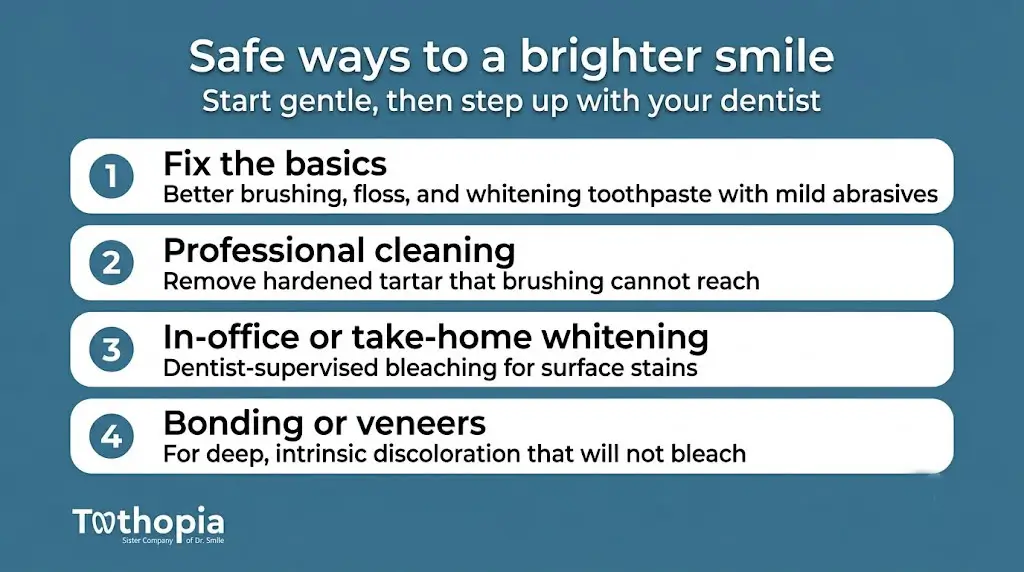
Work through the options in order:
- Fix the basics first. Dial in your two-minute technique, floss daily, and use a whitening toothpaste with a mild abrasive to keep new surface stains from settling.
- Get a professional cleaning. Removing tartar alone can brighten teeth a shade or two and gives any later whitening a clean surface to work on. A routine dental cleaning is the most underrated whitening step there is.
- Try dentist-supervised whitening. In-office treatment is the fastest route and can lighten several shades in one visit, while custom take-home trays work more gradually with less sensitivity. Both are safer and stronger than most drugstore kits.
- Consider bonding or veneers for deep stains. When discoloration will not bleach, tooth-colored bonding or veneers cover it for a lasting change. This is where cosmetic bonding turns a stubborn intrinsic case into an even, bright smile.
A word on home remedies: baking soda in moderation can help with light surface stains, but charcoal, acidic fruit scrubs, and hydrogen peroxide swishing can erode enamel and irritate gums when overused. Gentle and consistent beats harsh and fast every time. For a plan matched to your teeth, a dentist-supervised approach gives you the strongest result without the guesswork.
Need help getting started? Our California-based offices in Culver City and Inglewood are ready to assist. Reach out by filling out the consultation form or calling 310-643-6221.
The Bottom Line on Yellow Teeth
Yellow teeth despite daily brushing usually do not mean you are doing something wrong. They are the normal result of enamel, dentin, diet, and time, and most of them respond well to the right care. Remember one thing: clean is not the same as white. Brushing protects your teeth and slows new stains, but real brightening comes from matching the treatment to the cause, whether that is a cleaning, dentist-supervised whitening, or bonding for deeper color.
Start gentle, protect your enamel, and let a dentist confirm the cause before you spend money on a product that may not fit your situation. That order gives you a brighter smile and a healthier one.
Frequently Asked Questions About Yellow Teeth
Can yellow teeth become white again naturally?
Surface stains can fade with better brushing, rinsing after staining foods, and cutting back on coffee, tea, and tobacco. Natural methods will not change the internal color of your teeth, though. For a noticeable shift, a professional cleaning and dentist-supervised whitening work far better and more safely.
Is it normal for teeth to look yellow after braces?
Yes. Plaque builds around brackets and wires during treatment, and staining can settle on the exposed enamel. A professional cleaning after the braces come off, followed by whitening if you want it, usually evens the color out.
When should I see a dentist about yellow teeth?
See a dentist if a single tooth darkens, if you notice yellow or brown patches that feel rough, or if spots appear suddenly. These can signal decay or nerve damage rather than a stain, and they need treatment before any whitening.



0 Comments