

Yes, wisdom teeth can cause headaches. When a third molar erupts at an angle, stays trapped under the gum, or picks up an infection, that pressure travels along the trigeminal nerve, and the brain reads the signal as pain in the temple or behind one eye. Dentists call this referred pain, and it explains how a tooth you cannot even see ruins your whole week. Below you will find how the link works, what the pain feels like, how a dentist confirms it, and whether removal fixes it. The strange part is that many people with wisdom tooth headaches never feel a single twinge in the tooth itself.
Key Takeaways
- Wisdom teeth cause headaches through referred pain along the trigeminal nerve, not through anything happening inside your head.
- The usual routes are eruption pressure, impaction, gum infection (pericoronitis), jaw muscle strain, and sinus pressure from upper third molars.
- The pain is typically one-sided, dull, worse with chewing or opening wide, and worst in the morning.
- About 90% of people have at least one impacted wisdom tooth, according to the American Association of Oral and Maxillofacial Surgeons, so the pattern is common between ages 17 and 25.
- A panoramic X-ray settles the question. Symptoms only point the way, and a headache can happen with no tooth pain at all.
- Removal reliably helps when imaging shows a real problem, and does nothing when the true cause is a migraine, sinus disease, or a sleep disorder.
How Wisdom Teeth May Cause Headaches
Wisdom teeth cause headaches by loading structures that share nerve pathways with your head. The tooth is the source, but the temple is where you feel it, because the trigeminal nerve carries sensation from teeth, gums, jaw joint, and forehead along overlapping branches. Your brain gets a strong signal and guesses at the address.
Third molars sit in the worst possible spot for this. They erupt between roughly ages 17 and 25 into the back corner of a jaw that stopped growing years earlier, surrounded by the masseter and temporalis muscles and within millimeters of the mandibular nerve. Very little has to go wrong before something upstream complains.
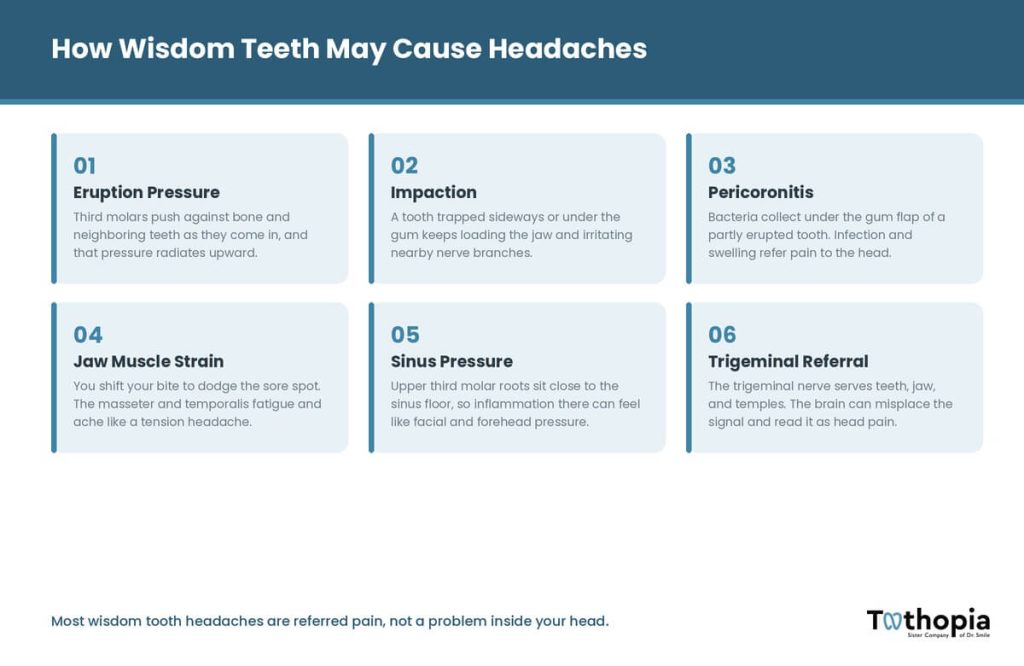
Two of those six deserve a closer look, because they cause the most confusion.
Pericoronitis, the infection under the gum flap
When a wisdom tooth erupts halfway, it leaves a hood of gum over part of the crown. Food and bacteria slip under it, and no toothbrush reaches them. The result is a wisdom tooth infection called pericoronitis, and it is the fastest route from mild annoyance to a genuine headache. Swelling raises pressure in a space with nowhere to expand, and the pain climbs.
Jaw muscle strain, the sneaky one
This route has nothing to do with the tooth hurting. When one back corner of your bite is sore or blocked, you chew on the other side and hold your jaw guarded. The masseter and temporalis fatigue like any overworked muscle, and the ache they produce feels exactly like a tension headache across both temples. If you already have TMJ or TMD symptoms, or you are grinding your teeth at night, a wisdom tooth adds fuel to a fire that is already burning.
Press a fingertip firmly on the gum behind your last visible molar, on the side that hurts. If the pressure reproduces or sharpens your headache within a few seconds, it may provide a clue about where the pain started. This is not a diagnosis, but it is useful information to share with your dentist.
Knowing the mechanism is useful. Knowing what the pain actually feels like is what tells you whether this is your headache or someone else's.
What a Wisdom Tooth Headache Feels Like
A wisdom tooth headache usually feels like a dull, steady pressure on one side of the head, centered around the temple or above the ear, that gets worse when you chew, yawn, or open wide. It is rarely a sudden ice pick pain. It builds, it lingers, and it tends to be worst in the morning after a night of jaw clenching.
People describe it as a helmet strapped a little too tight on one side. Light and sound usually do not bother them. What bothers them is biting into a sandwich. That single distinction separates most dental headaches from migraines faster than any other question.
| Feature | Wisdom Tooth Headache | Migraine | Sinus Headache |
|---|---|---|---|
| Location | One side, temple and above the ear | One side, often behind the eye | Cheeks, forehead, bridge of nose |
| Quality | Dull, steady pressure | Throbbing, pulsing | Heavy fullness |
| Worse With | Chewing, yawning, opening wide | Light, sound, movement | Bending forward, lying down |
| Companion Signs | Sore gum, jaw stiffness, ear pressure | Nausea, aura, light sensitivity | Congestion, postnasal drip |
| Responds To | Anti-inflammatories, then returns | Migraine-specific medication | Decongestants |
One more pattern worth naming. If the headache arrives with a bad taste, an odor from the back of your mouth, or gums that bleed when you brush that area, you are no longer guessing about tension. That is inflammation talking.
Signs Your Headaches Are Coming From Your Wisdom Teeth
No single sign proves the connection. A cluster of them makes it likely. Wisdom teeth can impact your headaches in ways that are easy to dismiss one at a time, so the pattern is what you are looking for.
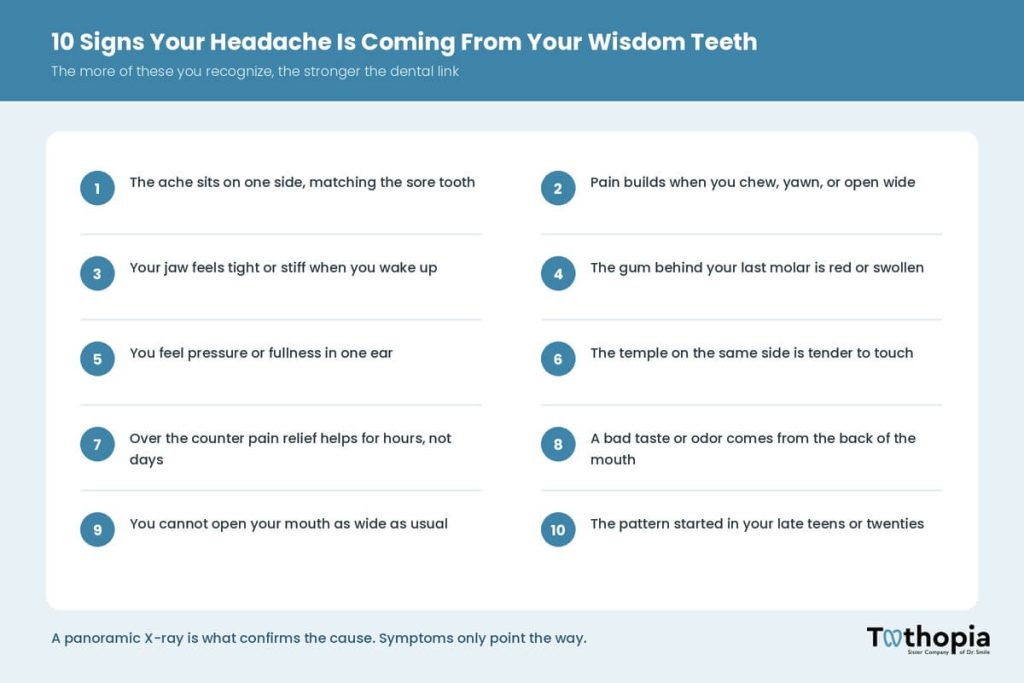
Two of these carry more weight than the rest. Pain that changes with jaw movement is the strongest single indicator, and an age between 17 and 30 is the strongest context clue, because that is when third molars are erupting or settling into a bad position. A bad taste, swollen gums behind the last molar, or a mouth that will not open as wide as it used to move this from likely to urgent, since those are infection markers rather than pressure markers.
How a Dentist Diagnoses a Wisdom Tooth Headache
Diagnosis comes down to imaging plus a clinical exam, usually in a single 30 to 45 minute visit. Symptoms narrow the field. The X-ray closes it.
- A history that maps the headache: which side, what makes it worse, what time of day, and what has already been ruled out medically.
- A hands-on exam of the back of the mouth, checking for gum swelling, a partially erupted crown, tenderness, and how wide you can open.
- A panoramic X-ray, which captures all four third molars in one image and shows angle, depth, and root position relative to the mandibular nerve.
- A cone beam CT scan when the roots sit close to the nerve or sinus and the surgical plan needs three-dimensional detail.
- A muscle and joint check, which separates pure tooth pressure from the muscle pattern layered on top.
If you have never had panoramic imaging as an adult, that is where this starts. You can read how dental X-rays work before your visit. The exam also rules things in that have nothing to do with third molars: a cavity between your molars refers pain the same way, and so does a cracked tooth or an old failing filling. Skipping this step is how people end up removing teeth that were never the problem.
The tooth that hurts and the tooth that is causing the pain are not always the same.
Will Removing Wisdom Teeth Help With Headaches?
Removing wisdom teeth relieves headaches when imaging confirms a real problem: impaction, infection, decay, a cyst, or clear pressure on the nerve. When the X-ray is clean, and the headache has another driver, extraction will not fix it, and it delays finding what will.
When removal is the right call, most patients notice meaningful improvement within three to seven days as swelling drops, and the headache pattern usually resolves around the two-week mark once the jaw muscles let go. Pain that had been daily for months tends to fade rather than switch off.
| Your Situation | What Removal Usually Does |
|---|---|
| X-ray shows impaction, and pain changes with jaw movement | Strong chance of lasting relief |
| Recurring pericoronitis around a partly erupted tooth | Strong chance of relief once infection clears |
| Decay in a tooth you cannot clean properly | Relief and prevention of worse problems later |
| Clean X-ray, headache unchanged by chewing | Unlikely to help; look for another cause |
| Diagnosed migraine plus healthy third molars | Not a migraine treatment |
The procedure itself is routine. A single tooth typically takes 20 to 40 minutes, and most people return to normal activity within three to five days. Sedation is available for anyone who needs it, and our team walks through the options first. You can read how we approach wisdom teeth removal and what oral surgery involves.
Ask your dentist to show you the panoramic X-ray and explain the angle of each wisdom tooth. If they can clearly show why a specific tooth may be causing your headache, the treatment plan is easier to understand. If the explanation is unclear, consider getting a second opinion before surgery.
Recovery has its own headache risk worth knowing about. Dry socket exposes bone and nerve endings and can produce head pain a few days after a smooth extraction. It is treatable, and planning what to eat after wisdom teeth removal is part of avoiding it.
How to Ease a Wisdom Tooth Headache Before Your Appointment
Reduce the inflammation and stop loading the joint. None of this fixes an impacted tooth, but it makes the next few days livable.
- Anti-inflammatories over plain painkillers. Ibuprofen targets the swelling driving the pressure, which acetaminophen does not. Follow the label and check with your physician if you take other medication.
- Warm saltwater rinses, three or four times a day. A half teaspoon of salt in warm water flushes debris from under a gum flap and calms irritated tissue.
- A cold compress on the outside of the cheek. Fifteen minutes on, fifteen minutes off, on the sore side.
- Chew on the other side and go soft. Every hard bite on the sore side reloads the exact structure that is complaining.
- Sleep with your head slightly elevated. Lying flat increases blood flow to inflamed tissue, which is why the pain often peaks at night.
- Stop clenching in daylight. Teeth should only touch when you swallow. If you clench at night, a custom night guard helps.
Skip the folk remedies that damage tissue. Aspirin held against the gum burns it, and clove oil applied directly can irritate the very gum flap you are trying to calm. There are safer ways to calm tooth nerve pain while you wait. And there is a line where waiting stops being reasonable.
When a Wisdom Tooth Headache Needs Same Day Care
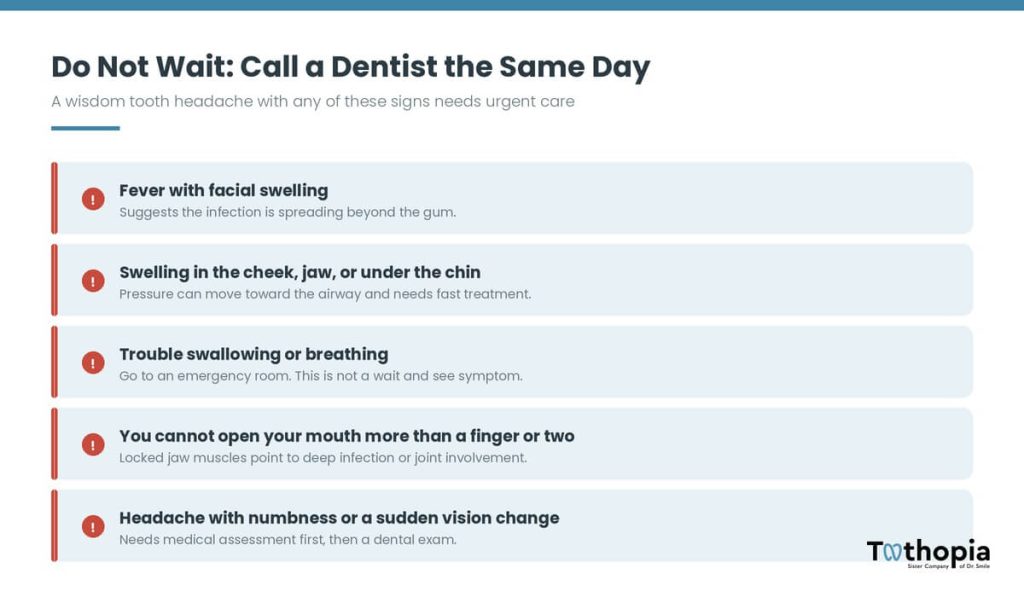
Most wisdom tooth headaches are a scheduling problem. A few are not. The difference is whether infection has started to move.
The reason these matter is anatomy. The spaces around a lower third molar connect to the floor of the mouth and the neck. A tooth infection that spreads along those planes becomes a serious medical problem quickly. If you have swelling and a fever with your headache, do not wait for a routine slot. Emergency dental care exists for exactly this.
The Bottom Line on Wisdom Teeth and Headaches
Wisdom teeth cause headaches through referred pain, and the pain is real even when the tooth stays silent. The pattern that should get your attention is a one-sided ache that changes when you move your jaw, in someone between roughly 17 and 30, that has not responded to anything a general physician has tried.
What separates a good outcome from a frustrating one is sequence. Image first, diagnose second, treat third. When a panoramic X-ray shows an impacted or infected third molar that explains your symptoms, removal usually ends the headache within about two weeks. When the X-ray is clean, the honest answer is that your headache came from somewhere else, and taking out a healthy tooth only costs you time. If you have been chasing an unexplained headache for months, ask for the X-ray.
Frequently Asked Questions About Wisdom Teeth and Headaches
Can wisdom teeth cause headaches on one side?
Yes, and one-sided pain is the most typical presentation. Wisdom teeth rarely misbehave symmetrically, so one tooth is more angled or more infected than the rest, and the pain follows that nerve branch and stops at the midline. Trigeminal branches do not cross over, so an ache that always sits above the same ear, on the same side as a tender gum, is a strong clue.
Can wisdom teeth cause headaches every day?
Yes. Daily headaches may happen when an impacted or inflamed wisdom tooth creates ongoing pressure, jaw tension, or irritation. Persistent headaches lasting weeks should be checked with a dental X-ray.
Can wisdom teeth cause headaches without tooth pain?
Yes. Impacted wisdom teeth may not cause typical tooth pain but can still create pressure, jaw strain, and referred headaches. An X-ray is often needed to identify the cause.
Can wisdom teeth cause headaches and ear pain?
Yes. Wisdom tooth inflammation can refer pain to the ear because the jaw and ear share nearby nerve pathways. Ear pressure that changes with chewing may be linked to dental issues.
Can wisdom teeth cause headaches and dizziness?
Sometimes, but the connection is usually indirect. Wisdom teeth may contribute through jaw problems, sinus pressure, infection, or disrupted sleep. Ongoing dizziness should be evaluated separately.
Can wisdom teeth cause headaches and blurred vision?
Blurred vision is not a common wisdom tooth symptom. Dental issues may cause facial or sinus pressure near the eye, but sudden vision changes require medical evaluation.



0 Comments