

Many patients dealing with bite problems want a straightforward and reliable answer to one important question: Can invisalign fix overbite effectively and for the long term? In many situations, Invisalign can correct an overbite successfully, especially when the issue is related to tooth positioning rather than severe jaw imbalance. With proper diagnosis and careful treatment planning, clear aligners can improve bite function, comfort, and overall oral health, not just the appearance of the smile.
What Is an Overbite and Why It Matters
An overbite occurs when the upper front teeth overlap the lower front teeth. A small overlap is normal and even protective, but excessive overlap can interfere with proper chewing and jaw movement. Understanding the overbite type and severity is essential for planning effective treatment and preventing long-term dental problems.
Normal vs Problematic Overbite
In a healthy, normal bite, the upper front teeth slightly overlap the lower front teeth, which helps guide the jaw during chewing and protects the teeth from uneven wear. This slight overlap is considered natural and generally does not cause discomfort or functional problems. On the other hand, an overbite occurs when this overlap becomes excessive. A slight overbite may still be harmless, affecting appearance minimally while maintaining proper chewing and jaw function. A problematic overbite, however, goes beyond cosmetic concerns: it can interfere with chewing efficiency, contribute to speech difficulties, increase strain on the jaw muscles and temporomandibular joint (TMJ), and lead to uneven enamel wear or tooth sensitivity over time.

Why Overbites Should Not Be Ignored
Overbites are more than a cosmetic concern. When the upper teeth overlap excessively, it can cause enamel wear, tooth sensitivity, and even increase the risk of decay. Jaw function may be affected, leading to discomfort, headaches, or issues with the temporomandibular joint (TMJ).
Untreated overbites can also impact chewing efficiency and, in children, proper bite development. Correcting an overbite early protects your teeth, improves jaw function, and prevents more serious problems in the future.
Can Invisalign Fix Overbite in a Predictable Way?
Invisalign can correct many overbite cases, especially when the problem is dental rather than skeletal. Aligners work gradually to reposition teeth into a healthier bite. A thorough assessment ensures that treatment addresses bite depth and alignment, not just cosmetic straightening. Before diving into the mechanics, it's important to understand the specific scenarios in which Invisalign can be most effective and when it might be limited. Aligners apply precise, controlled forces to move teeth incrementally into proper alignment.
When Invisalign Is a Good Option
Many patients notice that mild to moderate overbites affect not only their smile but also their comfort during daily activities such as eating and speaking. People often look for solutions that don’t interfere with work or social life.
For these cases, Invisalign provides a discreet and flexible option. Patients seeking a personalized, effective treatment plan can explore services like Invisalign in Culver City, which focus on gently correcting overbites while maintaining comfort and oral hygiene throughout the process.
Need help getting started? Our California-based offices in Culver City and Inglewood are ready to assist. Reach out by filling out the consultation form or calling 310-643-6221.
Which Types of Overbite Can Invisalign Treat
Not all overbites are the same. Invisalign works best for cases where tooth position is the main cause of the overlap. Some mixed cases with minor jaw discrepancies can also be treated successfully with attachments or elastics. Skeletal overbites usually require more advanced planning.
- Dental overbites: caused by tooth positioning
- Combination overbites: mild jaw discrepancies with dental misalignment
- Skeletal overbites: primarily jaw-related, may need orthodontics or surgery
Understanding Overbite Severity: Mild, Moderate, and Severe
Severity determines how treatment is approached. Mild cases are usually corrected efficiently with aligners, while moderate cases may need attachments or elastics. Severe overbites often involve jaw structure or bite collapse.
This section prepares you to understand the nuances of mild, moderate, and severe cases, and why treatment plans differ for each.
- Mild Overbite: Mild overbites respond very well to Invisalign and often require minimal intervention.
- Moderate Overbite: Moderate cases can still be treated successfully, but may require attachments or elastics for optimal results.
- Severe Overbite: Severe cases usually need additional treatment planning due to jaw structure involvement or bite collapse.
How Invisalign Corrects an Overbite Step by Step
Invisalign uses a series of custom aligners to gradually move teeth while maintaining proper bite balance. Each step is carefully monitored for precision. The following sections explain how the aligners and attachments work to achieve bite correction.
Step 1: Comprehensive Evaluation and Digital Planning
The process begins with a detailed examination of your teeth and jaw. Your dentist will take digital scans and X-rays to analyze the severity of your overbite. This step is crucial to determine whether Invisalign is suitable for your case or if additional orthodontic support may be needed.
A digital model of your teeth allows precise planning of each movement, ensuring that the aligners gradually reposition the teeth without compromising bite function. This step sets the foundation for predictable and safe correction.
Step 2: Custom Aligners and Gradual Tooth Movement
Once planning is complete, a series of custom clear aligners is created. Each aligner is designed to apply gentle, controlled pressure to specific teeth, moving them incrementally toward the ideal position. Attachments may be placed on certain teeth to improve aligner control, and elastics can be used if the upper and lower teeth need guidance.
Patients wear each set of aligners for about 1–2 weeks before moving to the next, gradually correcting the overbite while improving overall alignment and bite function. Regular check-ups ensure progress is on track, adjustments are made if necessary, and treatment stays comfortable and effective.
When Invisalign May Not Be Enough on Its Own
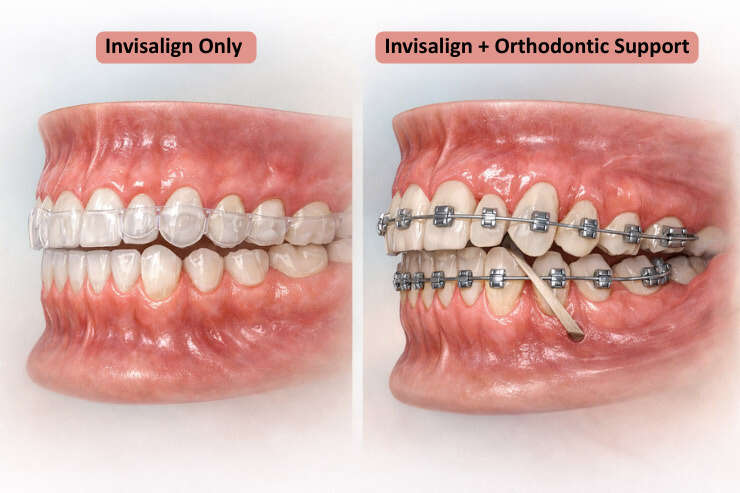
While Invisalign is highly effective for many overbite cases, some patients need more than clear aligners alone to achieve a stable, functional bite. In these situations, combining Invisalign with additional orthodontic support allows for better control of tooth movement and bite correction.
Complex bite problems such as skeletal discrepancies, bite collapse from tooth wear, or long-standing overbite patterns often require a coordinated approach. Invisalign can still play an important role in aligning teeth, but added orthodontic techniques help guide the jaws and bite relationship more predictably.
Invisalign Combined With Orthodontic Support
For moderate to complex cases, Invisalign may be used alongside attachments, elastics, or other orthodontic methods to improve bite correction. This combination allows the orthodontist to manage vertical overlap, jaw positioning, and bite balance more effectively than aligners alone.
When Additional Support Is Necessary
- Structural bite problems: Severe skeletal overbites or collapsed bites may need traditional orthodontic mechanics or advanced planning in addition to aligners.
- Cases requiring enhanced bite control: Invisalign combined with an orthodontist’s guidance helps achieve long-term stability and proper function when aligners alone are not sufficient.
Using a combined approach ensures that treatment focuses not only on straightening teeth, but also on creating a healthy, balanced bite that remains stable over time.
Why Correcting an Overbite Is More Than a Cosmetic Choice
Correcting an overbite improves both function and health. Excessive overlap can lead to uneven tooth wear and jaw strain. Before we discuss age-specific approaches, it's important to recognize the long-term health benefits of treatment.
- Functional and Long-Term Health Benefits: Proper bite alignment reduces stress on teeth and supports efficient chewing.
- Connection to Jaw Joint Health: Chronic bite imbalance can lead to joint strain and symptoms that may require care, such as TMJ treatment in Inglewood. Correcting the overbite reduces strain and supports healthier jaw function.
Fixing Overbites With Invisalign at Different Ages
Invisalign is effective for children, teenagers, and adults, but treatment goals vary. Understanding age-specific considerations helps set expectations.
| Age Group | Main Treatment Goal | Invisalign Effectiveness |
|---|---|---|
| Children | Guide bite development early | Effective in selected cases |
| Teenagers | Correct bite during growth | Highly effective with compliance |
| Adults | Restore function and stability | Very effective for mild to moderate cases |
This table illustrates how age influences planning and outcomes, and why customised evaluation is crucial.
Severe Overbite Cases and Full Mouth Reconstruction Options
In severe overbite cases, especially when teeth are worn, the bite has collapsed, or multiple dental issues are present, Invisalign alone may not be enough to achieve a fully functional and stable result. These complex situations often require a coordinated approach with a full mouth reconstruction specialist, combining restorative procedures to rebuild bite height, improve balance, and restore proper function. When the overbite is caused by jaw structure problems or severe tooth wear, aligners by themselves may not fully correct the bite. By integrating orthodontic correction with restorative dental treatment, patients can achieve a stable, long-term solution that addresses both alignment and overall oral health.
Conclusion
Invisalign can correct many overbite cases effectively, particularly those caused by tooth misalignment rather than skeletal issues. The most important step is a thorough, personalised assessment. When properly planned, Invisalign improves alignment, supports proper bite function, reduces jaw strain, and ensures long-term oral health. Early evaluation and tailored treatment lead to better outcomes and lasting comfort.
FAQs
Can Invisalign fix overbite and gap teeth?
Yes. Invisalign can address both overbite and spacing issues simultaneously when bite mechanics allow.
How long does it take Invisalign to fix overbite?
Typically 12 to 24 months, depending on severity and compliance.
What causes an overbite?
Genetics, jaw growth patterns, childhood habits, and long-term bite imbalance are common causes.
Is the Invisalign process painful for overbite correction?
Most patients experience mild pressure rather than pain when switching aligners.
Is Invisalign as effective as braces for fixing an overbite?
For mild to moderate cases, yes. Severe cases may respond better to traditional braces.



0 Comments